Methodology
This report is based on primary and secondary sources, including on-the-ground documentation by BHRN and other human rights groups and media reports from trusted national and international outlets. It provides a detailed analysis of key events during the month, situating them within international legal frameworks and offers policy recommendations to guide international responses, humanitarian action, and justice efforts.
For more information about any of the incidents documented in this report, or to request interviews or supporting materials, please contact Kyaw Win, Executive Director of BHRN at
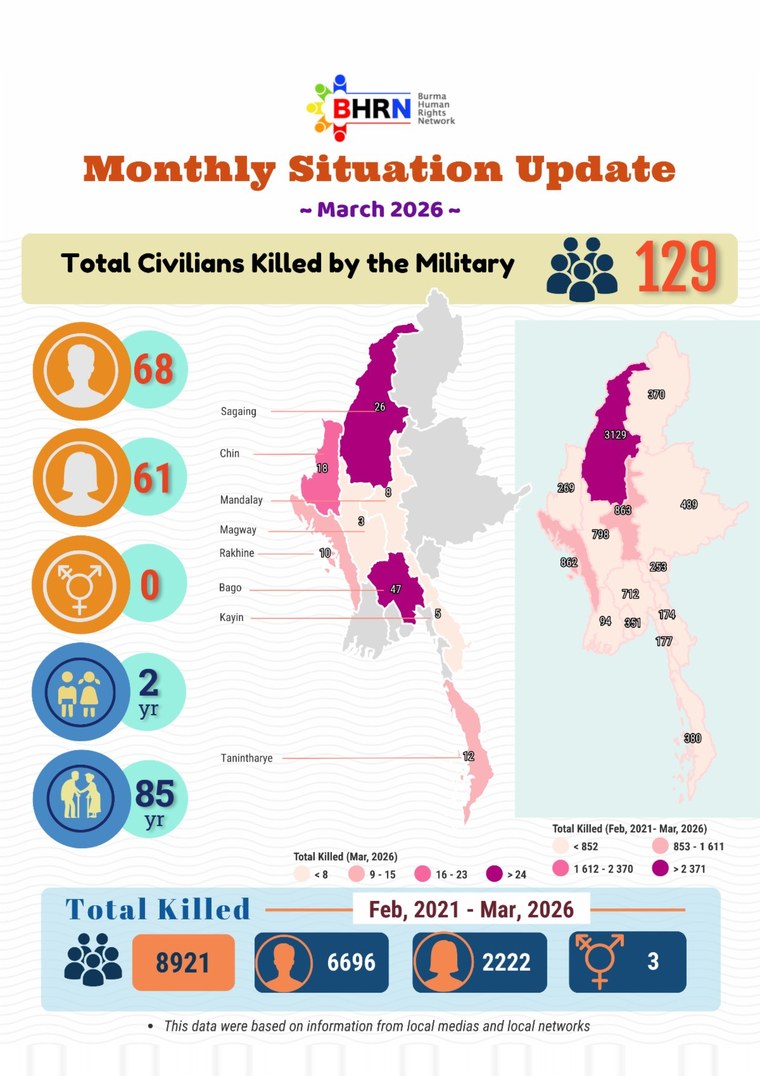
1Info-graphs of BHRN’s Report
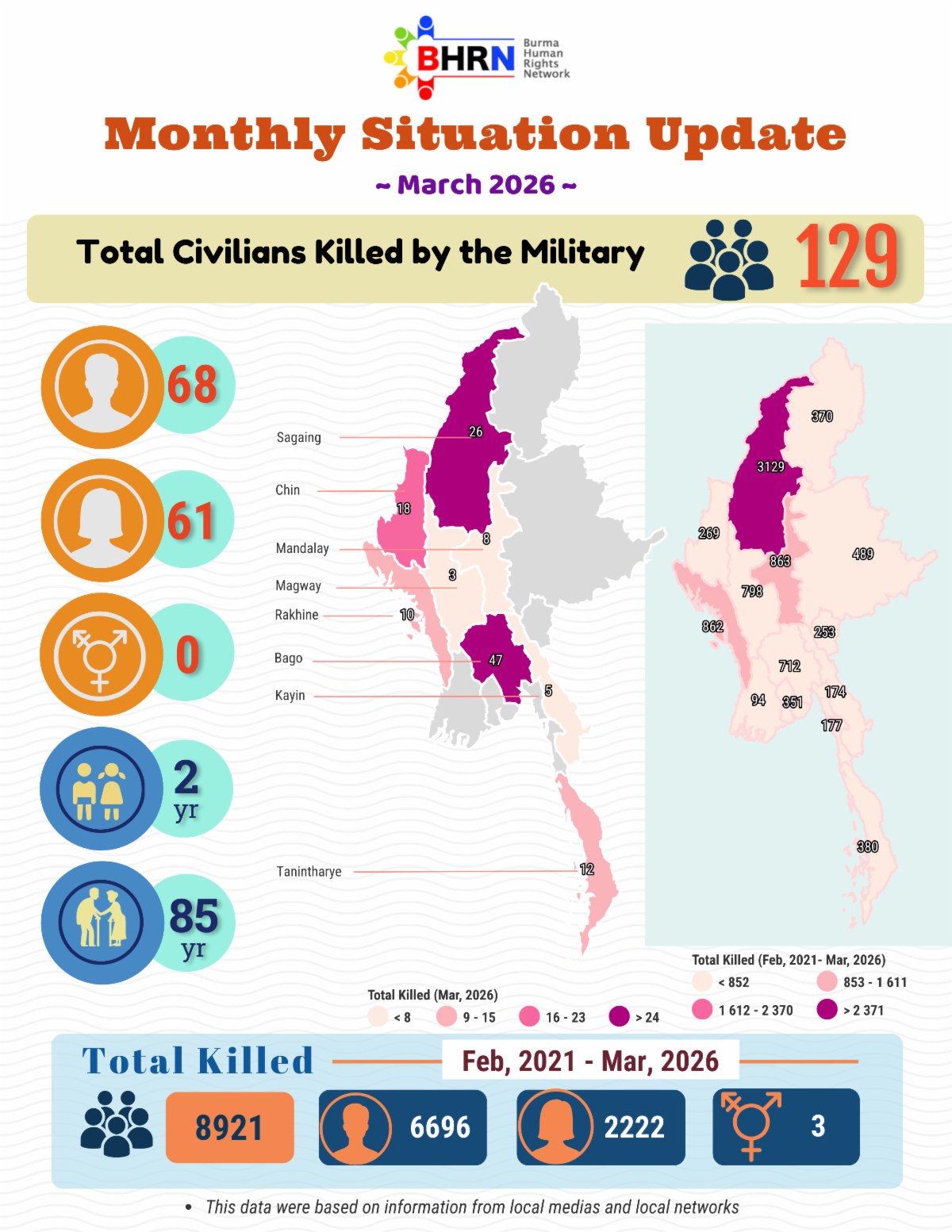
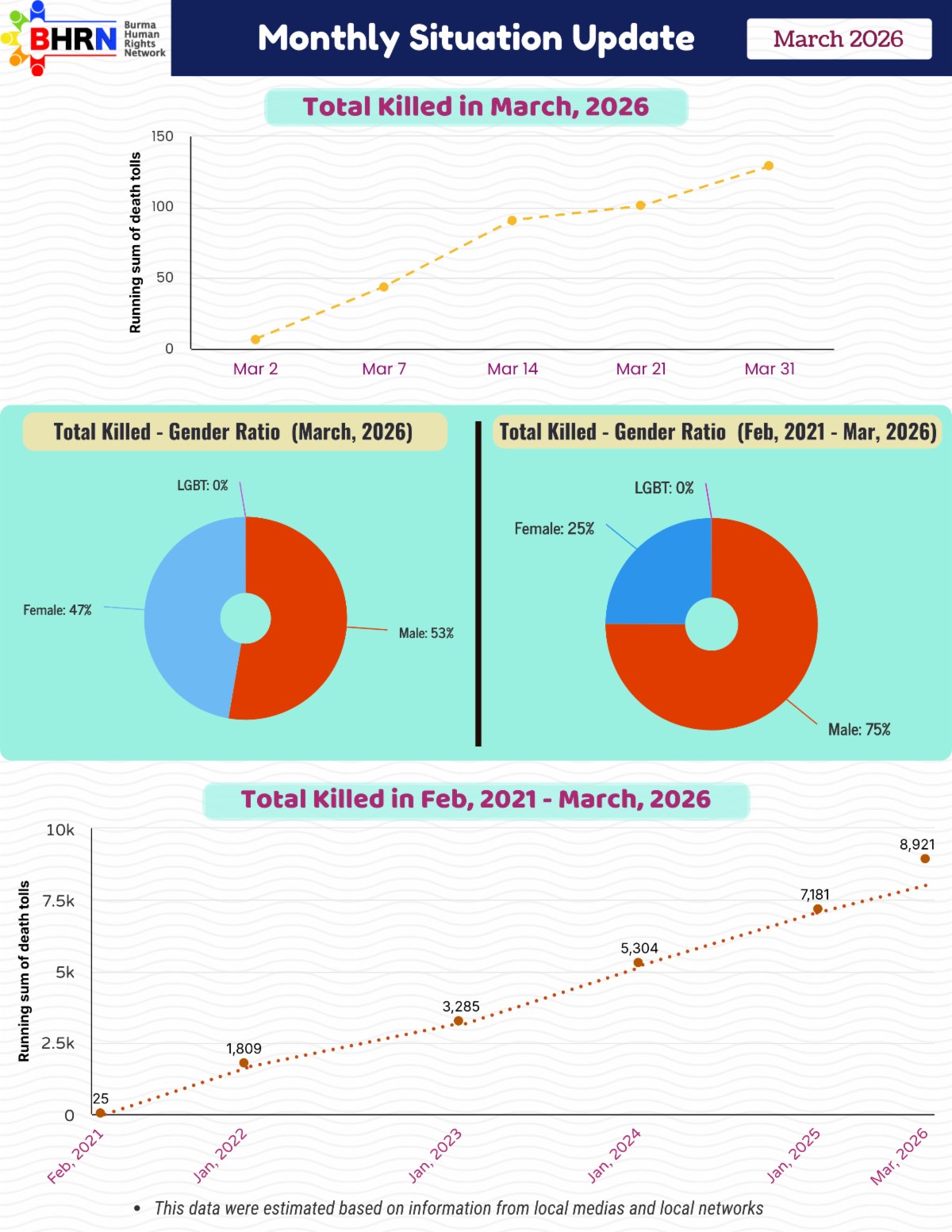
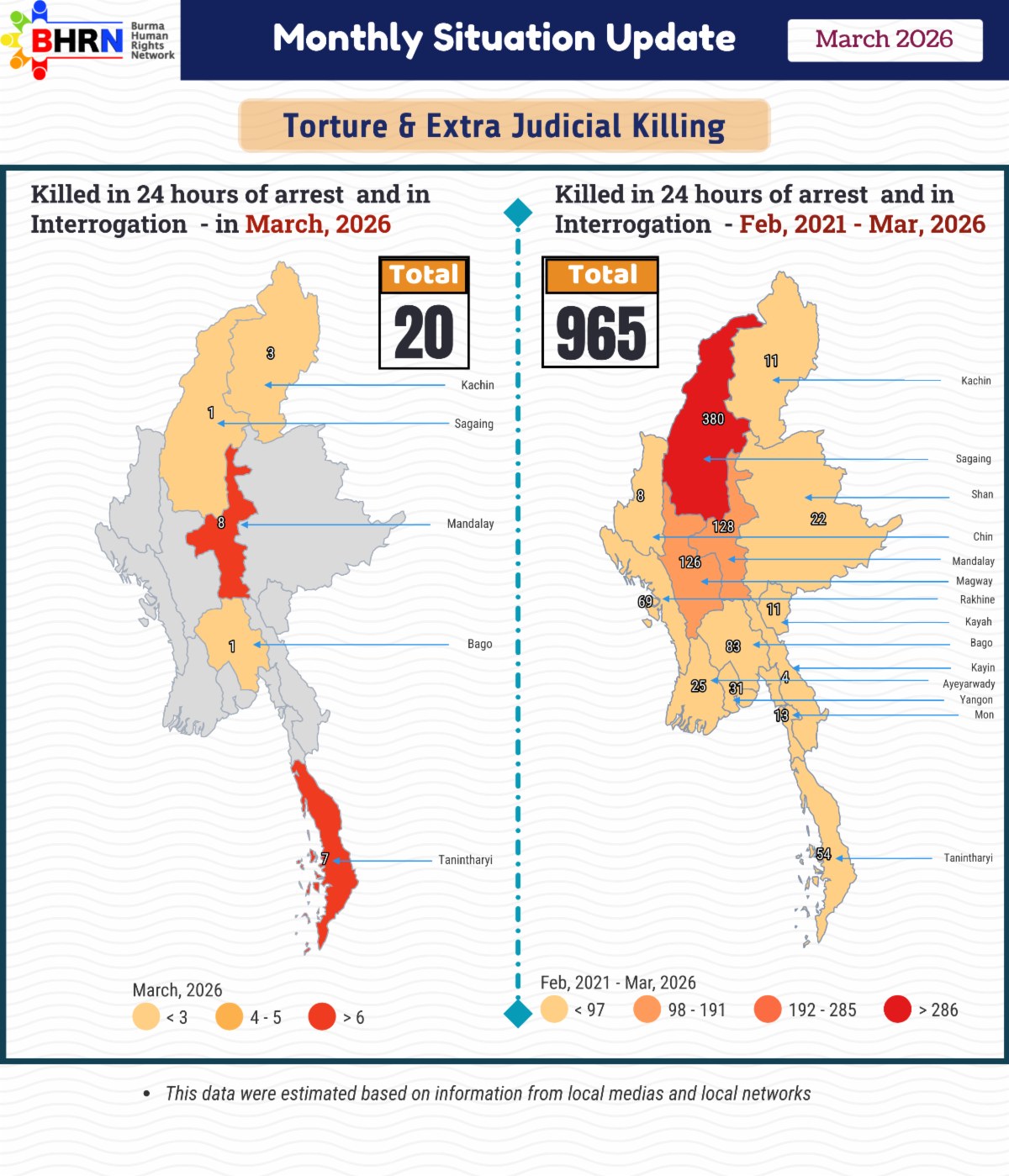

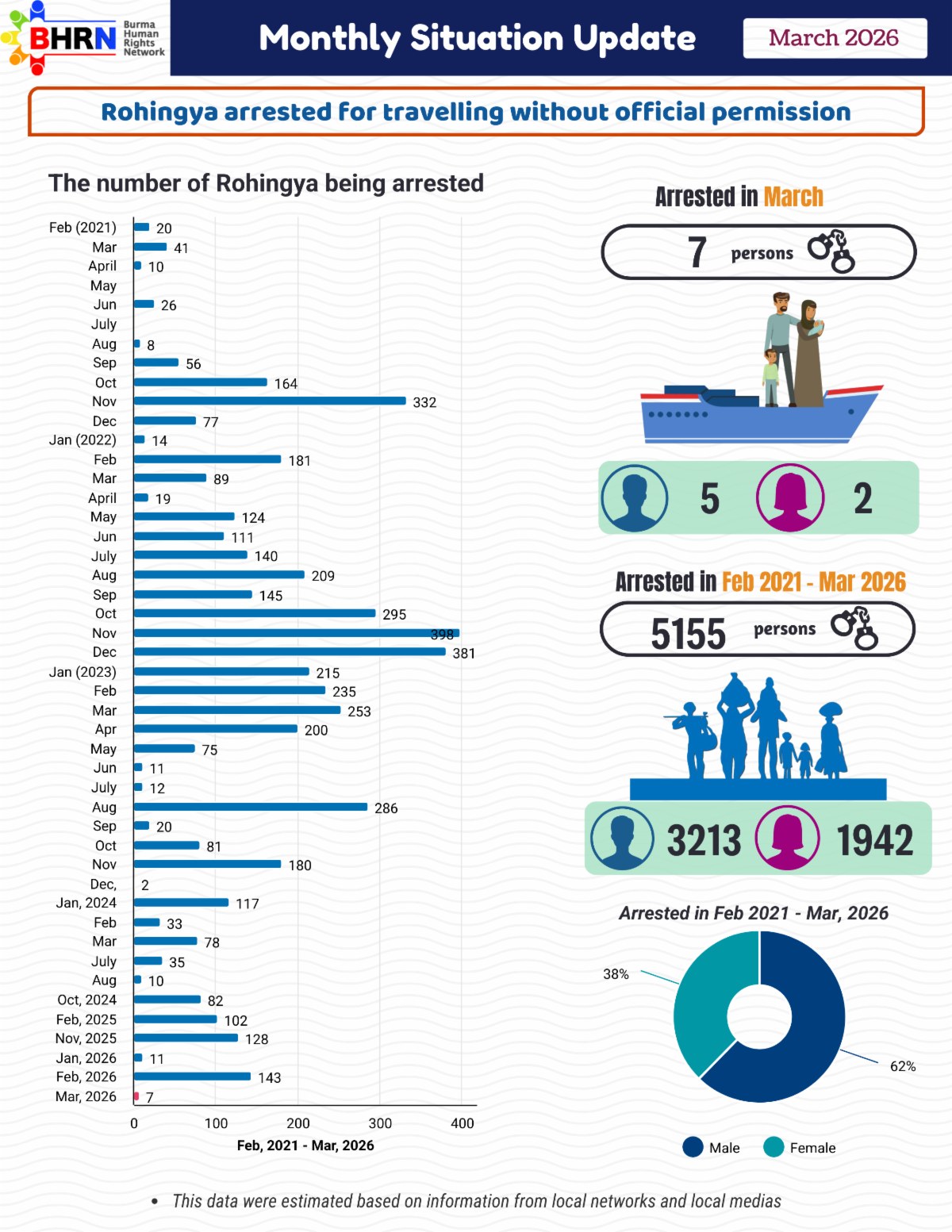

Tap any image to see it full size.
2News Summary and Analysis
This Month in Myanmar – March 2026
In March 2026, Myanmar's military chief Min Aung Hlaing became president, the culmination of an election process that the United Nations, ASEAN, and Western governments had rejected as a sham. The military and its proxy party hold 505 of 586 parliamentary seats. The cabinet is dominated by recently retired military officers. The Union Consultative Council, a five-member body Min Aung Hlaing created earlier this year and chairs, has authority over the government, the military, and the legislature, effectively placing him above every institution in the state.
On 30 March, the National Unity Government and four major ethnic armed organisations formed the Steering Council for the Emergence of a Federal Democratic Union, the most significant step toward a unified political and military leadership since the NUG was established in 2021. According to recent figures, the junta only controls roughly 21 percent of Myanmar's territory. The resistance and its allies govern or contest the rest. Myanmar's UN Ambassador wrote to the Secretary-General the same week asking member states to formally recognise the NUG and the new council as the country's legitimate government.
On the ground, the violence continued at the same pace. Junta forces killed hundreds of civilians across Myanmar in March, including in strikes on a monastery sheltering displaced people in Sagaing, a prisoner of war camp in Rakhine State where 116 of the military's own captured soldiers died, and a truck stop in Magway where 25 traders were killed. In Rakhine State, BHRN also documented abuses by the Arakan Army against Rohingya civilians in Maungdaw and Buthidaung Townships, including forced conscription, arbitrary detention, land seizure, extortion, and rape by AA soldiers, abuses that Human Rights Watch, Fortify Rights, and the UN's Independent Investigative Mechanism have also been documenting. This monthly report documents those attacks, BHRN's findings from interviews with Rohingya survivors in Maungdaw and Buthidaung on Arakan Army abuses, the junta's new restrictions on the movement of released political prisoners, cuts to food aid for Rohingya refugees in Bangladesh, and the steps the resistance is taking to build governance in the territory it controls.
3Political, Legal, and International Developments Affecting Myanmar
Parliament Convenes, Min Aung Hlaing ‘Elected’ President
Following sham elections held in three phases between December 2025 and January 2026, the junta convened parliament in Naypyidaw on 16 March 2026. The military's constitutionally reserved 166 seats, filled by appointed soldiers, combined with 339 seats won by its proxy party, the Union Solidarity and Development Party, to give the junta and its allies 505 of 586 total parliamentary seats. Khin Yi, the USDP chairman and a retired general, was elected lower house speaker. The Committee Representing Pyidaungsu Hluttaw, the body established by elected lawmakers expelled by the coup, held a simultaneous online session refusing to recognise the Naypyidaw parliament. Independent analyst Htin Kyaw Aye described the outcome as "merely a manoeuvre by the military leadership to shift power from their left hand to their right hand."
On 30 March, Min Aung Hlaing retired as Commander-in-Chief, as the 2008 Constitution prohibits a president from concurrently holding military command. General Ye Win Oo, a former intelligence chief, was appointed in his place. Min Aung Hlaing was then nominated for the vice presidency by the lower house. On 3 April, he received 429 of 584 parliamentary votes and was ‘elected’ president. He was sworn in on 10 April. China congratulated him the same day and pledged cooperation on Belt and Road projects. Representatives from China, India, Thailand, and approximately 20 other countries attended the ceremony.
Why it matters
The elections that brought Min Aung Hlaing to the presidency were held across less than half the country, excluded Myanmar's most popular political party, and took place while the military was conducting airstrikes on civilian areas. The parliament they produced was always going to elect him. The military and its proxy party held 505 of 586 seats. He already chaired the Union Consultative Council, which sits above every institution in the state. The presidency adds nothing to his control of Myanmar. What it does is give governments looking for a reason to re-engage one. BHRN urges them not to take it. A military responsible for the deaths of tens of thousands of civilians does not become a legitimate interlocutor because it has staged a vote.
New Passport Law Restricts Movement of Released Political Prisoners
On 17 March 2026, one day after parliament opened, the junta enacted a new passport law barring individuals released under regime amnesties from obtaining passports to travel abroad until their original sentences have fully expired. The law also gives the Ministry of Home Affairs the power to deny travel documents to anyone deemed "harmful to the state's security and interests," without defining the term. The Burma Lawyers' Council described the law as a human rights violation.
The law was enacted one week after the junta's mass amnesty of 2 March, in which over 7,000 prisoners were released, widely read as a pre-presidential-selection gesture toward international audiences. The passport law ensures those same released prisoners cannot leave the country. The release and the restriction are two sides of the same exercise.
Why it matters
Article 12(2) of the ICCPR guarantees the right to leave one's country, and any restriction must be necessary, proportionate, and sufficiently precise that those subject to it can foresee its application. A standard of 'harmful to state security and interests', with no definition, no criteria, and no avenue for challenge, meets none of those requirements. The junta's amnesty of 2 March released over 7,000 political prisoners. The passport law of 17 March ensured they cannot leave Myanmar until their original sentences expire. Governments that issued statements welcoming the amnesty owe their publics an honest account of what accompanied it.
Myanmar's UN Ambassador Requests International Recognition of the NUG and SCEF
On 31 March 2026, the same day Min Aung Hlaing was nominated for the vice presidency, Myanmar's UN Ambassador Kyaw Moe Tun wrote to UN Secretary-General Antonio Guterres requesting that the UN and member states formally recognise the NUG and the Steering Council for the Emergence of a Federal Democratic Union as Myanmar's sole legitimate representatives. The letter attached the SCEF's founding statement of 30 March.
The European Parliament has previously recognised the NUG as Myanmar's legitimate government. A bipartisan letter from the US House Foreign Affairs Committee to Secretary of State Rubio, sent in late March, noted that the junta controls approximately 21 percent of Myanmar's territory.
Why it matters
The formation of the SCEF fundamentally changes the recognition question. For four years, governments resisted formal recognition of the NUG on the grounds that it lacked the territorial control and institutional breadth of a functioning government. The SCEF removes that argument. It unites the democratic mandate of the 2020 election with ethnic armed organisations that have administered territory, delivered services, and commanded forces for decades. Governments that continue to treat Min Aung Hlaing's staged presidency as the only viable interlocutor are making a political choice, and the SCEF's formation makes the consequences of that choice harder to ignore.
Junta's IMEI Registration Requirement Extends Surveillance to Device Level (Deadline: 31 March 2026)
The regime required all mobile phone users in Myanmar to register their device's International Mobile Equipment Identity number with the Central Equipment Identity Register by 31 March 2026, or face fines and network disconnection. The Assistance Association for Myanmar-based Independent Journalists stated that the CEIR has been used to track and arrest anti-coup activists since 2024, and urged citizens not to register. The measure extends the junta's surveillance architecture, which already includes internet shutdowns and SIM registration, to the device level.
Why it matters
The IMEI registration requirement is the latest expansion of a surveillance system that the junta has built systematically since the coup. SIM registration, internet shutdowns, and social media monitoring already allow authorities to identify and locate people who oppose military rule. Device-level registration closes the remaining gap. The Assistance Association for Myanmar-based Independent Journalists has documented arrests of activists linked to CEIR data since 2024. States that supply surveillance technology or telecommunications infrastructure to Myanmar bear direct responsibility for how that technology is used.
UK Suspends Student Visa Processing for Myanmar Nationals
The UK Home Office announced a temporary suspension of student visa processing for applicants from Myanmar, alongside Afghanistan, Cameroon, and Sudan, citing a more than fivefold increase in asylum applications from students from those four countries between 2021 and 2025. British embassy staff in Yangon did not state when processing would resume. Students who had already received university offers reported immediate uncertainty. The suspension removes one of the few legal pathways available to young people leaving Myanmar to escape conscription and conflict. The Home Office did not provide a country-by-country breakdown of the data underpinning the decision.
Why it matters
The UK has condemned the junta's atrocities, called for accountability, and imposed sanctions on military leaders. Suspending student visa processing for Myanmar nationals sits in direct contradiction to each of those positions. For a young person who has received a university offer, the suspension closes one of the few legal routes available to those seeking safety from a military that has killed tens of thousands of its own civilians. The Home Office has not published country-by-country data to justify the decision. Without it, there is no basis on which to assess whether the suspension is necessary, proportionate, or consistent with the UK's own stated commitments to the people of Myanmar.
Iran's Shadow Fleet Fuelling Junta Airstrikes; Calls for Coordinated Sanctions
Following publications by Amnesty International and Reuters in late January 2026 documenting the role of Iran's shadow fleet in supplying aviation fuel to Myanmar, Justice for Myanmar called on 23 February on the EU, UK, US, Canada, and Australia to impose coordinated sanctions on four vessels and eight corporate owners based in Vietnam, the UAE, and the Marshall Islands. On 2 March, JFM noted it was monitoring any impacts of US and Israeli strikes on Iran on the junta's fuel supply chain. Canada remains the only country to have banned the export, sale, supply, and shipment of aviation fuel to Myanmar.
Why it matters
Without a sustained supply of aviation fuel, the junta cannot maintain its air campaign against civilians at its current scale. Amnesty International and Reuters have identified the specific vessels and corporate owners supplying that fuel through Iran's shadow fleet. Justice for Myanmar has named four vessels and eight entities, based in Vietnam, the UAE, and the Marshall Islands, whose sanctioning would directly disrupt that supply chain. Canada has already banned the export, sale, supply, and shipment of aviation fuel to Myanmar, demonstrating that a unilateral measure is legally achievable. Every airstrike on a monastery, a school, a clinic, or a displacement camp that has occurred since that documentation was published is a strike that the EU, UK, US, and Australia had the means to make harder.
WFP Reduces Food Assistance to Rohingya Refugees in Bangladesh
The World Food Programme reduced food assistance to approximately 1.2 million Rohingya refugees in Bangladesh's Cox's Bazar camps, introducing a tiered system under which around 17 percent of the population will receive as little as $7 per month, down from $12. Bangladesh's Refugee Relief and Repatriation Commissioner described the change as a ration cut and warned that refugees will attempt to flee in search of food and work. Programs supporting the Rohingya were only 19 percent funded in 2026. The closure of schools in 2025 had already contributed to increased child kidnapping, child marriage, and child labour in the camps. The military responsible for the 2017 atrocities against the Rohingya remains in power, making a safe return impossible.
Why it matters
The military that expelled the Rohingya from Myanmar in 2017 remains in power. There is no safe return. People in the camps cannot work legally, cannot move freely, and have nowhere to go. Cutting their food rations deepens a crisis that donor governments have chronically underfunded. Bangladesh's own Refugee Relief Commissioner has warned that the cuts will push people to flee. Child kidnapping, child marriage, and child labour rose sharply after camp schools closed in 2025. Rohingya programs stand at 19 percent funded. Donor governments have the resources to change that.
4Resistance Updates
On 30 March 2026, the National Unity Government and four major ethnic armed organisations announced the formation of the Steering Council for the Emergence of a Federal Democratic Union. For the first time since the coup, the KIO, KNU, KNPP, and CNF joined a formal union-level decision-making body alongside the NUG and CRPH as co-equal members. Fighting continued across Sagaing, Bago, Magway, and Karen regions throughout the month. Inside Myanmar, a new civilian political body formed, operating without armed protection, to coordinate toward a federal democratic transition.
Formation of the Steering Council for the Emergence of a Federal Democratic Union (SCEF): The NUG, CRPH, Kachin Independence Organization (KIO), Karen National Union (KNU), Karenni National Progressive Party (KNPP), and Chin National Front (CNF) jointly established the SCEF, a new body to coordinate military, political, and administrative strategy across the resistance. Its six objectives include ending military involvement in politics, placing all armed forces under civilian control, opposing reinstatement of the 2008 Constitution, drafting a new federal democratic constitution, implementing transitional justice, and establishing transitional governance arrangements. The council is structured around three pillars representing ethnic states and armed organisations, the broader public, and women. The KNPP announced a 60-day window for additional organisations to join. The Sagaing Federal Unit Interim Government, the Mandalay Interim Regional Administration, and several civil society bodies formally signalled support within days.
Formation of the Political Coordination Body (PCB): A coalition of political actors operating inside Myanmar, including 88 Generation student movement leader Ko Mya Aye, Shan Nationalities League for Democracy chairman Sai Nyunt Lwin, and Arakan National Party chairman U Tha Tun Hla, announced the formation of the PCB. The body issued nine demands coinciding with Min Aung Hlaing's presidential nomination: the unconditional release of all political prisoners including Aung San Suu Kyi and U Win Myint; abolition of the conscription law; freedom of association and expression; an end to military operations targeting civilians; a halt to attacks on religious buildings, hospitals, and schools; humanitarian access; conditions for safe return of exiled political actors; cooperation with international organisations; and inclusive political dialogue toward a federal union. The PCB operates without formal protection inside the country and has no armed wing.
NUG UN Ambassador formally requests international recognition of NUG and SCEF: Myanmar's UN Ambassador Kyaw Moe Tun submitted a letter to UN Secretary-General Antonio Guterres requesting that the United Nations and member states formally endorse the NUG and SCEF as Myanmar's legitimate representatives.
Late March: Karen resistance lays siege to Waw Lay base, Karen State-Thailand border: Karen resistance forces maintained a siege of the Waw Lay military base on the border with Thailand, prompting civilian displacement as junta airstrikes attempted to relieve the besieged position. The operation is strategically relevant at a moment when Thailand declared its intention to reintegrate the junta into ASEAN.
5On the Ground: Escalating Violence and Human Rights Violations
In March 2026, junta forces carried out airstrikes, drone attacks, artillery bombardment, ground raids, summary executions, and forced detentions across Sagaing, Rakhine, Bago, Magway, Chin, Kachin, and Karen regions. The period following the opening of parliament on 16 March saw an intensification of aerial attacks, with multiple aircraft increasingly deployed against single targets. Approximately 100 civilians were killed in airstrikes in the two weeks following parliament's opening. These incidents reflect ongoing violations of international humanitarian and human rights law.
ITargeted attacks on civilians and civilian infrastructure
Under international humanitarian law, civilians must never be the object of attack. Article 8(2)(e)(i) of the Rome Statute prohibits attacks intentionally directed against civilians in non-international armed conflicts. When such attacks form part of a widespread or systematic campaign against the civilian population, they may amount to crimes against humanity under Article 7(1).
Near Pyaung village, Mindon Township, Magway Region: Burma Air Force fighter jets carried out eight bombing and strafing runs on a commercial truck stop, killing at least 25 civilians, 23 men and 2 women, and injuring 20 others. Most of those killed were traders assembled at a transit point for goods entering Rakhine State, where the junta has imposed trade blockades since November 2023. The site had no apparent military purpose.
- 9 March
Hta Naung Taw (North) Village, Monywa Township, Sagaing Region: Military council troops and Pyu Saw Htee militia entered the village at approximately 9:00 p.m. in columns totalling around 200 personnel. Two civilians were killed: Ko Yan Naing Tun, 28, shot twice in the back while fleeing, and Ma Nilar Moe, 16, a Grade 10 student, shot twice while attempting to run with a bag of clothes. A civilian named Ko Maung Maung was tortured. Troops poured gasoline on him and pulled out his fingernails. One person was arrested and later released. Vehicles and belongings were looted and one house was burned. Witnesses confirmed there were no armed groups based in the village and no prior clashes or conflict between residents and the military. (BHRN documentation: Interviews_01_Monywa_Sagaing /09Mar2026)
- 19 March
Ngar Shan Village, Chaung-U Township, Sagaing Region: Military council troops and Pyu Saw Htee militia entered the village at approximately 8:30 a.m. and set fire to 170 houses, using bottles of fuel. The fire burned from 8:30 a.m. until after 1:00 a.m. the following morning. Residents who attempted to re-enter were warned: "This is not your village anymore. Don't come back." The village, which has approximately 1,000 households, has been burned approximately ten times since the coup, with over 700 homes destroyed and more than 20 civilians killed across incidents. No resistance forces were based in the village and no clashes preceded the attack. Mingalar Tharsi Naga Monastery was burned in a prior incident; monks now shelter in the forest. One witness described trying to extinguish the fire at her home: "I was alone, and no one dared to follow me, so I couldn't reach it in time. All the houses were burning, and there was almost no way out." (BHRN documentation, interviews with Ma Yin Yin Mon, 40, and U Tin Htun, 66, residents of Ngar Shan Village: Interviews_02_ChaungOo_Sagaing/19Mar26)
Yei Twin Gone village tract, Kyaukkyi Township, Nyaunglebin District, Bago Region: Four military columns totalling approximately 300 troops from Light Infantry Battalions 20, 264, and 439 under Light Infantry Division 77 entered the area at approximately 5:00 a.m. on 5 March and detained around 160 civilians at the village school. Five men aged between 35 and 53 were summarily executed. When KNLA and PDF forces intervened to free the detainees on 7 March, junta forces launched drone and jet fighter strikes on the area. Twenty-five of the detained civilians were killed in the airstrikes, bringing the total to approximately 30 civilian deaths. The youngest victim was eight years old. At least 14 children were among the dead, according to the KNU. The NUG's separate count put the total at 40 killed. The KNLA rescued more than 100 of the detained civilians.
Three villages, Kani Township, Sagaing Region: A drone strike killed nine civilians, including three Buddhist novices, and injured 15 others.
Darlat Chaung area, Ann Township, Rakhine State: Four Burma Air Force jet fighters and four Y-12 aircraft bombed an Arakan Army prisoner of war detention camp in a sustained attack lasting approximately three and a half hours, from 11:02 a.m. to 2:28 p.m. The Arakan Army reported 116 prisoners of war killed and 32 injured. Among the dead was Brigadier General Myint Shwe, commander of Light Infantry Division 101. A surviving senior POW stated that the military had conducted reconnaissance flights in the preceding week and was fully aware the site held captured personnel. BNI-Myanmar Peace Monitor recorded this as the ninth junta strike on a POW detention facility since 2024, with 287 prisoners of war killed across all such strikes. The deliberate bombing of a known prisoner of war facility constitutes a grave breach of the Third Geneva Convention.
Katha Township, Sagaing Region: Burma Air Force jets bombed a Buddhist monastery sheltering approximately 100 war-displaced civilians, killing around 80 people, including monks and children. Airstrikes in Myaung Township the same day killed civilians, including two children.
Kani Township, Sagaing Region: Eight junta warplanes conducted 13 sorties in under half an hour, striking a monastery and a school in the same township, killing one monk and causing further casualties.
Kler Lwee Htoo (Nyaunglebin) District, Bago Region: Villages in Ledo (Kyaukkyi) Township, including Pho Ta, Shwe Hte Su, Shwe Khar Moe, Dala Seik, and Lein Pin We, were attacked 23 times by Y-12 aircraft, 30 times with 120mm artillery, and four times by drones over two days, forcing mass civilian displacement.
Ayardaw Township, Sagaing Region: Two Burma Air Force jets carried out six airstrikes, killing at least six civilians.
Myaung Township, Sagaing Region: A Burma Air Force jet dropped four bombs on a residential area, killing four civilians and destroying at least 40 homes.
Gangaw-Htilin border, Yaw Region, Magway Region: Six junta fighter jets struck the Maulay junction area in two waves: four jets dropped six 500-pound bombs and fired three rockets at 1:22 p.m., and two jets dropped a further two 300-pound bombs at 2:43 p.m. Five men were reported injured. Separately, two civilians were killed in junta airstrikes on Yaw Defence Force positions in the same region.
Budalin Township, Sagaing Region: Regime aircraft struck a village clinic in a sustained attack lasting approximately one hour. Seven patients were killed, including a mother and her newborn. At least 24 others were injured.
Monywa, Sagaing Region: Five Burma Air Force jets bombed a resistance-run clinic. Staff had evacuated just before the strike. No casualties were reported.
Thandwe and Ngapali, Rakhine State: Four Burma Air Force jets bombed Arakan Army-controlled Thandwe and the coastal town of Ngapali, killing four civilians including children and injuring three others.
Krong Chaung village, Paletwa Township, Chin State: The Myanmar Air Force conducted three bombing raids and two rocket attacks on the village, killing seven civilians, including four children under the age of 16 and wounding four others.
Rakhine and Chin States: Narinjara News compiled data showing at least 124 people killed and 40 injured across Arakan Army-controlled areas in Rakhine and Chin States throughout March from junta airstrikes. Targeted townships included Ann, Kyaukphyu, and Paletwa.
IIAttacks on Religious and Cultural Sites
Under Article 8(2)(e)(iv) of the Rome Statute, intentionally directing attacks against buildings dedicated to religion or education constitutes a war crime unless those buildings are being used for military purposes.
Mashikahtaung neighbourhood, Hpakant Township, Kachin State: Regime forces burned three homes and a church.
Katha Township, Sagaing Region: Burma Air Force jets bombed a four-story monastery sheltering approximately 100 displaced civilians, killing approximately 80 people, including monks and children.
Kani Township, Sagaing Region: Eight warplanes carried out repeated strikes on a monastery and a school.
IIISummary Executions and Arbitrary Detention
Summary executions constitute extrajudicial killings in violation of the right to life under Article 6 of the ICCPR and may constitute war crimes under Article 8(2)(c)(i) of the Rome Statute. Arbitrary detention of civilians violates Article 9 of the ICCPR and may amount to a crime against humanity under Article 7(1)(e) of the Rome Statute.
Yei Twin Gone village tract, Kyaukkyi Township, Bago Region: Junta troops detained approximately 160 civilians at a village school and summarily executed five men aged between 35 and 53.
Sittwe, Rakhine State: Muslim residents reported that the junta's Office of the Chief of Military Security Affairs (SaYaPha) had arrested nearly 50 men, including administrators from nine Muslim villages, on alleged associations with the Arakan Army. Some were charged under the Counter-Terrorism Law and the Unlawful Associations Act.
IVAttacks on Detention Facilities Holding Prisoners of War
The deliberate bombing of a known prisoner of war facility constitutes a grave breach of the Third Geneva Convention and a war crime under Article 8(2)(a)(i) of the Rome Statute.
Mese Township, Karenni State: Five family members of detained regime soldiers were killed and approximately 20 others were injured in a Burma Air Force airstrike near a Karenni State Interim Executive Council detention facility.
Darlat Chaung area, Ann Township, Rakhine State: This is the ninth recorded junta strike on a POW facility, and the deadliest, with 116 killed and 32 injured.
VForced Conscription
Forced recruitment of civilians constitutes a war crime under Article 8(2)(e)(vii) of the Rome Statute.
Ayeyarwady Region and nationwide: The regime was reported to be selecting women from conscription lists and constructing barracks for female recruits in Ayeyarwady Region, marking a new phase of the forced conscription programme activated in February 2024. In Kanma, Magway Region, workers delivering purified water were seized as porters, forcing a factory to close. Forced porter seizures were also reported in Monywa, Wundwin, and Yangon during the month. As of early 2026, an estimated 45,000 men had been conscripted across nine batches, with approximately 35,000 deployed to frontlines.
5.1Arakan Army Abuses Against Rohingya in Rakhine State
Since seizing control of most of Rakhine State following its offensive launched in November 2023, the Arakan Army has pledged inclusive and equitable governance for all communities. Human Rights Watch, Fortify Rights, and Crisis Group have each documented a different reality on the ground. HRW found that the AA's territorial gains have been accompanied by movement restrictions, pillage, arbitrary detention, forced labour and recruitment, and other abuses against the Rohingya. In November 2025, Fortify Rights documented that the AA imposed a system of forced labour across villages under its control, often requiring at least one member from each household to work for periods ranging from a single day to several months, enforced through direct threats to village administrators. In July 2025, the UN Independent Investigative Mechanism for Myanmar reported it had initiated investigations into crimes allegedly committed by members of the Arakan Army, including summary executions, torture and beheadings of soldiers and civilians suspected of being military informants, and sexual violence against Chin women. The UK government's own January 2026 country policy note on the Rohingya states that Rohingya are "likely to face a real risk of persecution or serious harm" from the Arakan Army in Rakhine State. In February 2026, Arakan Now reported that the AA abducted a 16-year-old Rohingya girl from Buthidaung Township for forced conscription, with local residents stating that abductions of underage girls were continuing across the township. On 25 February 2026, Burma Campaign UK called on the British government to impose sanctions on the AA and to use its position as UN Security Council penholder on Myanmar to convene a Council meeting specifically on the situation in Rakhine State. Burma Campaign UK director Mark Farmaner stated: "Allowing the Arakha Army to continue to commit human rights abuses with impunity only encourages them to think they can get away with more abuses." HRW, Amnesty International, and Fortify Rights have each separately called on the ICC to investigate the AA's conduct as potential war crimes.
In March 2026, BHRN interviewed two Rohingya residents of Maungdaw and Buthidaung Townships who reported that these abuses are deepening and systematic. Under AA administration, Rohingya residents require travel authorisation even to move between neighbouring villages, a restriction that does not apply to Rakhine or other communities. The AA has demanded that Rohingya households provide members for military service, implementing a lottery system in Buthidaung Township under which those selected must serve or the entire family must leave the country immediately. One interviewee stated that 30 people from his village alone were forced to join the AA's intelligence department: "The AA also once asked for 30 people from our village in the meeting, and we had to give them." He added that the AA is demanding female recruits in Buthidaung, with girls used as night guards at AA stations: "We cannot allow our female to join their armed forces as their society is very different from the society in the village. We live in constant fear." Rohingya land is being seized and redistributed, with properties in villages abandoned during the 2017 genocide, including Maung Nama and Kyauk Lay Ga, being reallocated to Rakhine families brought in from other townships. A five-member committee is appointed in each Rohingya village to collect monthly fees from households on behalf of the AA, with those failing to pay for three consecutive months summoned to the ULA regional office. Two incidents of rape by AA soldiers were reported to BHRN: one in Nanthar Phyu village during Ramadan, in which three drunk soldiers raped a woman at gunpoint while stabbing her husband as he tried to intervene, with the soldiers sentenced to only two months and already released at the time of interview; and one in Nacha Pur village involving a 25-year-old married woman. One interviewee reflected: "The Rohingya in rural areas face such abuses every day but do not dare to disclose them."
There is no mechanism within AA administration to report violations. The AA confiscated Starlink equipment from Rohingya communities in Buthidaung after accusing residents of using it to share information with the international community, and one family was forced to flee after a young man was discovered to have shared information externally. AA soldiers routinely refer to Rohingya residents using the slur "Kalar" in speech, while formal documents use "Muslim." One interviewee stated: "The authorities usually refer to us as 'Muslim', but I heard ULA officials many times referring to us as Kalar in conversation. They never use the designation 'Rohingya.'" This documentation does not equate the AA's conduct with that of the military junta, whose decades of atrocity crimes against the Rohingya constitute genocide. However, all parties to the conflict, including ethnic armed organisations, are bound by Common Article 3 of the Geneva Conventions, which prohibits violence, torture, arbitrary detention, and outrages upon personal dignity against persons not taking active part in hostilities. The UK, as UN Security Council penholder on Myanmar, should heed Burma Campaign UK's call to convene a Council meeting on the situation in Rakhine State and invite a senior UN human rights official to brief it. BHRN calls on the AA and the ULA to immediately cease forced conscription of Rohingya civilians, release all arbitrarily detained individuals, halt land seizures, and establish an independent accountability mechanism.
6Policy Recommendations
On non-recognition and political engagement
- States should formally reject the results of the junta’s illegitimate elections. They should engage with the SCEF as the primary political framework for Myanmar's democratic transition and recognise the NUG as Myanmar's legitimate government. The junta only controls roughly 21 percent of Myanmar's territory. The SCEF's constituent organisations govern or contest the rest. Recognition of the SCEF and NUG reflects both political principle and territorial reality.
- ASEAN members should resist any move to reintegrate the junta into regional institutions on the basis of the March parliament and April presidency.
On sanctions and economic pressure
- States should impose coordinated sanctions on the vessels and corporate owners identified by Justice for Myanmar as part of the aviation fuel supply chain enabling junta airstrikes, including four vessels and eight entities based in Vietnam, the UAE, and the Marshall Islands. Canada has demonstrated that a unilateral aviation fuel ban is legally achievable. The EU, UK, US, and Australia should match it. Interdicting aviation fuel is the most direct available lever for reducing the junta's capacity to bomb civilian areas.
- States should extend and update existing targeted sanctions to cover officials and entities linked to the new administration. Retirement from military command should not result in sanctions relief. Individuals who directed atrocity crimes while in uniform do not become eligible for normalised engagement by changing their title.
On humanitarian assistance
- States must urgently reverse funding cuts to humanitarian programmes for Myanmar and for Rohingya refugees in Bangladesh. WFP food assistance to 1.2 million Rohingya refugees has been reduced at a moment when camp programs are only 19 percent funded. Bangladesh's Refugee Relief Commissioner has warned this will drive refugees to attempt to flee. Myanmar humanitarian programs should be channelled through the NUG, ethnic resistance organisations, and civil society networks, including through cross-border routes.
- States should publicly oppose the UK's suspension of student visa processing for Myanmar nationals and call for its immediate reversal. The suspension removes one of the few legal pathways for young people fleeing conscription and conflict. Governments that reject the junta's legitimacy should be expanding protection pathways for those fleeing it, not contracting them.
On accountability
- States should document and preserve evidence of the junta's March 2026 attacks on prisoner of war facilities, which constitute potential grave breaches of the Third Geneva Convention, and of the summary executions at Yei Twin Gone village tract in Bago Region. Where domestic law permits, states should consider initiating universal jurisdiction proceedings. A pro-regime figure's public admission that the Kani Township monastery and school were deliberately targeted is itself evidentiary material that should be preserved.
On the Arakan Army and Rohingya protection
- The UK government, as UN Security Council penholder on Myanmar, should act on Burma Campaign UK's call to convene a Security Council meeting specifically on the human rights situation in Rakhine State and invite a senior UN human rights official to brief it. The Council has consistently failed to address abuses by all parties in Rakhine State. That failure has real consequences for the Rohingya, who are caught between the junta and the AA with no protection and no accountability.
- States should consider targeted sanctions against Arakan Army commanders responsible for forced conscription of Rohingya civilians, arbitrary detention, sexual violence, and land seizure documented by BHRN, HRW, Fortify Rights, and the UN Independent Investigative Mechanism for Myanmar. The IIMM has already initiated investigations into crimes allegedly committed by AA members. Sanctions would signal that accountability applies to all armed actors in Myanmar, not only the junta, and would give the AA concrete incentive to change conduct that has, so far, continued with complete impunity.
About BHRN
Burma Human Rights Network (BHRN) is based in London, operates across Burma/Myanmar and works for human rights, minority rights and religious freedom in Burma. BHRN has played a crucial role in advocating for human rights and religious freedom with politicians and world leaders.