Methodology
This report is based on primary and secondary sources, including on-the-ground documentation by BHRN and other human rights groups and media reports from trusted national and international outlets. It provides a detailed analysis of key events during the month, situating them within international legal frameworks and offers policy recommendations to guide international responses, humanitarian action, and justice efforts.
For more information about any of the incidents documented in this report, or to request interviews or supporting materials, please contact Kyaw Win, Executive Director of BHRN at
Highlights of the month

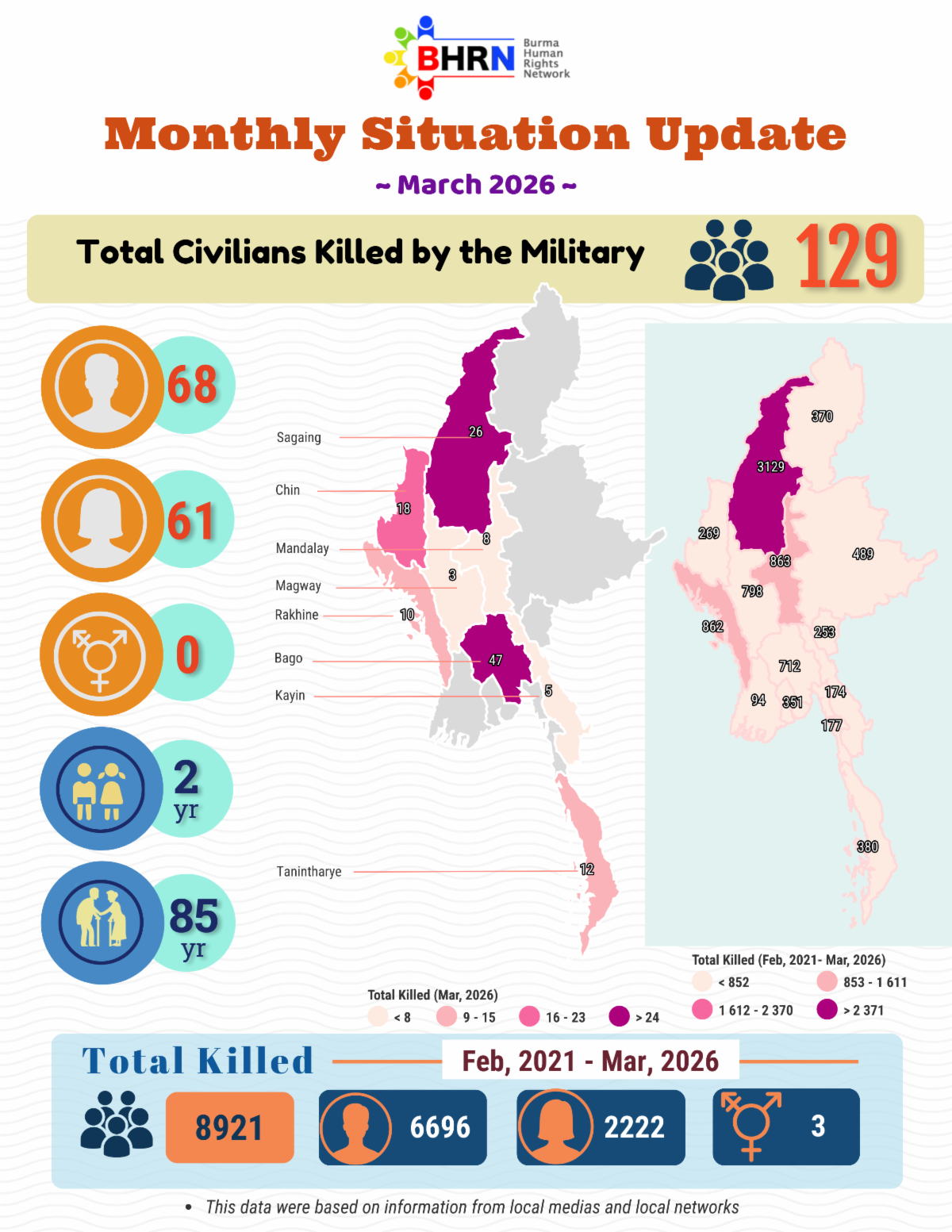
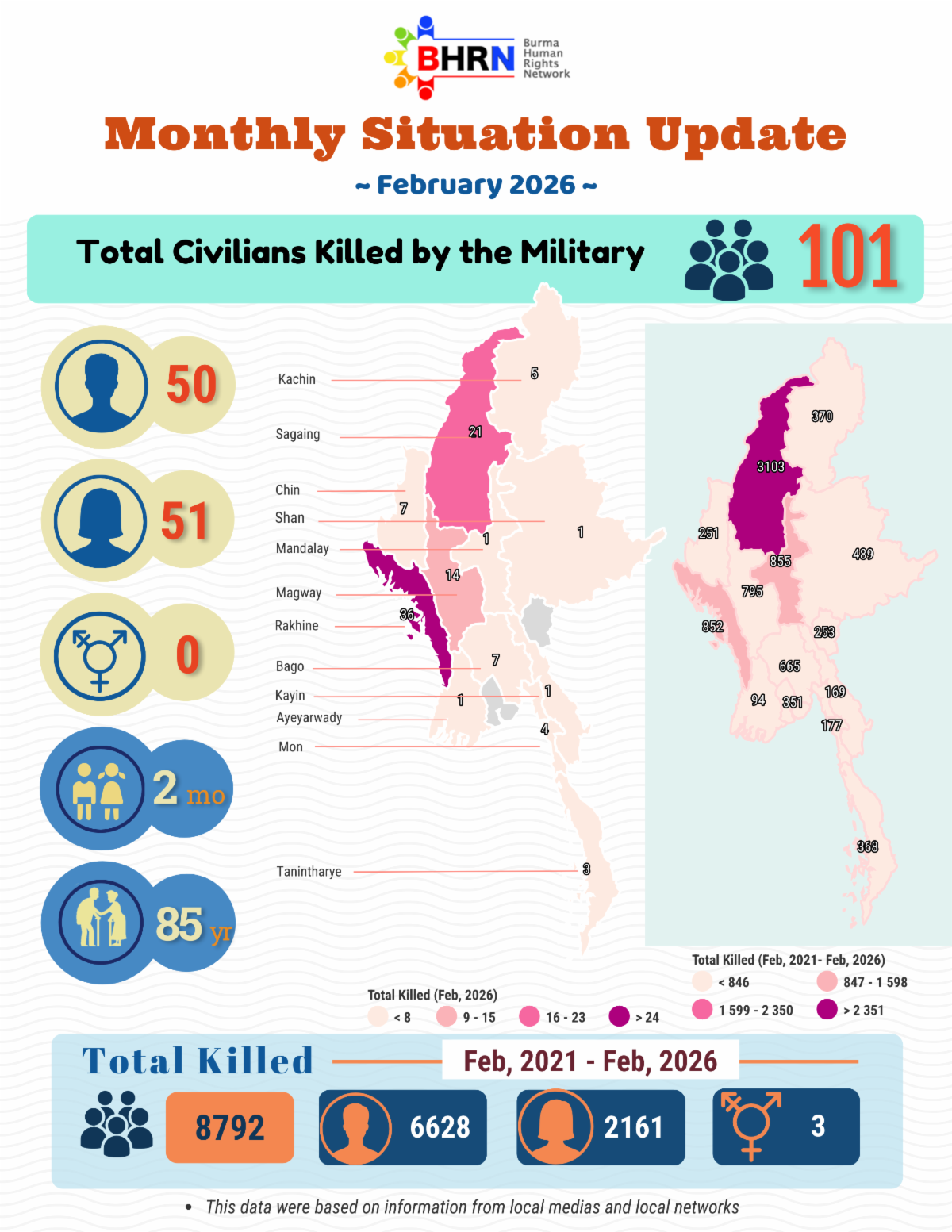
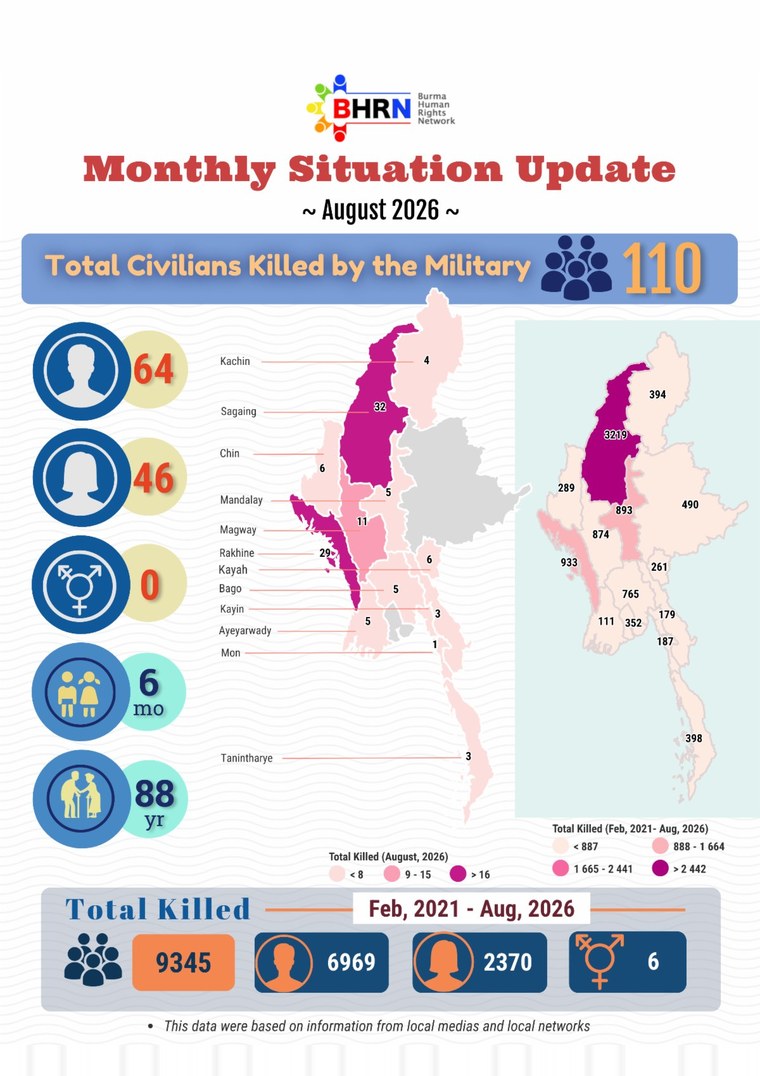
1Info-graphs of BHRN’s Report


Tap any image to see it full size.
2News Summary and Analysis
This Month in Myanmar – August 2026
In August, Thailand normalised relations with the Myanmar junta and backed its return to full participation in ASEAN, giving the military new regional access after sham elections that did nothing to end attacks on civilians, political imprisonment or forced conscription. At the same time, protection for Myanmar people outside the country weakened. The United States ended Temporary Protected Status for nearly 4,000 Myanmar nationals, Malaysia moved ahead with returns to Myanmar while taking greater control over refugee registration, and junta authorities tightened passport procedures for Myanmar nationals in Thailand.
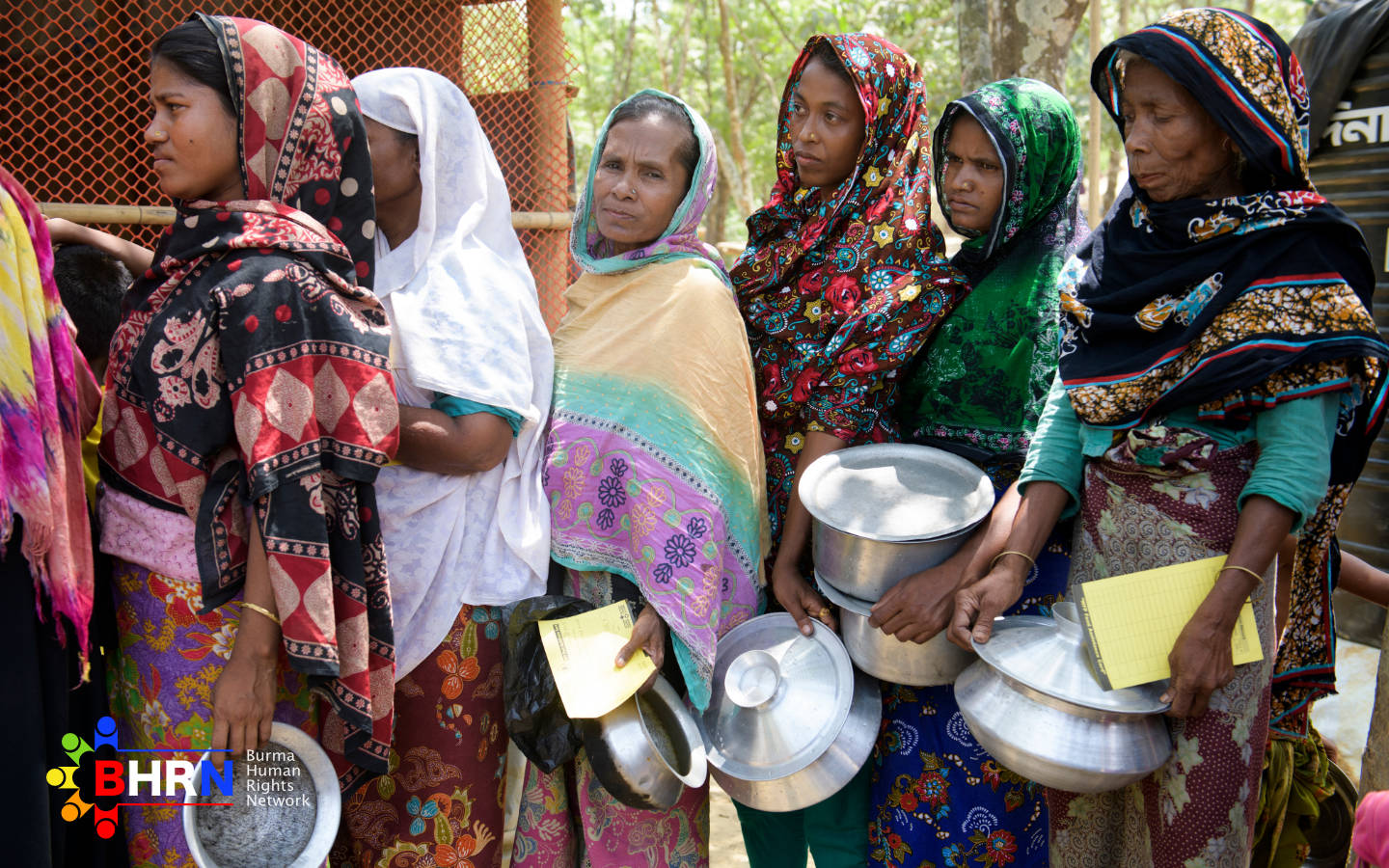
Rohingya remain without citizenship, freedom of movement or effective protection in Rakhine State, where they continue to face abuses by both the Myanmar military and the Arakan Army. In areas under United League of Arakan and Arakan Army control, BHRN received reports during August of forced unpaid labour, the demolition of unoccupied Rohingya-owned houses, new checkpoints and curfew hours applied to Rohingya alone, the transfer of shops belonging to Rohingya who had fled, the detailed registration of Rohingya households and occupations, and a multi-level permission requirement for inter-township travel. More than 500 people, most of them Rohingya, are also feared dead following two shipwrecks in July, and departures toward Malaysia reportedly slowed during August as fear of the route grew.
Inside Myanmar, the military continued airstrikes, artillery attacks, village burnings, forced recruitment and restrictions on humanitarian assistance. Civilians were killed at displacement sites, monasteries, hospitals, schools and in residential areas across Sagaing, Rakhine, Chin, Karenni, Kachin, Bago and Magway. Attacks continued to the end of the month, including a strike on a village sheltering displaced people in Mindat Township on 30 August. The junta also expanded conscription through local administrative structures and imposed new recruitment demands on Rohingya communities in Sittwe. International accountability efforts advanced as the Independent Investigative Mechanism for Myanmar identified military units linked to specific aerial attacks and examined their command structures. Resistance groups also strengthened political and military coordination through the SCEF while continuing to contest key roads, border crossings and military supply routes across the country.
3Political, Legal, and International Developments Affecting Myanmar
Thailand Normalises Relations With the Junta
Thailand normalised relations with the Myanmar junta in August. During Min Aung Hlaing’s official visit to Bangkok on 6–7 August, Thailand said it would support Myanmar’s return to “full and equal participation” in ASEAN, while the junta thanked Thailand for helping to normalise its relations with the bloc. The visit came after the junta’s sham elections and despite its continued rejection of the Five-Point Consensus. On 8 August, the junta rejected ASEAN’s call for the release of Aung San Suu Kyi and argued that the ASEAN Special Envoy was no longer needed because the institutions created through the elections were now in place.
Thailand’s position gives the junta a route back into ASEAN without ending attacks on civilians, releasing political prisoners or complying with the Five-Point Consensus. It also helps the military use its sham elections to present continued military rule as a return to normal government and reduce the political costs imposed after the coup. If other ASEAN governments follow Thailand’s lead, the junta could regain high-level regional access while its human rights record remains unchanged.
Why it matters
Full participation in ASEAN would give the military greater diplomatic access and make it easier to claim that the political crisis has been resolved through its sham elections. It would also weaken pressure for the release of political prisoners, an end to attacks on civilians, and implementation of the Five-Point Consensus. For the junta, normalisation offers a way to gain abroad what it has failed to secure inside Myanmar: political acceptance of continued military rule.
Regional Governments Move Ahead With Refugee Returns Despite Unsafe Conditions
Malaysia announced in August that it would begin returning Myanmar nationals in September, while transferring refugee registration from UNHCR to a government-run system. On 27 August, Malaysian authorities announced that 1,476 Myanmar nationals would be returned on 29 September as the first group under an arrangement covering 5,000 people. Malaysia has also replaced UNHCR’s registration with its own Refugee Registration Document system, which will determine who is recognised, allowed to remain temporarily and potentially permitted to work. Human Rights Watch has raised concerns about safeguards in the new system, including refugee-status determination, appeals, confidentiality and data protection. At the same time, junta authorities said they had verified 308,797 Rohingya refugees in Bangladesh as former residents of Rakhine State and could receive them once security conditions permitted. These return plans are moving forward while Rohingya remain without citizenship or freedom of movement in Myanmar and face continuing abuses by both the military and the Arakan Army. On 24 August, the UN Secretary-General said conditions still did not allow for voluntary, safe, dignified and sustainable Rohingya return.
Why it matters
Malaysia and Bangladesh are moving closer to returning people to Myanmar even though the conditions that forced many of them to flee have not been resolved. For Rohingya, verification as a former resident does not restore citizenship, land, freedom of movement, or protection from persecution. Malaysia's new registration system could improve documentation and access to work for some refugees, but it also gives the government more control over who is recognised and who may be returned. Any return from Malaysia or Bangladesh must comply with the principle of non-refoulement. Rohingya remain stateless, face severe restrictions on their rights, and continue to face abuses by both the military and the Arakan Army.
US Ends TPS as Thailand Tightens Controls on Myanmar Nationals
On 7 August, a US federal judge allowed the Trump administration to end Temporary Protected Status for nearly 4,000 Myanmar nationals, removing the protection from deportation and work authorisation granted after the 2021 coup. In Thailand, the government signed a new labour agreement with the junta on 6 August covering the recruitment and employment of Myanmar workers and further cooperation on labour rights and social protection. Four days later, Thai authorities arrested 28 ethnic Karen villagers in Phetchaburi after they could not prove Thai citizenship. Twenty-six, including eight children and two pregnant women, were transferred to immigration detention for deportation to Myanmar. Human Rights Watch said their return could violate Thailand’s obligations under the Convention against Torture, the principle of non-refoulement and Thailand’s Prevention and Suppression of Torture and Enforced Disappearance Act. On 21 August, the Myanmar embassy in Bangkok and consulate in Chiang Mai stopped directly approving passport category changes and began sending applications to Naypyidaw for security checks. DVB reported that the change affects exiles and migrant workers in Thailand and that applicants were being told to wait at least two months for a decision.
Why it matters
Thailand’s new labour agreement could improve legal status and labour protections for Myanmar workers able to enter or remain in the formal system. It does little for people fleeing persecution, conflict or conscription who cannot safely obtain documents through junta-controlled authorities. The arrests also show the protection gap facing Myanmar people in Thailand who cannot secure recognised legal status, including people who may be unable to obtain documents through junta-controlled authorities. In the United States, ending TPS removes a country-wide protection for nearly 4,000 Myanmar nationals, leaving affected people dependent on any other immigration status or individual protection claim they may have, even though conditions in Myanmar have not improved. As governments tighten immigration rules while expanding selected legal migration routes, Myanmar people who cannot meet documentation requirements may face the greatest risk of losing protection. The new passport procedure also gives the junta greater control over Myanmar nationals in Thailand whose applications must now pass security checks in Naypyidaw.
Junta Expands Conscription and State Digital Control
The junta expanded its use of civilian administration for conscription in August. In Sittwe, authorities ordered Rohingya leaders in five wards to provide 20 men aged 18 to 35 each month and required communities to contribute money for recruits’ salaries and food. Residents told DVB that at least 3,000 Rohingya had already been conscripted from villages and displacement camps in Rakhine State since the military activated the People’s Military Service Law in 2024. The junta also continued expanding the digital systems available to institutions under its control. A subsidiary of sanctioned Russian technology company Astra Group was contracted to build Myanmar’s National Single Window, which will place import and export processes for multiple ministries and agencies on a single online platform. Astra has said the same architecture could later support additional state digital services. Justice For Myanmar warned that the project could expand the junta’s digital surveillance capabilities. Starlink also discontinued its Global Roam service for existing customers on 17 August. Civil society groups had warned that recent Starlink restrictions in Myanmar were already cutting access for schools, hospitals, humanitarian responders and civilian early-warning networks in areas where conventional telecommunications are unavailable.
Why it matters
The junta is using ward administrators, household records and community quotas to identify recruits and enforce conscription. The junta is forcing Rohingya communities to provide recruits and finance their service while continuing to deny Rohingya citizenship and accountability for the military’s 2017 atrocities. The Astra contract also gives the junta new digital infrastructure at a time when it already uses SIM and device registration, internet restrictions, and online surveillance against political opponents. The immediate functions of the National Single Window are commercial, but its planned expansion into other state services raises serious concerns about how much more information the junta will be able to centralise and access. At the same time, reduced access to Starlink in conflict areas can cut civilians off from airstrike warnings, humanitarian coordination and independent communications where the junta has already shut down or restricted conventional networks.
Accountability Efforts Move Closer to Identifying Individual Responsibility
The Independent Investigative Mechanism for Myanmar reported on 11 August that it had identified some of the military units responsible for particular aerial attacks and was investigating their command structures. It also advanced investigations into arbitrary detention, torture and sexual and reproductive violence in military-controlled detention facilities, as well as alleged crimes in Rakhine State committed by the military, the Arakan Army and other perpetrators. On 25 August, OHCHR added further evidence of killings, torture, arbitrary detention, forced recruitment, forced labour, sexual violence and displacement affecting Rohingya and other communities, including abuses attributed to both the military and the Arakan Army.
Why it matters
The IIMM is moving beyond documenting patterns of abuse towards evidence that can link crimes to particular units and commanders. That is important for criminal cases, universal jurisdiction proceedings and targeted sanctions, especially as senior military figures move into positions created through the junta’s sham elections. The growing evidence of Arakan Army abuses in Rakhine also makes clear that accountability must apply to all armed actors without equating those abuses with the military’s decades of persecution and atrocity crimes against Rohingya.
NUG Moves to Establish an Independent Human Rights Commission
The National Unity Government dissolved its Ministry of Human Rights on 21 August and announced plans to replace it with an independent Union Human Rights Commission. The proposed National Human Rights Commission Law has been approved by the National Unity Consultative Council and is currently under review by the Committee Representing Pyidaungsu Hluttaw. The commission would sit outside the executive rather than operate as a government ministry. Its mandate, appointment process, investigative powers and safeguards for independence will depend on the final law. On 7 August, 146 Myanmar, regional and international civil society organisations called on the Southeast Asia National Human Rights Institutions Forum to block the junta-controlled Myanmar National Human Rights Commission from assuming the forum’s 2027 chairship and to review its continued membership. GANHRI removed the MNHRC’s accreditation in 2024 after finding that it had failed to comply with the Paris Principles and lacked independence from the military.
Why it matters
An independent commission could provide stronger oversight than a ministry that forms part of the NUG itself. That will depend on whether it can investigate allegations involving NUG authorities, resistance administrations, and armed actors without political interference, as well as violations committed by the junta. The reform also gives the democratic movement an opportunity to build a human rights institution around the Paris Principles before a political transition, rather than trying to create credible oversight after new institutions are already in place. Its independence in practice will determine whether it strengthens accountability or simply changes the institutional home of the NUG’s existing human rights work. Allowing the junta-controlled MNHRC to chair SEANF would move in the opposite direction, giving a regional leadership role to a body that lost its international accreditation for failing basic independence standards.
Russia Expands Support for the Junta Amid Military Operations Around the Dawei SEZ
Russia expanded political and economic support for the junta in August, including projects linked to areas where the military is carrying out new offensives. During Min Aung Hlaing’s visit to Moscow on 18 August, Russia and the junta discussed energy, defence and infrastructure projects, including plans to revive the Dawei Special Economic Zone in Tanintharyi Region. Reuters reported that around 700 junta troops had moved into the Dawei area since July, burning villages and displacing residents as the military sought to secure land around the stalled deep-sea port and industrial project. Russia has shown interest in developing Dawei as a trade route to the Indian Ocean, alongside wider cooperation on oil refining, hydrocarbon exploration and energy.
Why it matters
Foreign investment in areas seized or secured through military operations risks financing the junta and entrenching abuses against communities living around major infrastructure projects. Dawei is particularly concerning because military operations are already forcing civilians from land connected to a project the junta is trying to revive with Russian support. Governments should block investment, financing and technical support for projects that provide revenue or other material support to the junta, including projects linked to military operations, forced displacement or land seizures around Dawei. States should also impose and enforce coordinated sanctions against Russian and other entities supplying the junta with military equipment, technology, finance and infrastructure.
Junta Plans New By-Elections to Extend Its Sham Electoral Process
Min Aung Hlaing announced on 21 August that the junta would hold by-elections in early 2027 in areas excluded from its 2025–26 elections and invite international observers. The original elections could only be organised in 263 of Myanmar’s 330 townships and covered an estimated 42 percent of the country. SAC-M and the Asian Network for Free Elections found that the process failed basic international standards and could not provide democratic legitimacy to the institutions created through it. The announcement came during Min Aung Hlaing’s visit to Belarus, which sent observers to the earlier elections. Belarus and the junta also signed an agreement on cooperation between their electoral bodies during the visit.
Why it matters
The by-elections would extend the junta’s sham electoral process. Political opponents remain imprisoned or excluded, resistance-controlled areas remain outside junta authority, and criticism of the electoral process has been criminalised. Holding additional votes in selected areas could nevertheless help the junta claim that its electoral process is expanding and give friendly governments another reason to engage with the institutions it created. Governments and international organisations should not observe, endorse or otherwise legitimise this process.
Nationalist Monks Force Demolition of Shops at Thanlyin Mosque
On 14 August, around 30 monks from the Patriotic Sangha Union, led by the nationalist monk Ashin Thusitta, entered the compound of Sein Kone Mosque in Thanlyin Township, Yangon Region, and inspected construction work in progress. The monks summoned the mosque trustees, accused them of building unauthorised religious structures in the form of shops, demanded documents proving official approval, made threats, and recorded and livestreamed video accusing the trustees of secretly constructing an illegal mosque.
Sein Kone Mosque is believed to have been established around 1900 and has stood for more than 120 years. Local sources said the trustees had previously built a row of shops inside the compound and were rebuilding them because the existing structures had deteriorated with age. A video statement by one of the trustees indicated that rebuilding had begun before the relevant department issued formal approval, with payments made to government authorities to allow work to start in advance. Although the inspection was carried out by monks rather than by municipal officials with any authority to enforce building regulations, the trustees demolished the shops on 20 August amid a sharp rise in anti-Muslim rhetoric and incitement on social media. Ashin Thusitta has previously been involved in hardline anti-Muslim activity under the banner of “race, religion and Sasana” and in violence against opponents of the military coup.
Why it matters
Enforcement of building rules against a mosque was effectively delegated to a nationalist monastic group with a record of anti-Muslim agitation, and the trustees demolished their own property under pressure rather than through any lawful process. Whatever the permit status of the shops, a religious minority was subjected to threats, filmed intimidation and online incitement, and lost income-generating property as a result. The episode shows that anti-Muslim mobilisation in central Myanmar continues under the post-election administration, and that Muslim communities in junta-controlled areas have no effective recourse when private actors act in place of the authorities.
4Resistance Updates
Resistance groups strengthened political and military coordination in August while fighting continued over key roads, border crossings, and military supply routes. NUG PDF commanders adopted plans for a “Strategic Offensive,” and the SCEF appointed its military coordination leadership and added the Sagaing Federal Unit and Mandalay Region Interim Administrative Council as members. The junta consolidated its earlier recapture of Khampat in Sagaing Region, while KIA, AA, KNLA and allied forces continued to contest junta offensives in northern Shan State, Ayeyarwady Region, Karen State, Tanintharyi Region and Kachin State.
CNO/CNDF dismisses chairman over unauthorised talks with the junta: The Chin National Organization/Chin National Defence Force dismissed its chairman after an internal investigation found that he and other officials had held talks with junta representatives in New Delhi without approval from the organisation’s leadership. The CNO/CNDF said no political or military agreement had been reached and reaffirmed that it would not enter into separate negotiations with the junta without agreement from the Chin Brotherhood, the Interim Chin National Consultative Council, and other allied resistance groups.
PDF commanders adopt plans for a “Strategic Offensive”: Senior commanders of the NUG’s People’s Defence Force approved plans to move from the People’s Defensive War towards a “Strategic Offensive” during a four-day commanders’ meeting. The plans include PDF participation in the SCEF’s Military Strategic Coordination and Command Committee and coordinated operations with allied ethnic resistance organisations across different military regions.
Junta restores administration in Khampat after earlier resistance loss: Junta administrative officials returned to Khampat in Tamu Township after the military recaptured the town from resistance forces on 20 June and secured positions along the Kalay–Tamu highway by the end of July. The military began repairing bridges along the road as part of efforts to reopen the 130-kilometre trade route to the Indian border. The development consolidated a significant junta gain on a corridor that had been heavily contested by resistance forces.
Chin resistance blocs continue reconciliation talks in Mizoram: Representatives of the Chinland Council and the Interim Chin National Consultative Council/Chin Brotherhood attended the Chin Peace Summit in Aizawl, India. Political differences prevented the two blocs from holding a joint formal meeting, and mediators instead met the delegations separately. Discussions included humanitarian coordination, direct communication between the rival resistance blocs and arrangements for further reconciliation talks.
SCEF establishes military leadership and expands into central Myanmar: On 7 August, the SCEF’s political leadership and Military Strategic Coordination and Command Committee appointed the committee’s leadership, with senior KIA and KNLA commanders serving as co-chairs and NUG Defence Minister Yee Mon as secretary. On 13–14 August, the Sagaing Federal Unit and Mandalay Region Interim Administrative Council agreed to join the SCEF, becoming its first new members since the coalition was established in March. The expansion brings two major resistance administrations in central Myanmar into the same political and military coordination structure as the NUG, KIO, KNU, KNPP and CNF.
KIA-led forces block junta advance towards Mabein: KIA and allied forces fought junta troops advancing from Mongmit into KIA-controlled territory near Nyaung Ni village in northern Shan State. KIA spokesperson Colonel Naw Bu said resistance forces blocked the advance, prompting the military to deploy an Mi-35 helicopter and Y-12 aircraft. Fighting continued as junta forces attempted to advance towards KIA-controlled Mabein from the south.
AA repels junta offensive in Ayeyarwady Region: The Arakan Army said it repelled coordinated junta attacks at five locations in Yekyi and Thabaung townships. Junta forces from Light Infantry Division 66 attacked AA positions with ground troops backed by aircraft, drones and artillery. The AA said its forces held their positions and forced the attacking troops to retreat, seizing weapons and ammunition after the fighting.
KNLA-led forces seize junta positions in northern Kawkareik: Karen National Liberation Army and allied forces overran junta positions at Kwimaungtaing village in northern Kawkareik Township, forcing military troops to withdraw and leave weapons and ammunition behind. The junta launched a counteroffensive the following day using ground forces, artillery, and airstrikes, and fighting continued across the Htihpoezan village tract.
Junta launches offensive towards KNU-controlled Hteekhee border crossing: Junta columns intensified operations across Dawei District in Tanintharyi Region. Local resistance sources said one objective was to advance towards Hteekhee, the strategic Thailand–Myanmar border trade crossing captured by KNU Brigade 4 and allied resistance forces in May 2025. Fighting and military operations continued across Thayetchaung, Launglon and the Myitta area, but no change in control of Hteekhee was reported during August.
KIA and PDF forces attack junta supply route to Bhamo: KIA and allied PDF forces repeatedly attacked a military supply flotilla travelling north along the Ayeyarwady River towards Bhamo and fought junta ground forces attempting to secure the route through Shwegu Township. Resistance forces damaged military vessels, seized a tugboat, and on 30 August captured a temporary junta position near Zinbon that had been used to protect the Shwegu–Sinkhan road and river corridor. The military responded with heavy airstrikes and ground operations as it tried to keep the route to Bhamo open.
5On the Ground: Escalating Violence and Human Rights Violations
In August, Myanmar military forces carried out airstrikes, drone and gyrocopter attacks, artillery fire, village burnings, forced recruitment, and restrictions on humanitarian assistance across multiple states and regions. Civilians were killed in homes, displacement sites, monasteries, hospitals, and villages under resistance or ethnic armed organisation control.
ITargeted attacks on Civilians and Civilian Infrastructure
Under international humanitarian law, civilians must never be the object of attack. Article 8(2)(e)(i) of the Rome Statute prohibits intentionally directing attacks against civilians in non-international armed conflicts. Indiscriminate attacks and attacks expected to cause excessive civilian harm may also constitute war crimes.
Sittwe Township, Rakhine State: A Myanmar Navy vessel opened fire on displaced civilians fishing near Paw Kone island, killing one man and wounding another. The fishermen were displaced residents of Aung Taing village who relied on fishing for their livelihoods. Continued naval gunfire prevented residents from immediately recovering the body.
Demoso Township, Karenni State: A Myanmar military fighter jet bombed a displacement site in western Demoso, killing a displaced man in his 50s and injuring a woman in her 70s. The aircraft made three bombing passes over the area.
Talaing Taung village, Ann Township, Rakhine State: A military airstrike hit a house and carport, killing Daw Ma Lay Nge, 67, and Maung Maung Nyan, 23, and injuring three other civilians.
Myaing Township, Magway Region: Three military gyrocopters attacked near Suwon village, killing two displaced civilians and injuring three others. Military forces had been conducting a wider counteroffensive in the township since 1 August that burned more than 200 homes and displaced thousands of residents from seven villages.
Phayargyi village, Ler Doh Township, Bago Region: A fighter jet from Taungoo Air Base dropped two 500-pound bombs on the village, killing three civilians and injuring eight others, including four children. Three houses were destroyed.
Sami town, Paletwa Township, Chin State: A 15-minute military airstrike hit Ward 2 shortly before midnight, killing a 16-year-old girl and injuring nine people, including members of her family and nearby residents.
Kyeintali town, Gwa Township, Rakhine State: A fighter jet dropped two bombs on residential areas in Ward 1, killing eight civilians, including children aged seven and 12. Later that evening, another airstrike on Kaing Khun village destroyed seven houses.
Thandwe Township, Rakhine State: A military airstrike killed a father and his son and injured six other civilians in an area under Arakan Army control.
Maing Tone Tar Gyi village, Pinlebu Township, Sagaing Region: Myanmar military aircraft bombed civilian gold-mining sites, killing at least four civilians. Four other people were still missing when rescue workers began searching the site.
Wetlet Township, Sagaing Region: Two military fighter jets providing air cover for a naval convoy travelling north along the Ayeyarwady River bombed villages in Wetlet Township, killing one civilian and injuring two others.
Shwegu Township, Kachin State: Junta forces escorting the same naval supply convoy shelled riverside villages, killing four civilians, including a child. Air and artillery attacks accompanying the convoy forced residents from riverside communities to flee.
IIAttacks on Religious, Educational and Medical Sites
Under Article 8(2)(e)(iv) of the Rome Statute, intentionally directing attacks against hospitals and buildings dedicated to religion or education constitutes a war crime provided those sites are not military objectives. Medical facilities and personnel also receive specific protection under international humanitarian law.
Mabein Township, northern Shan State: A military fighter jet bombed Mabein General Hospital, severely damaging three hospital buildings. The attack came while the township was experiencing severe flooding.
Kyaukkyi village, Thandwe Township, Rakhine State: Myanmar Air Force jets carried out three airstrikes on the village, killing at least 16 civilians and injuring 18. Around 20 homes and a Buddhist monastery were destroyed.
Source: BHRNKinpan village, Pinlebu Township, Sagaing Region: The Myanmar Air Force carried out 10 airstrikes on an NUG-run hospital compound, killing at least three civilians, including a six-year-old child, and injuring 15 patients. A school building inside the medical compound was also destroyed.
Mansi village, Pinlebu Township, Sagaing Region: A military airstrike destroyed an NUG-operated medical centre. Patients had been evacuated before the attack and no deaths were reported.
Swel Le Oh village, Myaung Township, Sagaing Region: A Myanmar Air Force jet bombed a Buddhist monastery during a meditation retreat, killing 14 people and injuring around 20. Residents and monks were gathered at the monastery for a Buddhist religious observance when the bomb struck.
Sein Nyin Wa village, Paletwa Township, Chin State: Two military fighter jets bombed a Buddhist monastery housing a primary school while children were in class. Five civilians, including two children, were killed and 17 others were injured, including nine children. The monastery, classroom, and 17 houses were destroyed.
IIIHumanitarian Access, Village Burnings and Forced Displacement
Parties to a non-international armed conflict must allow and facilitate impartial humanitarian relief for civilians in need. Deliberately impeding relief supplies can violate international humanitarian law. The forced displacement of civilians is prohibited unless required for civilian security or imperative military reasons.
Sagaing Region: Military forces blocked flood-relief convoys and medical supplies from reaching communities affected by severe flooding and conflict. Troops at the Sagaing, or Yadanabon, Bridge turned back vehicles carrying aid from Mandalay and Yangon, while other checkpoints confiscated medicines. Local relief groups also reported threats from military officials, including warnings that the homes of people delivering aid to resistance-controlled areas could be sealed.
Chaung-U Township, Sagaing Region: A military column of more than 300 troops raided villages while retreating from fighting near Monywa. On 30 August, drone attacks around Kyeekan East and Kyeekan West villages injured nine civilians and troops shot and killed a civilian who encountered the column. Around 50 residents had been detained when the column entered the area on 29 August. Later killings and burnings reported on 31 August and 1 September fall outside this report’s reporting period and are not included here.
IVForced Conscription and Extortion
Conscription enforced through abduction, threats, arbitrary detention, extortion, or other coercive abuses can violate international human rights law. Recruiting children under 15 into armed forces or armed groups, or using them to participate actively in hostilities, is a war crime under Article 8(2)(e)(vii) of the Rome Statute.
Kawthaung, Tanintharyi Region: Local sources reported that 184 Myanmar nationals, 113 men and 71 women, were returned from Ranong in Thailand to Kawthaung by long-tail boat after completing prison sentences in Thailand, and were handed to Myanmar military authorities on arrival. A Kawthaung resident said military personnel began selecting men of military age while the authorities were still checking names. Returnees through this crossing have previously been taken to Battalion 262 headquarters in Kawthaung and sent on for military training in Tanintharyi Region. The figures for this particular transfer have not been independently verified, but the practice is well documented, with Fortify Rights recording an estimated 4,571 forced returns through the Ranong–Kawthaung crossing since December 2023.
Source: BHRNSittwe Township, Rakhine State: Junta authorities ordered Rohingya leaders in five wards to provide 20 men aged 18 to 35 each month. Residents said communities were also forced to contribute money for recruits’ salaries and food. DVB reported that at least 3,000 Rohingya had already been conscripted from villages and displacement camps in Rakhine State since the military activated the People’s Military Service Law in 2024.
Mandalay Region and nationwide: Local authorities expanded conscription lists and quotas. DVB reported that recruitment quotas in some areas had doubled and that authorities were using household and administrative records to identify eligible people. Reports also emerged that women had begun military training in Hmawbi Township, despite junta denials that women were being forcibly recruited.
VAbuses in Areas Under United League of Arakan/Arakan Army Control
Common Article 3 of the Geneva Conventions binds all parties to a non-international armed conflict, including non-state armed groups, and prohibits adverse distinction based on race, religion or other similar criteria. Uncompensated or abusive forced labour is prohibited under customary international humanitarian law and under the ICCPR and ILO Convention No. 29. Destroying or seizing the property of an adversary is prohibited under Article 8(2)(e)(xii) of the Rome Statute unless imperatively demanded by the necessities of the conflict. Restrictions on freedom of movement imposed on one ethnic or religious group alone raise serious concerns under the prohibition of discrimination and, where they form part of a wider system of control over a persecuted group, may amount to persecution. The following incidents were reported to BHRN by residents during August. Several have not been independently verified and are recorded here as reported.
- From 21 August
Ward 5, Maungdaw Town
The AA established a security checkpoint at the entrance to a Rohingya village in Ward 5 and began checking residents entering and leaving. Rohingya residents are not permitted to pass the checkpoint after around 8:30 p.m., although the curfew announced for the district begins at 10:00 p.m. Residents said the checkpoint was set up without prior notice or any explanation of the security grounds for it, and regard it as a further measure to control Rohingya movement.
Source: BHRN - From 26 August
Maungdaw Township
AA personnel have reportedly been demolishing unoccupied houses, including brick and concrete structures, in several locations across the township, particularly houses belonging to Rohingya residents. No reason for the demolitions has been given. The number of houses destroyed and the extent of the damage require further verification.
Source: BHRN - From 30 August
Maungdaw Township
ULA authorities have reportedly required Rohingya residents to work without pay on the repair and renovation of a football field under ULA administration. Residents said around 100 people from each village are summoned each day, and that only Rohingya are subject to the requirement, while Rakhine and other communities are exempt. This follows the pattern BHRN documented in June 2026, when the ULA/AA imposed forced labour on at least six Rohingya villages in northern Maungdaw, more than 300 people in total, to build infrastructure for new Rakhine settlements at Sapay Kone and Maung Hna Ma, and earlier rotational labour demands on Ngan Chaung, Kyet Yoe Pyin and Ngar Sar Kyu villages from February 2026.
Source: BHRN - August
Pauktaw Township
The ULA is collecting detailed information on Rohingya communities across the township, including household lists and separate lists of business owners, farmers, fishermen and Islamic religious scholars. The purpose has not been explained. The ULA has also announced plans to issue new household registration documents, but has not made clear how Rohingya ethnicity will be recorded or whether the term “Rohingya” will appear at all. Residents said they want their identity and names recorded accurately, and are concerned about how the lists and the registration process may be used.
Source: BHRN - August
Western Ye village, Pauktaw Township
A local land management office under ULA administration has been issuing land documents in individual names and permitting the transfer and sale of land previously held as communal village property, including land used for grazing cattle and goats. Residents fear that access to land will be determined by ability to pay, that low-income households will lose access to land they depend on, and that livelihoods based on livestock and farming will be affected. Residents are calling for land allocation policies and criteria to be published, for communities to be consulted before communal land is sold or transferred, and for traditional and communal land rights to be protected.
Source: BHRN - August
Pauktaw Township and other AA/ULA-administered areas: Rohingya residents travelling from Pauktaw to another township, including Minbya, Mrauk-U, Myebon and Kyauktaw, are reportedly required to obtain recommendation letters at three separate administrative levels: the village administrator, the township territorial or administrative office, and the district territorial or administrative office. Applicants may be asked for their full name, household and village of residence, destination, purpose of travel, duration of the journey and other identifying information. Community accounts state that the requirement is compulsory for Rohingya travellers and is not applied in the same way to the wider non-Rohingya population. Even with the letters, travellers may face document checks at checkpoints along the route, and similar requirements have been reported for Rohingya entering Kyauktaw. The practical effects include difficulty reaching hospitals, visiting relatives, reaching workplaces and schools, moving goods for trade and travelling in emergencies. Administrative practice varies by location and may change with the security situation, and the three-level procedure should be recorded as a reported practice unless documentary evidence or multiple independent testimonies establish that it applies uniformly across AA/ULA-controlled areas.
Source: BHRN
6Policy Recommendations
On ASEAN and political engagement
- ASEAN members should reject Thailand’s push to restore the junta’s full participation in the bloc. The junta should remain excluded from ASEAN leaders’ and foreign ministers’ meetings, and the Special Envoy mechanism should remain in place until the military ends attacks on civilians, releases political prisoners and implements the Five-Point Consensus. ASEAN should expand formal engagement with the National Unity Government, SCEF, ethnic resistance organisations and Myanmar civil society rather than treating the junta’s sham elections or planned 2027 by-elections as a basis for normalisation.
- SEANF members should block the junta-controlled Myanmar National Human Rights Commission from assuming the forum’s 2027 chairship and review its continued membership. A body that lost GANHRI accreditation for failing the Paris Principles should not be given a regional human rights leadership role.
On refugee protection and migration
- Malaysia should suspend planned returns to Myanmar, restore UNHCR access to immigration detention centres, and ensure that its new refugee registration system includes independent refugee-status determination, an effective appeal process, confidentiality and data-protection safeguards. No person should be returned without an individual assessment of protection risks and compliance with the principle of non-refoulement.
- The United States should restore or redesignate Temporary Protected Status for Myanmar based on current country conditions. Thailand should expand lawful stay and work options for Myanmar nationals without making protection dependent on security vetting by junta-controlled authorities, and should apply its domestic non-refoulement law and obligations under the Convention against Torture before any removal to Myanmar.
On abuses by the United League of Arakan and Arakan Army
- The ULA/AA should immediately end forced and uncompensated labour, halt the demolition of Rohingya-owned houses and the transfer of Rohingya-owned shops and land, and remove movement restrictions, curfew hours and permission requirements that apply to Rohingya alone. It should publish the legal basis and purpose of its household registration and data collection in Pauktaw and Maungdaw townships, guarantee that Rohingya identity will be recorded accurately in any documentation it issues, and publicly confirm that the data collected will not be used to restrict rights or determine access to land, property, or services.
- Governments and donors engaging with the ULA/AA on humanitarian access or governance should raise these practices directly, seek verifiable commitments and time-bound corrective action, and make clear that abuses by the Arakan Army will be documented and pursued through the same accountability mechanisms as those of the military. Accountability must apply to all armed actors, without equating these abuses with the military’s decades of persecution and atrocity crimes against Rohingya.
On sanctions, technology and economic support
- Governments should prohibit companies and financial institutions under their jurisdiction from providing technology, financing or services that expand the junta’s surveillance and data-control capacity, including the National Single Window project. States that have not already done so should impose coordinated targeted sanctions on entities directly facilitating the project and other junta digital-control systems.
- Governments, financial institutions and companies should not finance or participate in the Dawei Special Economic Zone where projects would provide revenue or strategic infrastructure to the junta, rely on land secured through military operations, or deepen displacement.
- States should expand and enforce sanctions on aviation fuel, aircraft maintenance, spare parts, drones and other dual-use technologies used in the junta’s air campaign, including against the banks, shipping companies and intermediaries that keep those supply chains operating. August attacks on hospitals, schools, monasteries, displacement sites and villages again show that reducing the military’s air capability remains an urgent civilian-protection priority.
On communications and civilian protection
- SpaceX should create a secure access route for verified humanitarian and human rights organisations, health providers, independent media and civilian early-warning networks that rely on Starlink in areas where conventional communications are unavailable. Measures targeting scam compounds should be directed at identified criminal users and locations rather than cutting off civilian and humanitarian access across conflict-affected areas.
On accountability and human rights institutions
- States should provide the IIMM with sustained funding, evidence and technical cooperation and use its work identifying military units and command structures to update targeted sanctions and support criminal investigations, including universal jurisdiction cases where domestic law permits. Evidence from the August attacks on hospitals, schools, monasteries and displacement sites should be preserved and shared through secure channels.
- The CRPH and NUG should ensure that the proposed Union Human Rights Commission law meets the Paris Principles, including through transparent and independent appointments, security of tenure, adequate resources, and powers to investigate allegations involving NUG authorities, resistance administrations and armed actors as well as the junta.
About BHRN
Burma Human Rights Network (BHRN) is based in London, operates across Burma/Myanmar and works for human rights, minority rights and religious freedom in Burma. BHRN has played a crucial role in advocating for human rights and religious freedom with politicians and world leaders.