Methodology
This report is based on primary and secondary sources, including on-the-ground documentation by BHRN and other human rights groups and media reports from trusted national and international outlets. It provides a detailed analysis of key events during the month, situating them within international legal frameworks and offers policy recommendations to guide international responses, humanitarian action, and justice efforts.
For more information about any of the incidents documented in this report, or to request interviews or supporting materials, please contact Kyaw Win, Executive Director of BHRN at
Highlights of the month

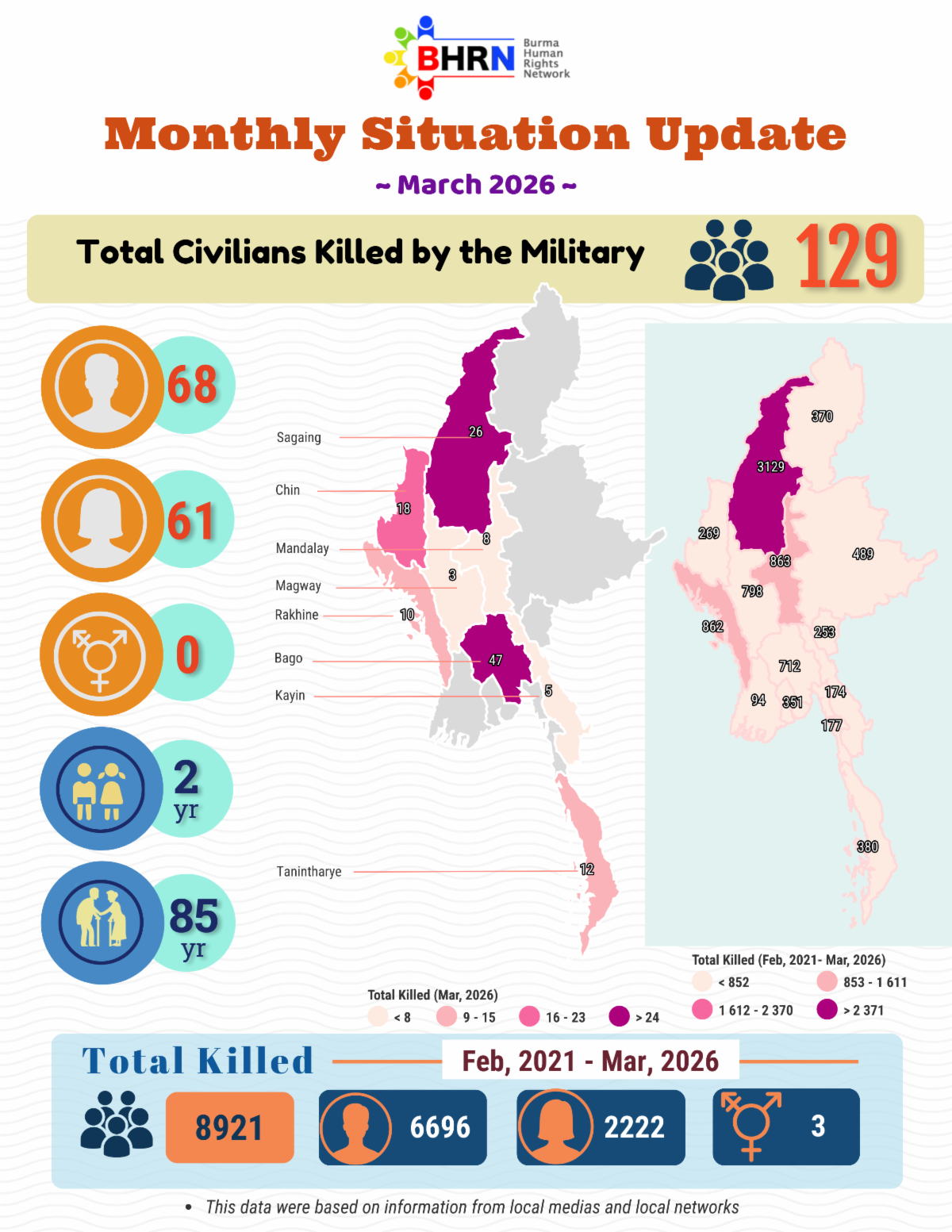
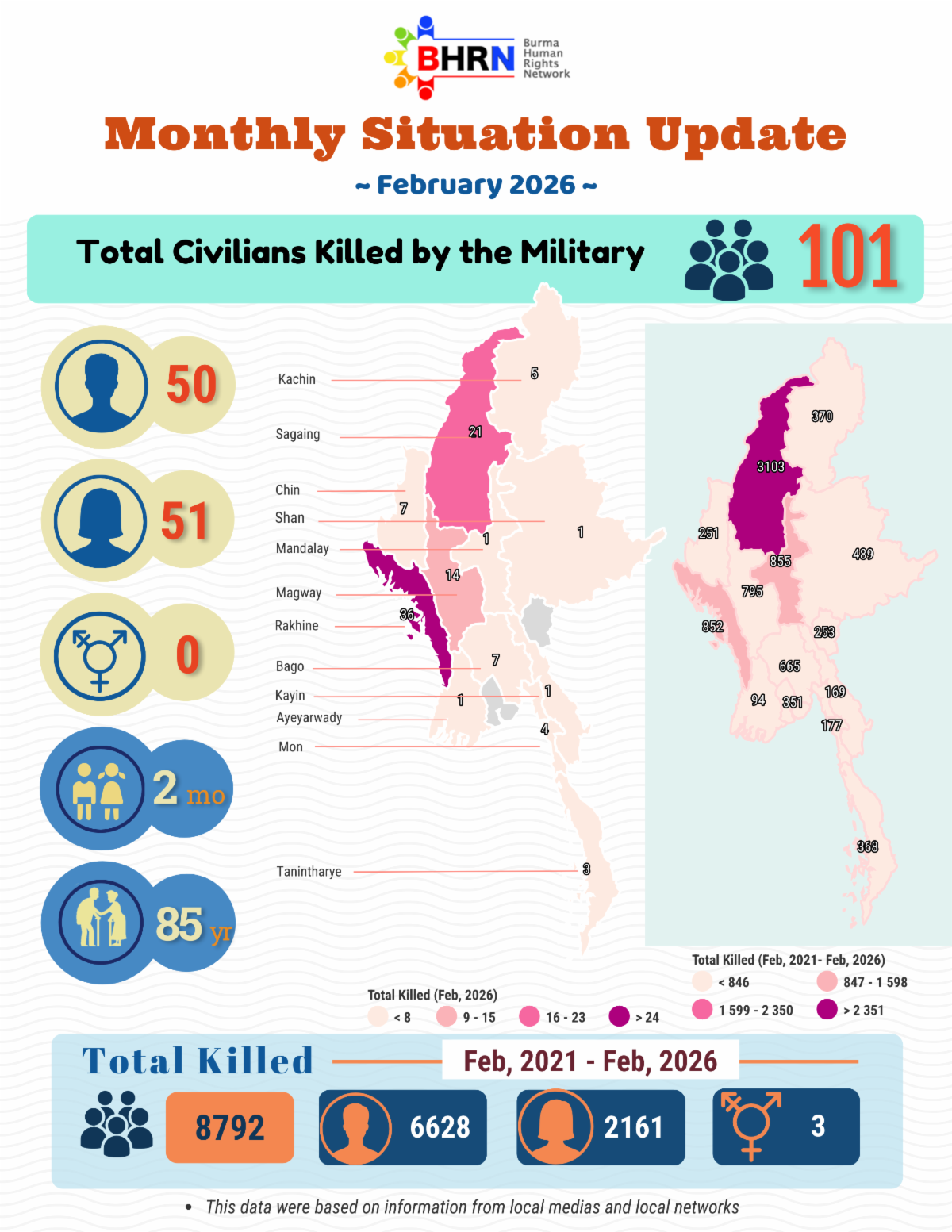
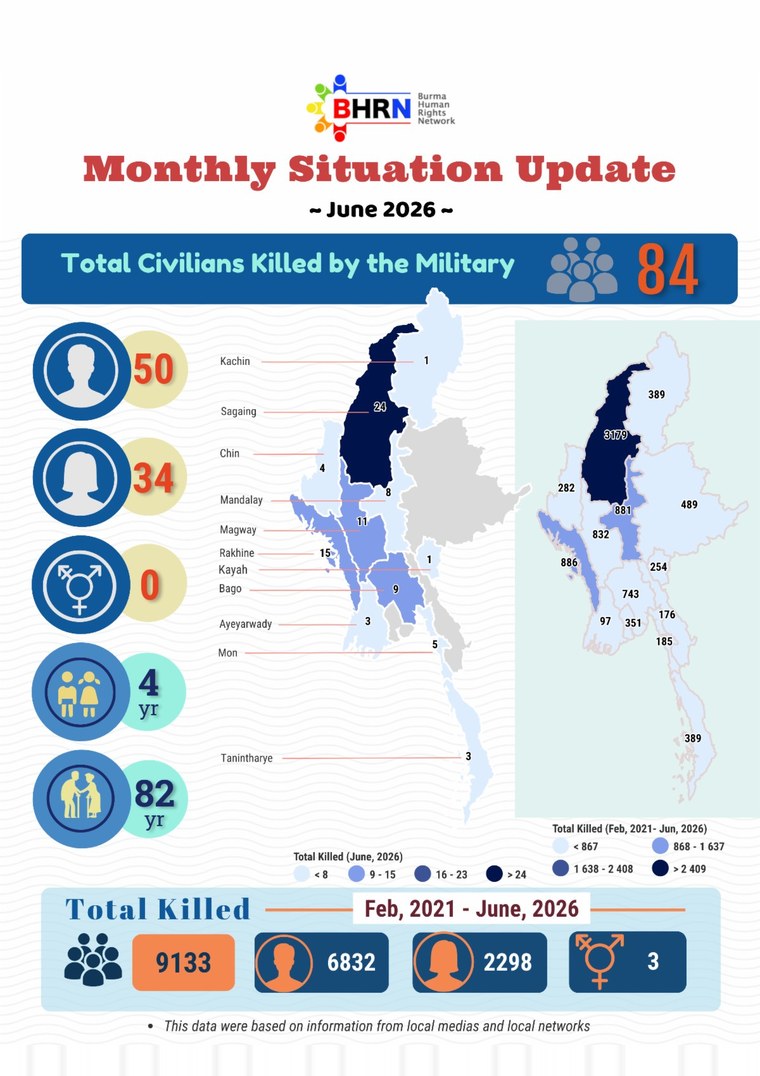
1Info-graphs of BHRN’s Report
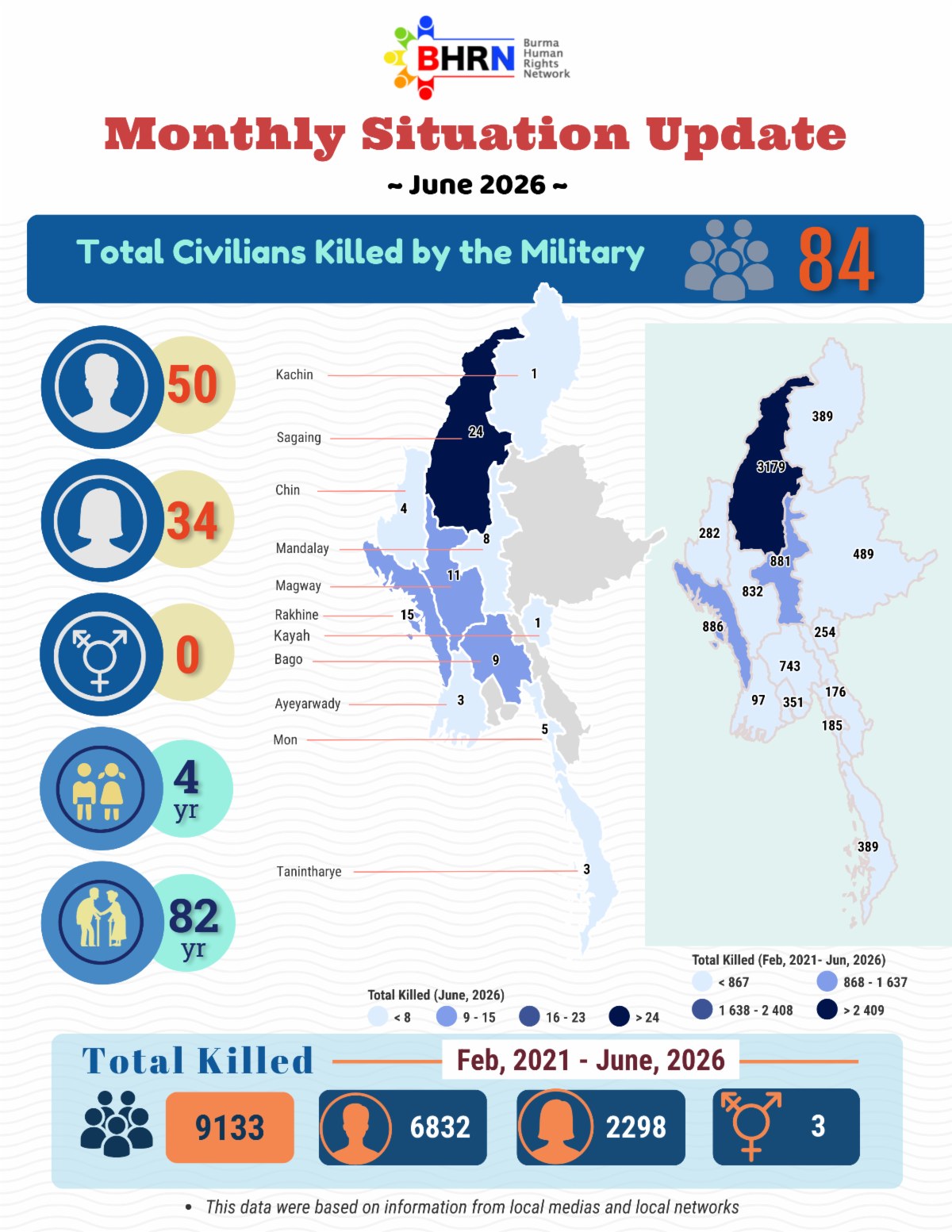
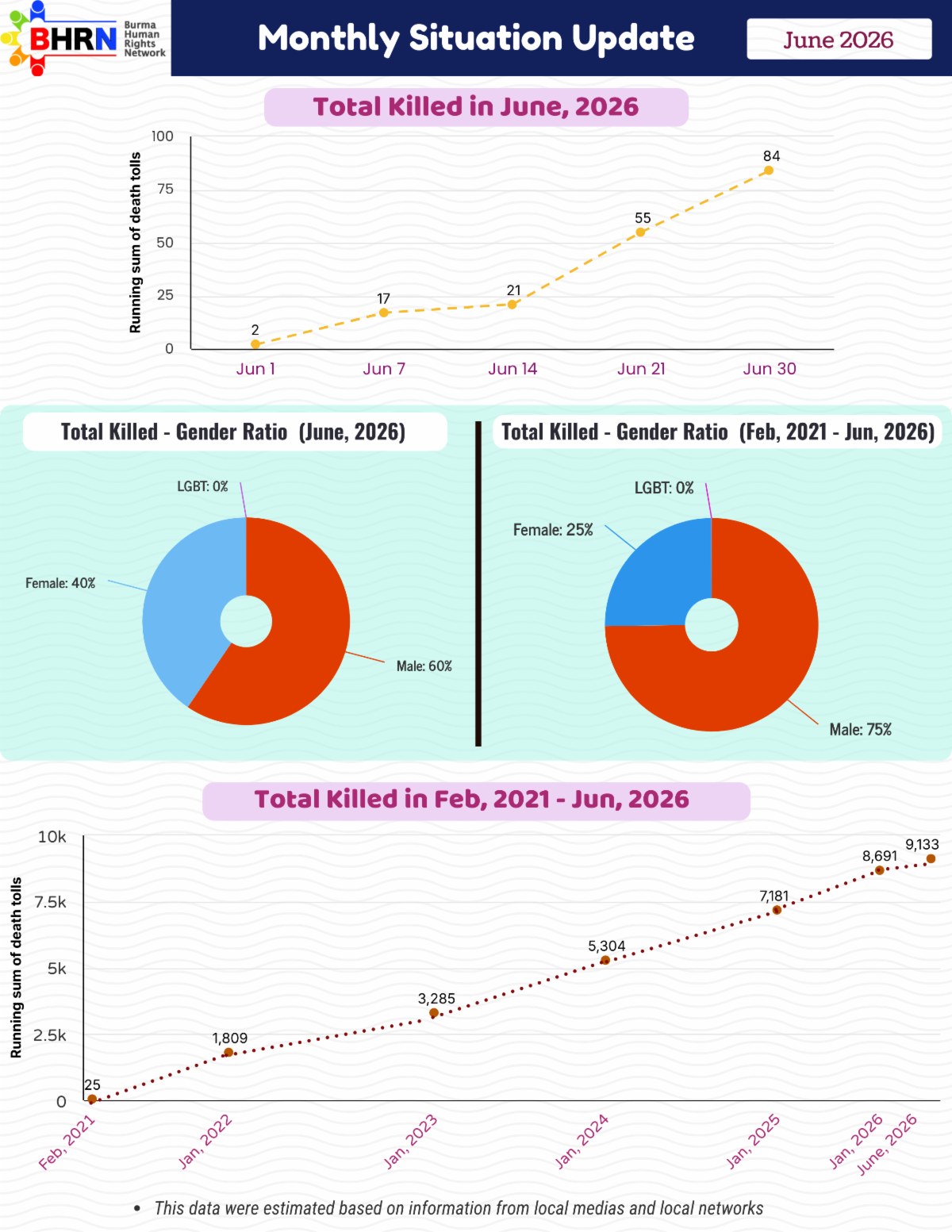
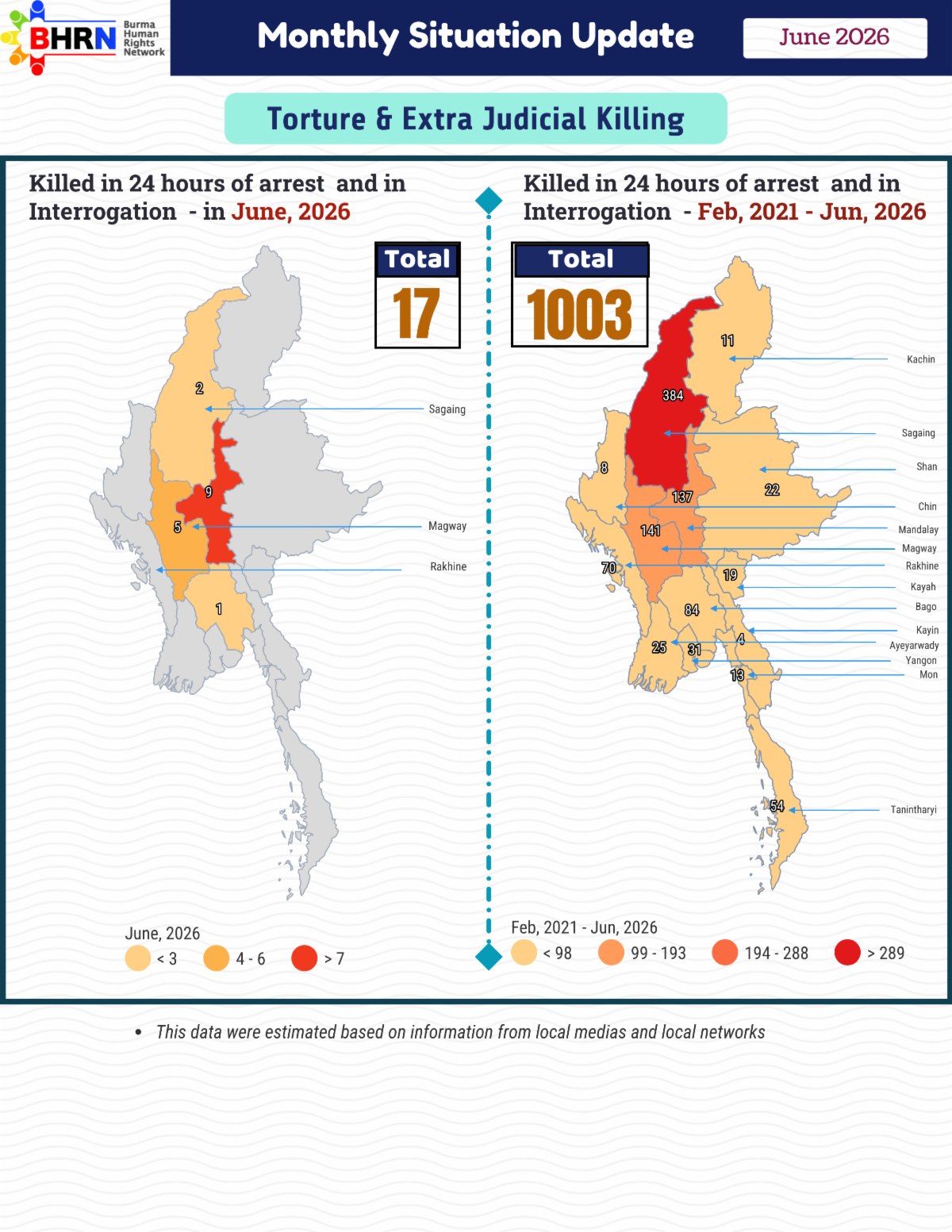
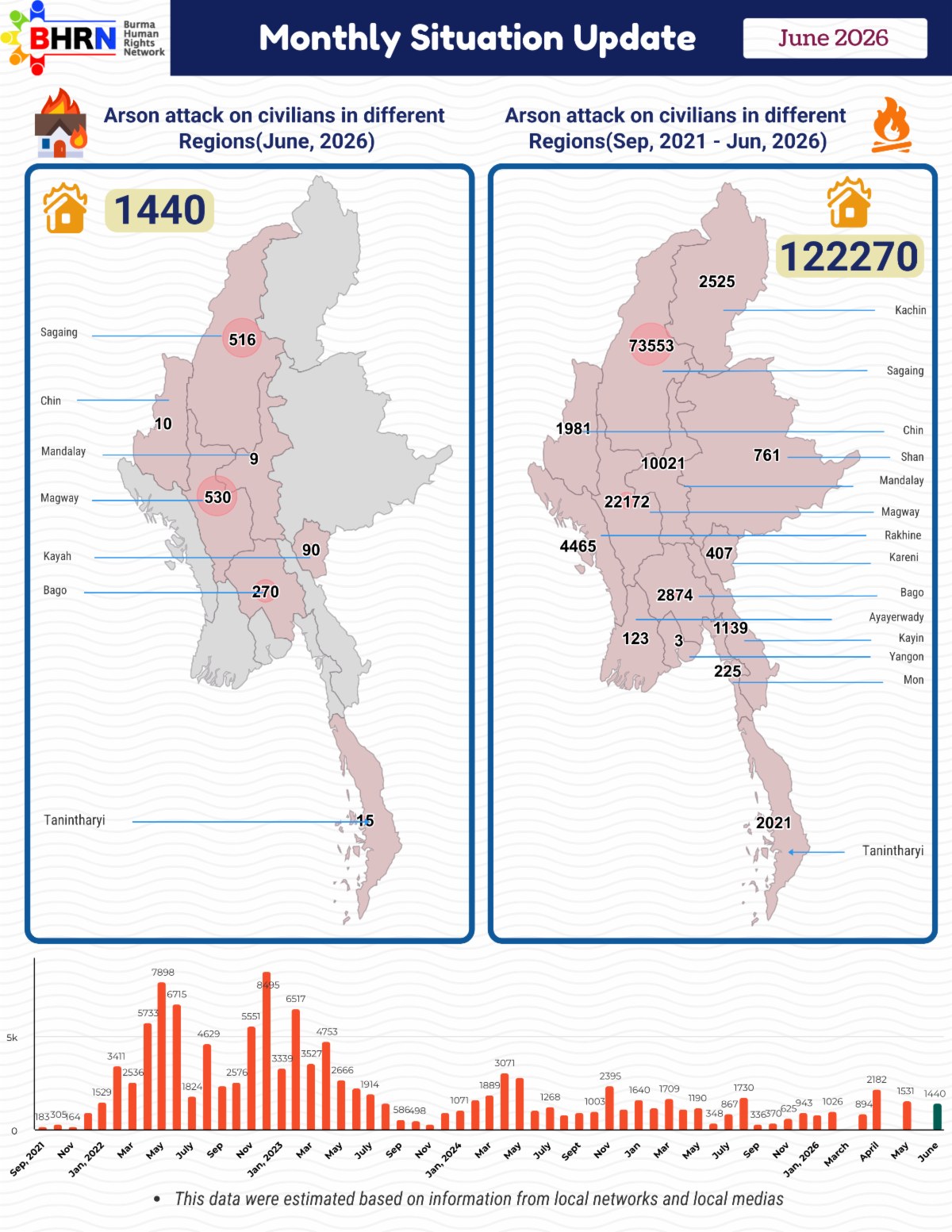
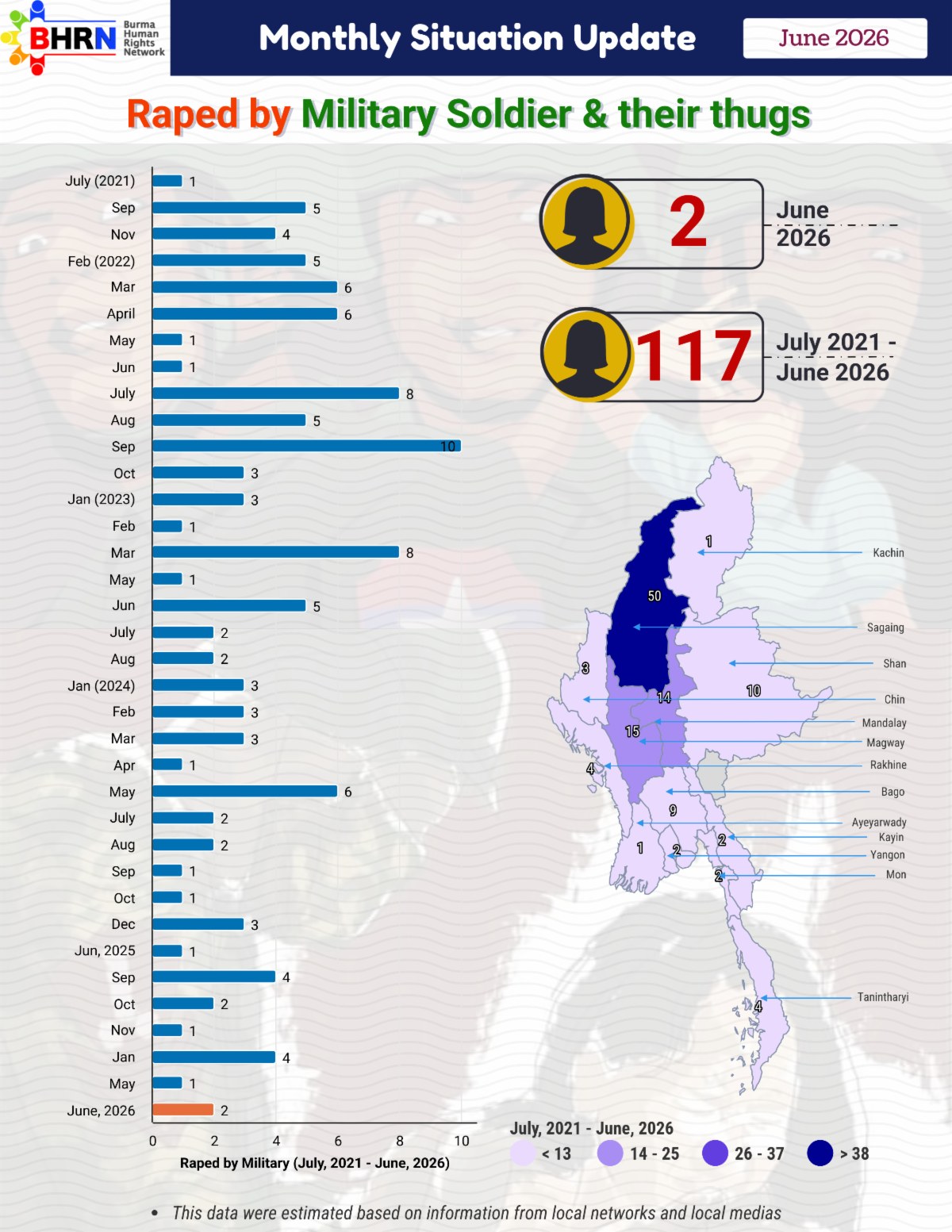
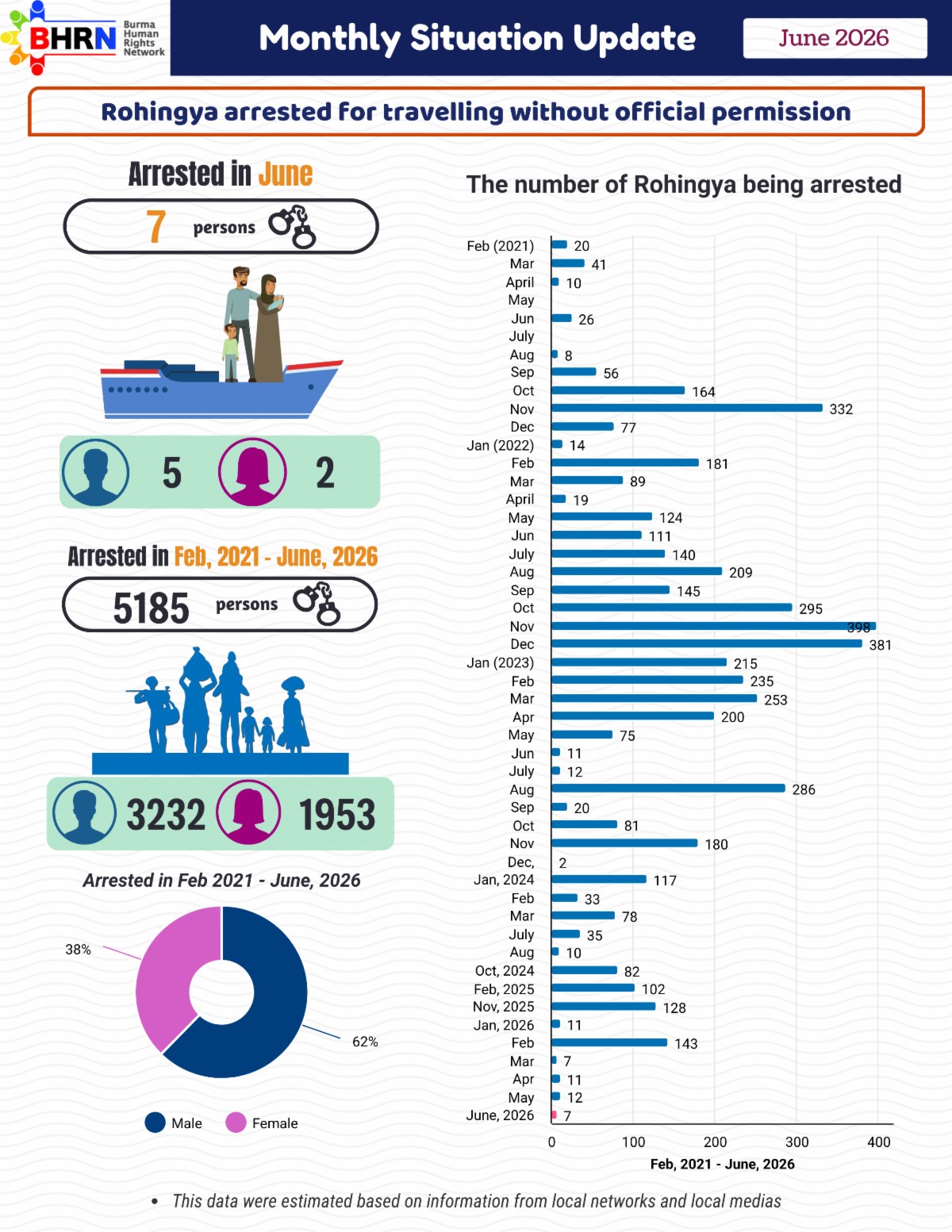
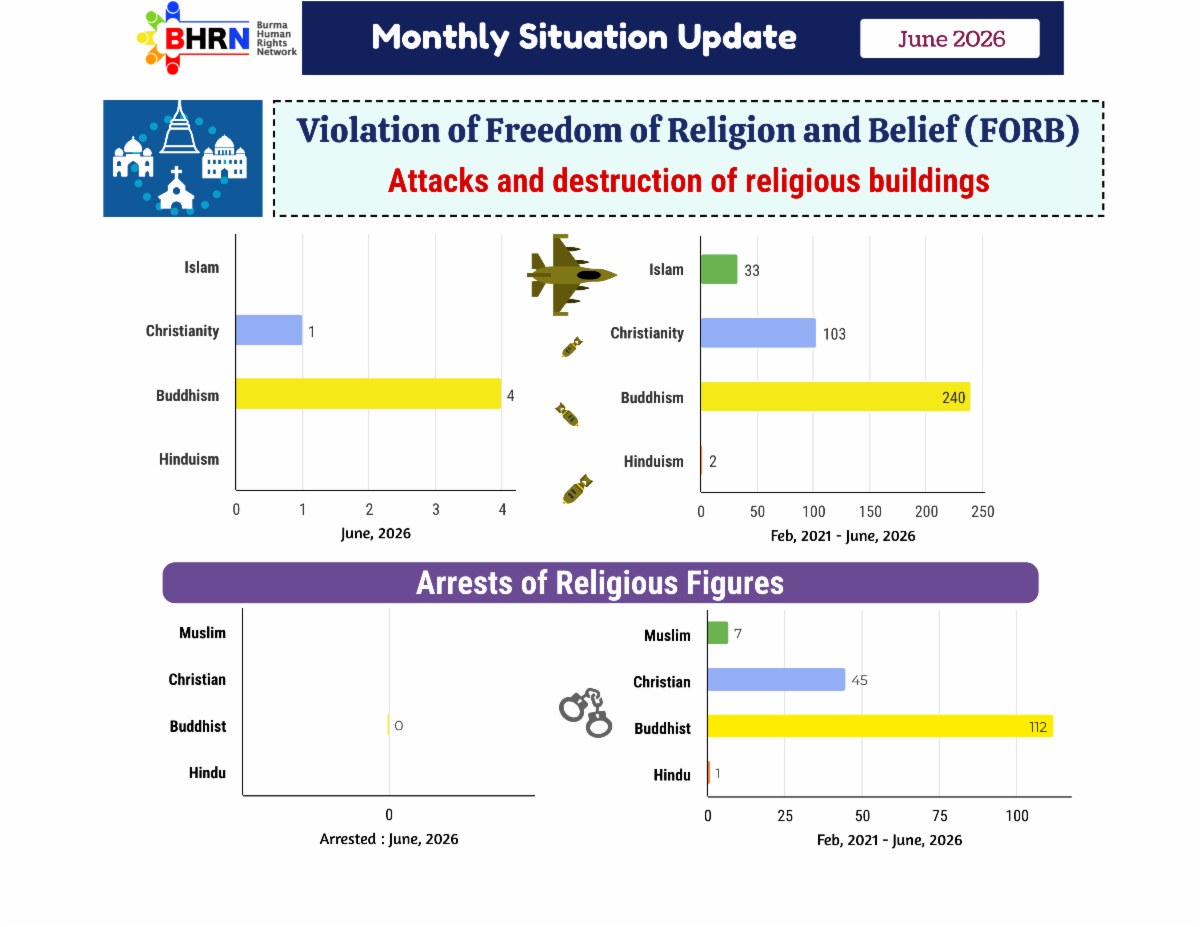
Tap any image to see it full size.
2News Summary and Analysis
This Month in Myanmar – June 2026
In June 2026, the junta continued to seek recognition from foreign governments as it simultaneously carried out airstrikes on villages, displacement camps, and other civilian areas across the country. Min Aung Hlaing followed his late-May visit to India with a state visit to China, where China issued a joint statement endorsing Min Aung Hlaing and welcoming the military’s fraudulent elections, and the month closed with BIMSTEC moving to hand the junta a regional leadership role while Laos and Belarus deepened ties with the junta. Human rights organisations and parliamentarians pressed governments to reject the junta and pursue accountability for its crimes, as Fortify Rights urged the United Kingdom to lead an International Criminal Court referral under Article 14 of the Rome Statute and civil society lodged a complaint with Thailand’s national human rights commission over gas revenue reaching the military.
Foreign governments’ engagement with the junta did not deter its attacks on civilians. Throughout June, the military bombed, shelled, and strafed villages, displacement sites, markets, and homes across Sagaing, Rakhine, Chin, Bago, Mandalay, Magway, Mon, Kachin, and Tanintharyi, killing and wounding civilians, including many children, in the days after Min Aung Hlaing renewed an offer of peace talks. The military also established a committee to monitor online activity around the clock, widened its forced-conscription campaign, and continued to persecute Rohingya and other Muslim communities, including through arbitrary detention, extortion, and the confiscation of property by both the military and the Arakan Army.
Resistance forces continued to seize military and police positions in rural areas of Magway, Bago, and Ayeyarwady, taking prisoners and downing a military helicopter, even as tensions within the resistance surfaced, with NUG-aligned forces detaining a Sagaing PDF commander and raiding Communist Party of Burma positions in Mandalay Region. The Myanmar military is the primary perpetrator of atrocity crimes in Myanmar and the principal driver of the country's displacement crisis. Governments that recognise or engage the junta are enabling those crimes.
3Political, Legal, and International Developments Affecting Myanmar
India Hosts Min Aung Hlaing on His First Foreign Trip as “President”
From 30 May to 3 June, Min Aung Hlaing travelled to India on his first foreign trip since installing himself as president, meeting Prime Minister Narendra Modi in New Delhi on 1 June and President Droupadi Murmu, and addressing trade and investment forums in New Delhi and Mumbai. Modi welcomed the junta chief within India’s Neighbourhood First and Act East frameworks and wished him success, raising Aung San Suu Kyi’s detention only in general terms. Min Aung Hlaing travelled with a delegation of military-linked tycoons, including Aung Ko Win of KBZ Group and Aung Aung Zaw of Myanmar Airways International, seeking investment despite sanctions. Talks covered rare earths and critical minerals, the stalled Kaladan Multi-Modal Transit Transport Project, the India-Myanmar-Thailand Trilateral Highway, border security, and a stated goal of raising bilateral trade to US$5 billion. The visit closed without any new economic agreement signed.
The Special Advisory Council for Myanmar wrote to Australian Foreign Minister Penny Wong on 16 June, urging Canberra to press India, a fellow Quad member, to explain its decision to host an alleged war criminal weeks after the Quad agreed on its own position on Myanmar.
Why It Matters: India’s welcome gave the junta the recognition it has been seeking while its forces continue to bomb civilians. New Delhi frames engagement as strategic competition with Beijing, yet hosting Min Aung Hlaing draws India’s Myanmar posture closer to China’s and undercuts the democratic mandate of the 2020 election. The connectivity projects at the centre of the talks run through territory the junta does not control, and every offensive launched to secure those corridors displaces more civilians. Governments should withhold recognition from the junta rather than confer legitimacy on a leadership responsible for atrocity crimes.
China Endorses the Junta and Its Fraudulent Elections
Min Aung Hlaing made a state visit to China from 15 to 19 June, his first since seizing the presidency through fraudulent elections, and was received by President Xi Jinping at the Great Hall of the People with a guard of honour and a 21-gun salute. China issued a joint statement pledging cooperation on border security, resource extraction, and infrastructure, and Beijing welcomed the military’s fraudulent elections and committed to defending the junta’s interests in multilateral forums. Xi pressed for accelerated work on the China-Myanmar Economic Corridor, and Min Aung Hlaing pledged to protect Chinese enterprises and personnel and to combat online scam operations along the border. In an interview during the trip, Min Aung Hlaing said he expected Chinese investment to double Myanmar’s gross domestic product.
Why It Matters: China is among the junta's principal sources of arms, funds, and diplomatic protection, alongside Russia, and the state visit turned that support into open political endorsement. The joint statement commits Beijing to shielding the regime at the United Nations and within ASEAN, BIMSTEC, and other bodies, narrowing the space for coordinated pressure. For governments pursuing accountability, Chinese backing is the central obstacle at the Security Council and the clearest reason to pursue avenues that do not depend on it.
BIMSTEC Moves to Hand the Junta a Regional Leadership Role
BIMSTEC Secretary-General Indra Mani Pandey visited Naypyidaw from 22 to 24 June and met Min Aung Hlaing and Foreign Minister Tin Maung Swe, endorsing the junta’s recent visits to India and China and its claim to have held credible elections. Myanmar is positioned to assume the bloc’s rotating Secretary-General post in 2027. Days earlier, Laos invited Min Aung Hlaing to Vientiane, an offer extended when Lao Foreign Minister Thongsavanh Phomvihane travelled to Naypyidaw on 12 and 13 June, and regime media reported that Belarusian President Alexander Lukashenko would return to Myanmar for a second time. Justice For Myanmar has documented Belarusian supplies of air defence systems and training to the regime’s defence industry.
Why It Matters: Engagement by regional bodies gives the junta the international legitimacy it seeks. A BIMSTEC leadership role would let a government under investigation for genocide, war crimes, and crimes against humanity speak for the region on security and connectivity, even as its offensives to secure trade corridors displace tens of thousands. Member states that value the bloc’s credibility should exclude the junta from summits and leadership positions and engage the National Unity Government, ethnic resistance organisations, and civil society instead.
UK Pressed to Lead an ICC Referral of Myanmar
On 29 June, Fortify Rights called on the United Kingdom to lead a coalition of states in referring the full situation in Myanmar to the International Criminal Court under Article 14 of the Rome Statute, alongside fresh sanctions on the military’s revenue and aviation fuel and restored humanitarian aid. The call followed testimony by Fortify Rights Chief Executive Officer Matthew Smith to the House of Commons International Development Committee on 23 June, and a 10 June question in the Commons by former Foreign Secretary Jeremy Hunt on whether the government would invoke Article 14. Such a referral would rest on the National Unity Government’s 2021 declaration accepting the Court’s jurisdiction. It would reach crimes committed across Myanmar since the coup, which the existing ICC investigation into the deportation of the Rohingya does not cover.
Why It Matters: Forty-three states referred Ukraine to the ICC within weeks of Russia’s 2022 invasion, while Myanmar’s victims have waited years without a comparable coalition. An Article 14 referral would bypass the deadlock created by Russian and Chinese vetoes at the Security Council and would signal to commanders that impunity is ending. States that back accountability in Ukraine face a direct test of consistency, and the United Kingdom, as an ICC member and the Security Council penholder on Myanmar, is positioned to lead.
China Detains US Citizen Min Zin
On 3 June, Chinese authorities detained Min Zin, a United States citizen and executive director of the Institute for Strategy and Policy-Myanmar, as he arrived in Yunnan Province at the invitation of an academic institution, later accusing him of espionage endangering national security. His think tank documents China’s role in Myanmar since the coup. Human Rights Watch has urged Washington to declare Min Zin wrongfully detained, and Fortify Rights has called on Beijing to present credible evidence or release him.
Why It Matters: Min Zin's detention, days before Min Aung Hlaing's state visit to Beijing, is an act of transnational repression aimed at deterring independent scrutiny of China's role in Myanmar. Jailing a scholar on vague espionage charges denies him his rights to liberty and due process and sends a warning to others who document Beijing's conduct. China should release Min Zin immediately and drop all charges.
Forced Conscription Widens as Labour Groups Appeal to the ILO
A Myanmar workers’ rights federation reported receiving 534 requests for assistance involving men aged 18 to 35 seized for conscription while travelling to or from work, most of them in Yangon’s industrial zones, since the People’s Military Service Law took effect in 2024. Many of the men became unreachable after being taken. The regime has conscripted close to 120,000 men across 24 intakes, and labour groups are urging the International Labour Organization to take stronger action. ASEAN Parliamentarians for Human Rights has described the campaign as an effort to steal a generation.
Why It Matters: Forced conscription through abduction is a war crime and, where part of a widespread or systematic attack on civilians, a crime against humanity. Families are fleeing to save their children from conscription, only to face detention, trafficking, and deportation back to Myanmar, where many risk being forced into the ranks they fled, as the return of thousands of Myanmar nationals from Thailand has shown. The ILO's Commission of Inquiry has found the junta in serious breach of the Forced Labour Convention. States and ASEAN should act on that finding, pressing for the release of all conscripts and holding those responsible for abduction and forced recruitment to account.
Regime Establishes a Committee to Monitor the Internet Around the Clock
The regime formed a committee to monitor online activity around the clock, led by Deputy Home Affairs Minister Major General Min Thu, a former military intelligence officer who once oversaw interrogation operations. On 18 June, Min Thu told the junta’s parliament that authorities had taken action against 21,369 online users between 2024 and May 2026 for posts the regime labels political attacks, misinformation, and fake news, with nearly 20,000 prosecuted under counter-terrorism charges. Telecommunications operators and banks are legally required to cooperate. The committee builds on a surveillance apparatus the military has assembled since the coup. The regime has built a near-universal biometric and household database, enforces real-name SIM registration tied to a national identity system, and operates the Person Scrutinization and Monitoring System, which checks identity records against watchlists at checkpoints, hotels, and transport hubs. Much of the hardware and software, including facial-recognition cameras and a China-style firewall for filtering internet traffic, was supplied by Chinese firms such as Huawei, Hikvision, and Dahua. On 25 June, a Yangon food vendor’s prison term was extended to 13 years over a single satirical Facebook post about Min Aung Hlaing.
Why It Matters: The committee gives the military sweeping powers to monitor and punish what people say online. Since the coup, the authorities have prosecuted more than 21,000 people over their posts, including for simply sharing or liking content, in violation of the rights to free expression and privacy. The 13-year sentence handed to a Yangon food vendor over a single Facebook post shows how far the regime will go. Much of the surveillance technology, including facial-recognition cameras and internet filtering, comes from Chinese firms. Governments should ban the export of surveillance and dual-use technology to Myanmar, sanction the companies supplying it, and fund digital security for the activists, journalists, and others the junta is targeting.
New Offshore Gas Discovery Adds to a Sanctioned Junta Revenue Stream
On 15 June, the regime announced the discovery of four new offshore gas fields holding a combined estimated 109 trillion cubic feet of natural gas, with the largest in the Tanintharyi deep-sea zone. Gas is the single largest source of foreign currency for the junta, channelled through the Myanma Oil and Gas Enterprise, which the European Union and the United States sanctioned in 2022 and 2023 for financing the military. The announcement follows the regime’s continued signing of production-sharing contracts since the coup. Separately, on 25 May, the Blood Money Campaign and Campaign for a New Myanmar filed a complaint with Thailand’s National Human Rights Commission, urging an investigation into the revenue that Thai oil and gas operators, including PTT and its subsidiary PTTEP as operator of the Yadana field, channel to the junta, and calling for payments to be placed in escrow.
Why It Matters: Fresh gas prospects promise the junta long-term hard currency at a moment when its war economy is under strain, and they blunt the effect of existing sanctions. Revenue routed through MOGE funds the aircraft and fuel used in airstrikes on civilians. Governments serious about civilian protection should close the gaps that allow gas payments and aviation fuel to keep reaching the military, including through secondary measures against enablers and the jurisdictions that host them.
Bangladesh Revives Repatriation as Anti-Rohingya Hate Surges in Malaysia
At a United Nations briefing on 19 June by the Secretary-General’s Special Envoy, Bangladesh renewed its call for the early repatriation of Rohingya refugees to Myanmar, citing the burden of hosting roughly 1.2 million people. Conditions for safe, voluntary, and dignified return do not exist while the junta continues its crimes against the Rohingya and the Arakan Army imposes its own abuses in Rakhine State. In a statement to the General Assembly the same week, the European Union reiterated its call for a global arms embargo and for accountability. In Malaysia, more than 20 organisations warned on 9 June of a surge in online hate speech and threats against Rohingya refugees, after a petition demanding their removal drew close to 400,000 signatures and community leaders reported doxxing and threats.
Why It Matters: No government should force Rohingya back to Myanmar, where the military is committing genocide and other atrocities against them. There are no conditions for a safe, voluntary, and dignified return, and pushing people back now would violate the principle of non-refoulement. In Malaysia, online hate speech and threats are already putting Rohingya refugees in danger, and the authorities should publicly condemn the incitement, investigate the threats, and protect the community. Governments across the region should keep the Rohingya safe, maintain aid, and reject any forced or premature return to Myanmar.
Mandalay Muslims Denied Permission to Rebuild Quake-Damaged Mosques
More than a year after the March 2025 earthquake that struck central Myanmar, dozens of mosques in Mandalay remain in ruins because the regime has withheld permission to rebuild. Of the roughly 65 mosques in Mandalay city, more than 50 collapsed, and 33 require full reconstruction, yet worshippers are allowed only to raise temporary shelters for prayer. Officials say reconstruction cannot proceed until each site is designated as religious land, a status only about 40 of the city’s mosques hold, and applications must pass through as many as 16 offices. Muslim leaders say their communities face disproportionate delays and that repeated appeals to the regime, including letters to Min Aung Hlaing, have gone unanswered.
Why It Matters: The Myanmar military is violating Mandalay Muslims' right to freedom of religion by blocking them from rebuilding their mosques. More than a year after the earthquake, dozens of mosques remain in ruins and worshippers are forced to pray in tents and on the street, while the authorities withhold reconstruction permits that Muslim leaders say their community is denied far more often than others. Concerned governments and UN experts should call on the military to approve the reconstruction without further delay and to end its discrimination against Muslim communities.
4Resistance Updates
In June, resistance forces continued to seize junta positions across the central dry zone and the west, overrunning police stations and military camps, taking prisoners and weapons, and damaging aircraft, while the month also saw armed clashes and arrests among rival resistance groups in Sagaing and Mandalay:
Hswar, Bago Region
People’s Defence Force fighters captured the Tatmadaw’s Hswarmakyi camp near Hswar. Resistance sources reported that 19 soldiers and a major were killed, and multiple weapons were seized.
Magway Region (Yepyay and Kokkosu)
PDF forces captured Kokkosu village and the police station at Yepyay, which sits at the junction of the Myaing-Pauk and Pauk-Pakokku roads.
Myitche, Magway Region
PDF forces captured the Myitche police station, killing two junta personnel, taking 14 prisoners of war, and seizing weapons.
Sagaing Region
Sit Nyein Naing, leader of the Sagaing PDF under the Spring Revolution Alliance, was arrested by PDF forces aligned with the National Unity Government, an episode that exposed friction within the resistance.
Myingyan District, Mandalay Region
PDF units under the National Unity Government’s Myingyan District Command raided camps of the Communist Party of Burma’s People’s Liberation Army. The Communist Party of Burma condemned the raids as sparking infighting and risking further confrontation.
Myaing Township, Magway Region
Guerrilla forces, including the Magway PDF, used first-person-view drones to damage a Myanmar Air Force Mi-17 helicopter.
Yegyi Township, Ayeyarwady Region
The Arakan Army announced the capture of three Tatmadaw bases, following a failed junta counteroffensive toward Gwa Township in Rakhine State between 17 and 21 June.
Why It Matters: In June, resistance forces overran fortified military positions in Bago, Magway, and Ayeyarwady and shot down a military helicopter. Unable to hold ground, the junta relied on indiscriminate airstrikes that killed and wounded civilians, as documented above. The military no longer controls much of Myanmar; the National Unity Government, ethnic armed organizations, and local administrations hold or contest large parts of the country. Governments should support the democratic opposition and refuse the junta the recognition it seeks. Abuses by resistance forces also warrant scrutiny. The National Unity Government detained a Sagaing PDF commander, and its forces raided camps of the Communist Party of Burma, which the party condemned as provoking infighting. All parties to the conflict are bound by international humanitarian law, and all those responsible for serious violations should be held to account.
5On the Ground: Escalating Violence and Human Rights Violations
In June, the Burma Air Force and allied ground forces carried out sustained aerial, artillery, and drone attacks on civilian areas across Sagaing, Rakhine, Chin, Bago, Mandalay, Magway, Mon, Kachin, and Tanintharyi, killing and wounding civilians, including many children, and destroying homes, markets, and places of shelter. Beyond these attacks, the month saw arbitrary detentions, the prolonged detention of Rohingya including children, and a pattern of killings, extortion, and property confiscation targeting Rohingya communities in Rakhine State by both the military and the Arakan Army. The strikes continued, and in places intensified, even as the regime publicly offered peace talks. The incidents below reflect ongoing violations of international humanitarian and human rights law, including acts that may amount to war crimes and crimes against humanity. Several were documented directly by BHRN and are marked accordingly.
ITargeted attacks on Civilians and Civilian Infrastructure
Under international humanitarian law, civilians and civilian objects must never be the object of attack. Article 8(2)(e)(i) of the Rome Statute prohibits attacks intentionally directed against the civilian population in non-international armed conflicts. Where such attacks form part of a widespread or systematic campaign against civilians, they may amount to crimes against humanity under Article 7(1), including murder (Art. 7(1)(a)), persecution (Art. 7(1)(h)), and other inhumane acts (Art. 7(1)(k)).
Ramree Township, Rakhine State (Kyaung Cha Twin)
Burma Air Force bombs struck an internally displaced persons camp, killing two elderly displaced people.
Yebyu Township, Tanintharyi Region
A gyrocopter strike killed a pregnant woman and a man.
Ye Township, Mon State
An airstrike killed a plantation worker.
Okpho Township, Bago Region
Advancing junta columns killed at least five villagers during a raid and burned hundreds of homes across Chaung Gwa, Chaung Son Lay, and Kywe Te Kone villages. Thousands displaced from around 25 villages are sheltering in Bago Yoma forest camps facing severe shortages of food and medical supplies.
Thailand-Myanmar border
A junta military drone exploded on the Thai side of the border, killing three Myanmar migrant workers and injuring two others.
Kyaukphyu Township, Rakhine State (Baya, Kalardin, Thitkatoe)
Eight bombs dropped on three villages injured three displaced civilians.
Yetashay Township, Bago Region (Najet [Lower])
On the same day Indonesia’s foreign minister met the junta, military aircraft dropped around ten bombs, killing one civilian and injuring two others.
Wetlet Township, Sagaing Region (Wetluai)
A drone attack killed one woman and injured two of her family members.
Kyauktaw Township, Rakhine State
Regime fighter jets strafed residential wards for about half an hour, killing at least eight civilians, including a toddler, and injuring 17, destroying homes, warehouses, and a market. Other reports put the toll at ten or more, with seven aircraft dropping over 20 bombs in an hour.
Wetlet Township, Sagaing Region (Nyaungpingyitaw)
Burma Air Force airstrikes killed five civilians, including a five-year-old.
Shwegu Township, Kachin State
Regime artillery killed three civilians and injured five.
Kyaikto Township, Mon State (Kyaukhpyar, Chaungsauk)
The junta bombed the same area on two consecutive days, forcing residents of at least six villages to flee their homes.
Southern Chin State
An airstrike killed five displaced people and wounded more than ten others.
Gwa Township, Rakhine State
Successive night airstrikes on a rural village wounded four civilians.
- 25 June
Natmauk Township, Magway Region (Thamone Kone)
At around 4:30 p.m., military jet fighters dropped two 500-pound bombs in two separate bombing runs and strafed the village with machine-gun fire, killing five civilians and seriously injuring three others, while more than ten houses were damaged or destroyed. Those killed were eight-year-old Maung Nyi Bhone Khant, twelve-year-old Maung Aung Bhone Khant, their 33-year-old mother, Daw Than Than Maw, 39-year-old Ko Chit Oo, and 69-year-old Daw Yi. Local sources reported no clashes in or around the village at the time.
Source: BHRN - 27 June
Saw Township, Magway Region (Nat Kaung Kyin)
At around 5:30 p.m., a jet fighter approaching from the Kanpetlet direction dropped two bombs on Nat Kaung Kyin Village in the Yinke village tract, on the western outskirts of Laung Shay Town, killing three civilians, including a child aged around nine and two men in their 40s, and injuring around ten others, several of them elderly and in critical condition. At least five houses were damaged, and three were destroyed by fire. Local sources reported no clashes in or around the village at the time.
Source: BHRN Madaya Township, Mandalay Region
Air Force strikes injured two civilians.
Talaing village, Sagaing Region
Two Burma Air Force airstrikes killed at least eight civilians, four of them under 18 and the youngest five years old, injured more than 20 others, and destroyed five homes.
Mindat Township, Chin State
Nearly 40 bombs dropped on the township killed three children, aged 10, 12, and 16, and injured an unknown number of others, amid fighting that had intensified since 16 June.
IIUse of Prohibited Weapons
The use of chemical weapons is prohibited in all circumstances under the Chemical Weapons Convention, to which Myanmar is a party, and under customary international humanitarian law. Employing prohibited weapons in a non-international armed conflict may constitute a war crime under the Rome Statute. The following allegation requires independent verification.
Thantlang, Chin State
Amid heavy urban fighting, the junta was accused of deploying chemical munitions against Chinland Defence Force positions. The allegation has not been independently verified.
IIIArbitrary Detention
Arbitrary arrest and detention are prohibited under international human rights law. Committed as part of a widespread or systematic attack on a civilian population, imprisonment or other severe deprivation of physical liberty may amount to a crime against humanity under Article 7(1)(e) of the Rome Statute. The prolonged detention of children engages additional protections under the Convention on the Rights of the Child.
- 16 June
Myeik, Tanintharyi Region
Military Security Affairs officers (Sa Ya Pha) detained 67-year-old U Tin Maung Cho, also known as Hashim or Maw Tone Sayar, a Muslim traditional bone setter, after arriving at his home in Alae Kyun Ward and asking him to accompany them under the pretext of treating a patient. A relative said the arrest followed an informant’s claim that he had been in contact with relatives in Maw Tone Village who are members of the People’s Defence Force during discussions over inheritance. He is held at Myeik Township Police Station and is expected to face criminal charges, and family members have been allowed to deliver food but not to meet him.
Source: BHRN - Since March 2026
Myeik, Tanintharyi Region
Sixty-three Rohingya, including children, remained in detention from the Ramadan period in March through at least 27 June, held at an Islamic madrasa in Alae Kyun Ward and at the Myeik Township Police Station. More than 150 Rohingya were reportedly arrested in March on an island off Yebyu Township in Dawei District and transferred to Myeik, with adults sentenced to prison and those under 16 placed at the madrasa. Those held include 24 boys and 23 girls at the madrasa and 14 boys and two girls at the police station. Local Muslim communities were ordered to feed the detained minors, exhausting an Islamic scholars’ association’s resources after about two months. Military authorities said the detainees would be returned to Rakhine State or moved to youth rehabilitation centres in Yangon, but no transfers have taken place.
Source: BHRN
IVAbuses Against Rohingya in Rakhine State
Rohingya civilians in Rakhine State face abuses by both the Myanmar military and the Arakan Army, including killings, arbitrary detention, extortion, and confiscation of property. Persecution of an identifiable group on ethnic or religious grounds may amount to a crime against humanity under Article 7(1)(h) of the Rome Statute. All parties to the conflict, including non-state armed actors, are bound by international humanitarian law.
- 30 May
Kyauk Yoe Pyin village, Maungdaw Township
The Arakan Army reportedly arrested eight villagers on allegations, believed to be unfounded, of connections with terrorist groups. Four were released on 3 June, but four remained in detention with no information provided on their whereabouts or condition.
Source: BHRN - 8 June
Naf River, northern Maungdaw Township
Arakan Army forces on the Maungdaw side allegedly opened fire on four Rohingya from refugee camps in Bangladesh who were fishing, killing one and injuring three. The man killed was 27-year-old Nozir Ahemed, also known as Rozak Ali, of Camp 17, formerly of Kyet Yoe Pyin village. The three injured were not identified.
Source: BHRN - 13 June
U Shey Kya village, northern Maungdaw Township
A land records clerk from the Farmland Management Department extorted money from Rohingya residents under the false pretext of processing Form-105 residential land permits, though no such process was taking place. Those affected included Mv Edris and Noor Mohamed, at 200,000 kyats each, and Roshid Ahmed, at 500,000 kyats. The clerk was reportedly supported by informants within the village.
Source: BHRN - 18 June
Yae Twin Pyin village, Maungdaw Township
Several ULA members, along with brokers and three representatives of the Department of Farmlands, visited the Rohingya village to collect lists of Rohingya-owned farmland and fishing ponds now left without their owners, and conveyed that any property whose owners had fled to Bangladesh would be treated as belonging to the Arakan Army.
Source: BHRN - 27 June
northern Maungdaw Township
Township Office No. 3 ordered village administrators to rent out farmland owned by Rohingya who had fled. Administrators then informed local farmers that cultivating the abandoned land would require a rental fee of 250,000 kyats per acre.
Source: BHRN
VEmerging Threats to Civilian Communities
The following account describes a developing risk to civilians and is included here as an early warning.
- 28 June
West Maw Tone village, Tanintharyi Township
Residents reported fear of an imminent military offensive after increased troop movements and surveillance, including aerial reconnaissance by drones and gyrocopters and a military buildup on the eastern bank of Maw Tone, with artillery positioned and firing toward resistance outposts on the western bank. Residents linked the buildup to Deputy Commander-in-Chief Kyaw Swar Lin’s reported plan for area-clearance operations from Ye Township in Mon State to Kawthaung Township and expressed concern for East Maw Tone, West Maw Tone, and Kantaw Kam villages, which are predominantly inhabited by Pashu and Bamar Muslims.
Source: BHRN
6Policy Recommendations
1Withhold Recognition of the Junta’s Post-Election Institutions
States and regional bodies should refuse to treat the junta’s parliament, cabinet, and administrative structures as a legitimate civilian government, reject its narrative of a return to peace, and engage instead with the National Unity Government, ethnic resistance organisations, and civil society as representatives of Myanmar’s people. ASEAN should move beyond its policy of non-interference and address the military junta as the root cause of the country’s displacement and atrocity crises.
2Impose a Comprehensive Arms Embargo and Cut Off Aviation Fuel
The UN Security Council and individual states should halt the sale and transfer of arms, munitions, dual-use goods, and aviation fuel to the military, whose airstrikes on villages, displacement sites, and markets are documented throughout this report. Interdicting aviation-fuel supply chains and aircraft-maintenance networks is an urgent civilian-protection priority, and the likelihood of a Russian or Chinese veto should not be treated as a reason for inaction.
3Deny the Junta Revenue
States should expand and enforce coordinated, targeted sanctions on the junta’s revenue streams, including the Myanma Oil and Gas Enterprise and military-linked banks, and apply secondary measures against the brokers, insurers, and financial institutions that facilitate evasion. Governments should support the diversion of gas payments into escrow and respond to civil-society complaints such as the one filed with Thailand’s National Human Rights Commission over Yadana revenue.
4Advance Accountability and Apply Equal Standards to All Armed Actors
ICC States Parties should refer the full situation in Myanmar to the Prosecutor under Article 14 of the Rome Statute, and states should fund and support universal-jurisdiction proceedings, including those advanced in Timor-Leste and Indonesia, and the ongoing case at the International Court of Justice. Accountability must extend to serious abuses by all parties, including the Arakan Army’s documented abuses against Rohingya civilians in Rakhine State.
5Restrict the Export of Surveillance and Dual-Use Technology
Governments and companies should halt transfers of surveillance systems, facial-recognition and camera networks, deep-packet-inspection tools, and other dual-use technology that the junta uses to track, detain, and prosecute civilians, and should conduct rigorous human rights due diligence across supply chains. States should expand support for digital-security training and circumvention tools for civil society, journalists, and human rights defenders.
6Scale Up Cross-Border Humanitarian Assistance
International donors should reverse recent aid cuts and provide sustained, flexible funding delivered through cross-border mechanisms in partnership with ethnic resistance organisations, the National Unity Government, and trusted local responders, bypassing the junta. Assistance should reach the roughly 4.5 million people internally displaced within Myanmar and refugee populations in the region, including Rohingya refugees in Bangladesh, for whom aid is a core component of atrocity prevention.
About BHRN
Burma Human Rights Network (BHRN) is based in London, operates across Burma/Myanmar and works for human rights, minority rights and religious freedom in Burma. BHRN has played a crucial role in advocating for human rights and religious freedom with politicians and world leaders.