
Methodology
This report is based on primary and secondary sources, including on-the-ground documentation by BHRN and other human rights groups and media reports from trusted national and international outlets. It provides a detailed analysis of key events during the month, situating them within international legal frameworks and offers policy recommendations to guide international responses, humanitarian action, and justice efforts.
For more information about any of the incidents documented in this report, or to request interviews or supporting materials, please contact Kyaw Win, Executive Director of BHRN at
Highlights of the month

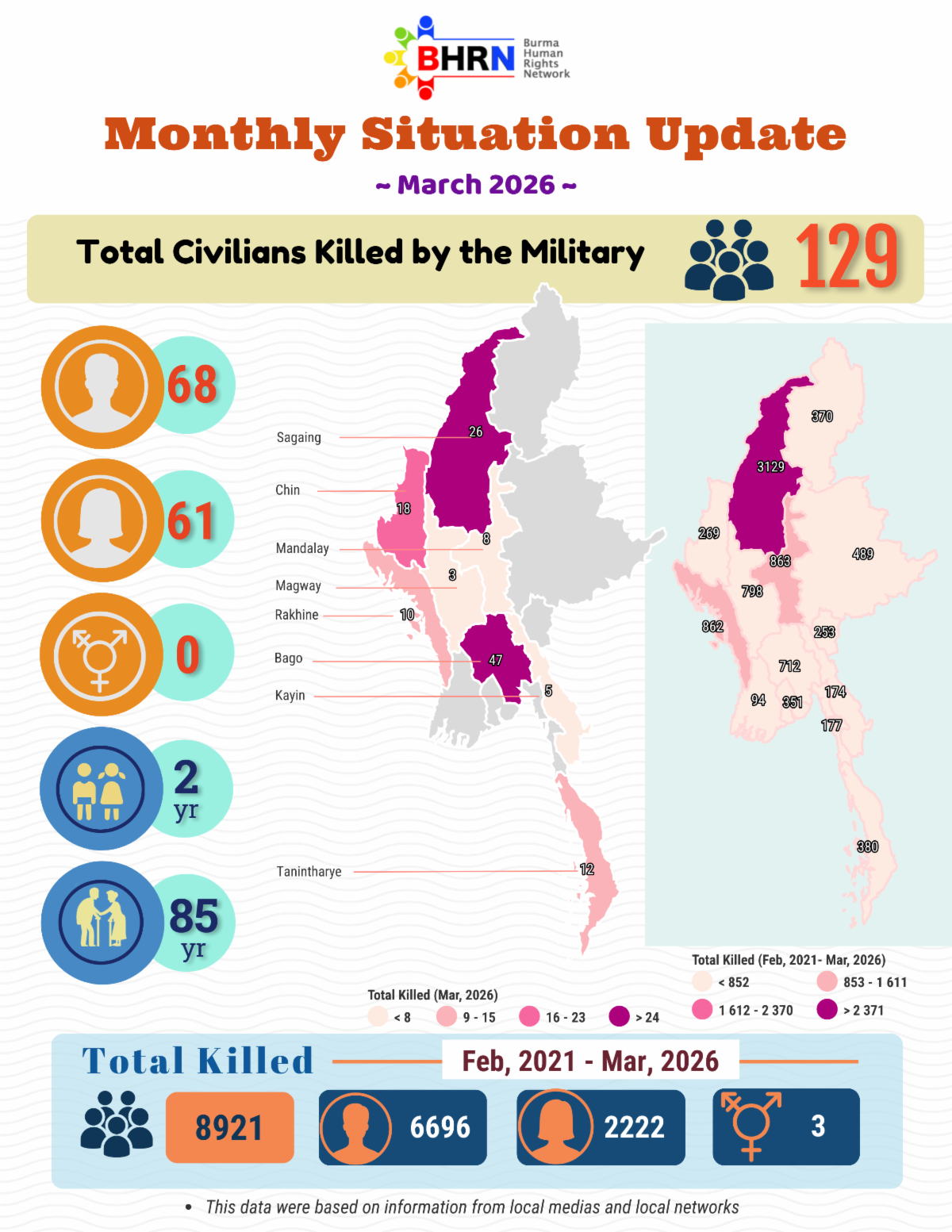
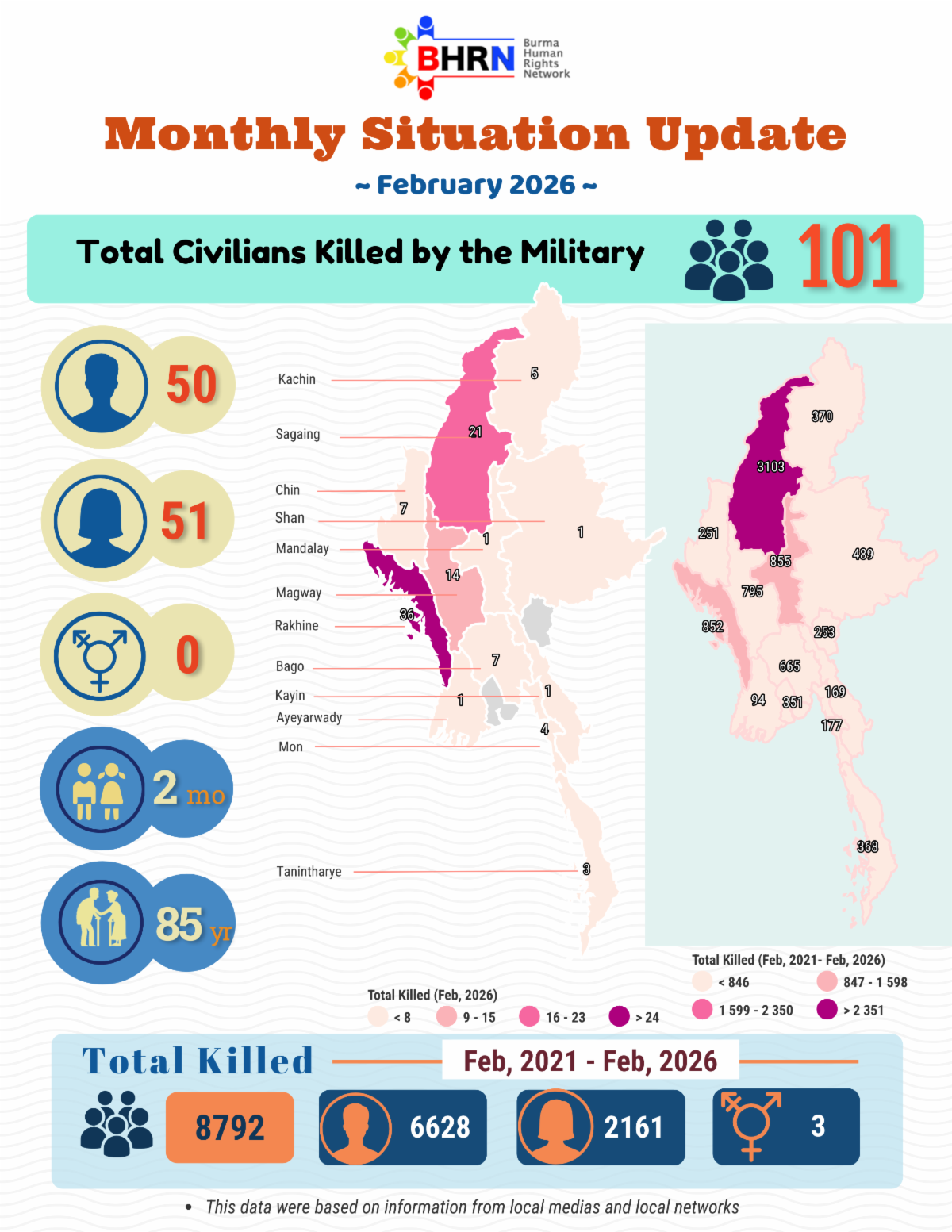
1Info-graphs of BHRN’s Report


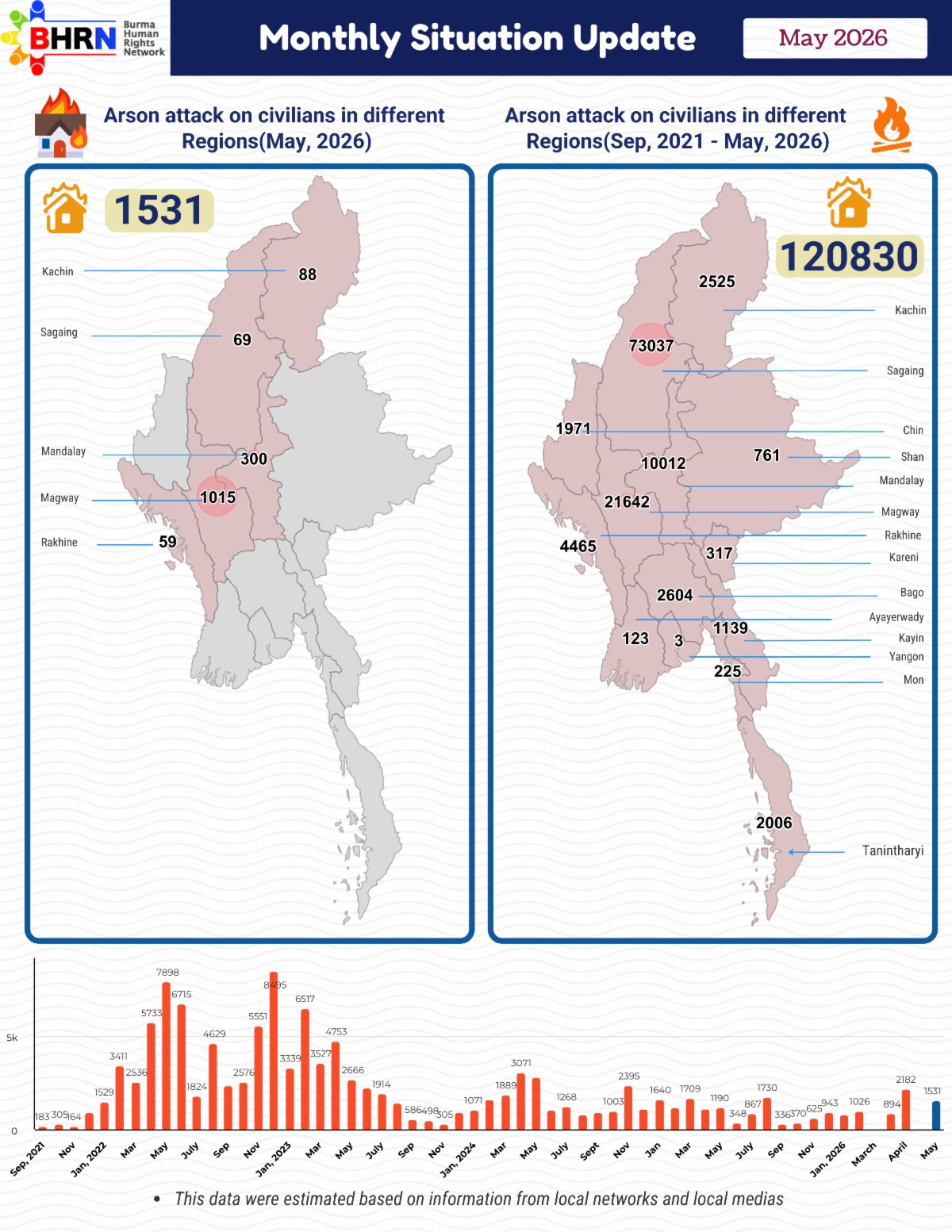


Tap any image to see it full size.
2News Summary and Analysis
This Month in Myanmar – May 2026
The Myanmar military junta carried out near-daily airstrikes, artillery bombardments, naval shelling, and village burnings against civilians across Myanmar in May 2026, while simultaneously pursuing international recognition from governments that have an obligation to hold it accountable. India became the first government to receive Min Aung Hlaing as a head of state since the Myanmar military junta’s illegal seizure of power in February 2021, extending full head-of-state honours to a man the ICC Prosecutor has sought to arrest for crimes against humanity. The Quad Foreign Ministers had called for the release of those detained in Myanmar just days before the visit. The 48th ASEAN Summit in Cebu produced no enforceable action on Myanmar for the fifth consecutive year. Thailand advocated for junta reintegration into ASEAN, and Malaysia’s foreign minister travelled to Naypyidaw without engaging the National Unity Government or any democratic actors. Foreign ministers agreed to hold a virtual meeting with junta Foreign Minister Tin Maung Swe outside the ASEAN Special Envoy’s mandate and without the National Unity Government present. On 5 May, the Rohingya Maiyafuinor Collaborative Network, the Chin Human Rights Organization, and the Myanmar Accountability Project jointly condemned the junta’s campaign to obstruct war crimes proceedings in Timor-Leste and Indonesia. The junta had expelled Timor-Leste’s chargé d’affaires in January 2026 after Dili opened a criminal file against Min Aung Hlaing. The Steering Council for the Emergence of a Federal Democratic Union carried out its first overseas diplomatic mission, with NUG Foreign Minister Zin Mar Aung leading a delegation to Canada from 30 May alongside representatives of the Karen National Union and the Karenni State Interim Executive Council.
On the military front, the Myanmar military junta recaptured Mawlu on 5 May, reopening the Mandalay-Myitkyina Highway after a 15-month closure and displacing more than 5,000 civilians from Myingyan District. More than 2,000 junta troops advanced to within 8 kilometres of Mindat town in Chin State under sustained aerial bombardment. As of 16 June, the Chin People’s Army and allied Chin Brotherhood forces are still holding. The Arakan Army intensified operations around Sittwe, with clashes reported within 2 kilometres of the Regional Operations Command, and junta military families evacuated from the base. The Karen National Liberation Army captured the Kyauk Lone Gyi military base on 29 May and launched an assault on Waw Lay on 2 June. Junta forces retook Mawtaung on the Thai border on 13 May after resistance forces withdrew without armed contact. The junta imposed a deliberate blockade on food, medicine, and essential goods across Pakokku District from 13 May, constituting collective punishment of civilian populations in and around resistance-held areas. On 2 May, ward officials and Ma Ba Tha monks arrested 50 displaced Rohingya, including 40 youths and 10 teachers, in Dawbon Township, Yangon, despite the individuals holding official identification documents. Ko Htay Aung Naing, 49, died in Pyay Prison on 22 May, and Ko Myint Naing died on 23 May, both due to inadequate medical care. Since the coup, more than 2,200 people have died in junta custody.
3Political, Legal, and International Developments Affecting Myanmar
ASEAN Summit in Cebu Produces No Enforceable Action on Myanmar
The 48th ASEAN Summit convened in Cebu, Philippines, on 8 May 2026. The Myanmar military junta’s illegal administration was excluded from the leaders’ table for the fifth consecutive year. The junta sent the permanent secretary of its foreign affairs ministry in its place. The joint summit statement expressed “deep concern” over the escalating conflict and “minimal progress” on the Five-Point Consensus but did not name the Myanmar military junta as the cause of the crisis. ASEAN welcomed the April amnesties and the reported transfer of State Counsellor Aung San Suu Kyi to house arrest, without noting that only 292 of those released were confirmed political prisoners, while more than 22,000 people remain detained. The statement omitted the official titles of President Win Myint and State Counsellor Aung San Suu Kyi, lending credibility to the junta’s rebranding of Myanmar’s political order in violation of Article 2 of the ASEAN Charter and the will of the people of Myanmar.
Malaysia's Foreign Minister Datuk Seri Mohamad Hasan stated that ASEAN was "not ready" to readmit junta leaders to its meetings because "atrocities towards their own citizens are still occurring." Thailand’s Foreign Minister Sihasak Phuangketkeow pushed to allow junta Foreign Minister Tin Maung Swe to brief ASEAN counterparts in a sideline format outside the mandate of the Five-Point Consensus, which requires the ASEAN Special Envoy to lead all stakeholder engagement. Foreign ministers agreed to hold a virtual meeting with Tin Maung Swe, reportedly to coincide with the ASEAN Foreign Ministers’ Meeting in July 2026. No benchmarks, timelines, or consequences for non-compliance were set. On 6 May, the Special Advisory Council for Myanmar, alongside former Foreign Ministers of Malaysia and Thailand and Philippine Representative Leila M. de Lima, warned that ASEAN “cannot mistake junta half-measures as genuine concessions against the backdrop of the junta’s unabated brutality.” On 19 May, FORUM-ASIA, ALTSEAN-Burma, and Progressive Voice described the Cebu outcome as “the catastrophic failure of ASEAN’s response to the Myanmar crisis” and called for time-bound benchmarks with transparent monitoring and enforceable consequences.
Why it matters
The summit produced no meaningful action, five years after the illegal military junta seized power and began its campaign of violence against the people. Rather than confront the junta, ASEAN moved to bring it back into the room. The proposed virtual meeting with the junta’s foreign minister would sideline the Special Envoy and exclude the National Unity Government, handing the illegitimate regime the recognition it has sought since the coup. ASEAN welcomed the junta’s amnesty as a positive step, though only 292 of those released were confirmed political prisoners while more than 22,000 remain imprisoned and the junta keeps arresting and conscripting civilians. The Five-Point Consensus has delivered nothing in five years because it was built to engage the junta rather than hold it accountable. ASEAN must cease all efforts to legitimise the junta, implement its own October 2025 commitment to deliver cross-border humanitarian aid independently of the regime, and stand with the people of Myanmar rather than those committing atrocities against them.
India Grants Min Aung Hlaing Full State Reception, Becoming First Government to Do So Since 2021 Coup
Min Aung Hlaing paid a five-day official visit to India from 30 May to 3 June 2026, his first overseas travel since the Myanmar military junta installed him as president following fraudulent elections. Prime Minister Narendra Modi received him on 1 June at Hyderabad House in New Delhi. Min Aung Hlaing also met President Droupadi Murmu, External Affairs Minister Subrahmanyam Jaishankar, and National Security Adviser Ajit Doval. India formally addressed him as “President of the Republic of the Union of Myanmar.” Indian Foreign Secretary Vikram Misri said India’s engagement was “not intended to be a commentary on the internal political arrangements” in Myanmar. Before the visit, 122 civil society organizations, humanitarian networks, and ethnic community groups urged India to rescind the invitation. Salai Dokhar, founder of India for Myanmar, said the community was “deeply pained to see the mother of democracy welcome the 21st century’s worst dictator.”
On 4 May, Myanmar’s Commander-in-Chief General Ye Win Oo received an Indian naval delegation in Naypyidaw led by Navy Chief Admiral Dinesh Kumar Tripathi. Junta-controlled media reported joint commitments to “enhance border security” and “clear” the 1,643-kilometre shared border of what the junta described as terrorists, framing that encompasses Chin resistance forces in areas the Burma Air Force was simultaneously bombing with jet fighters and Y-12 aircraft. On 26 May, five days before Modi received Min Aung Hlaing, the Quad Foreign Ministers issued a joint communiqué from New Delhi calling for an immediate cessation of violence in Myanmar and the release of those arbitrarily detained. India hosted Min Aung Hlaing with full head-of-state honours five days later.
Why it matters
India became the first government to receive Min Aung Hlaing in full state capacity since the 2021 coup. The ICC Prosecutor’s November 2024 application for an arrest warrant for Min Aung Hlaing for the crimes against humanity of deportation and persecution of the Rohingya remains before the Pre-Trial Chamber. Extending full presidential honours to a man the ICC Prosecutor has sought to arrest for crimes against humanity, while hosting Quad talks calling for an end to that same man’s campaign of violence, sets a precedent with consequences well beyond Myanmar. India must condition all engagement with Naypyidaw on a verified halt to airstrikes, the unconditional release of all political prisoners, and independent humanitarian access.
China Advances Myitsone Dam Revival as a Political Transaction
Chinese Foreign Minister Wang Yi visited Naypyidaw in April 2026 and pledged continued political support and deeper investment to the Myanmar military junta’s administration. The junta subsequently intensified efforts to revive the Myitsone Dam, a USD 3.6 billion Chinese-backed hydropower project in Kachin State suspended in 2011 following mass public opposition. The junta held at least 14 staged public consultations on restarting construction between December 2025 and May 2026. The project would displace an estimated 18,000 people, submerge an area the size of Singapore, and sits approximately 100 kilometres from the Sagaing Fault, near the site of a 7.7-magnitude earthquake in March 2025.
The Kachin Independence Organization, whose armed wing controls much of the territory surrounding the dam site, rejected the revival. KIO spokesperson Colonel Naw Bu stated: “This concerns the people deeply. It was strongly opposed before, and public sentiment remains central to the KIO’s position.” The National Unity Government declared all junta-signed agreements legally void and warned that investors will bear sole responsibility for any losses. The Kachin State Human Rights Defenders Network has called for the permanent cancellation of the project.
Why it matters
The Myitsone Dam project cannot proceed without the Myanmar military junta establishing control over Kachin State territory currently held by the Kachin Independence Army, meaning any revival of the project requires the continuation of the military’s campaign against the Kachin people. The project was suspended in 2011 following widespread public opposition and would displace an estimated 18,000 people, submerge an area the size of Singapore, and sits near a fault that produced a 7.7-magnitude earthquake in 2025. The Myanmar military junta’s staged public consultations do not constitute meaningful consent from the affected population. States should consider sanctions against entities financing or contracting for the Myitsone Dam project and press China to condition any infrastructure investment in Myanmar on a complete end to military operations against civilians in Kachin State, said BHRN.
Russia and Belarus Deepen Military and Diplomatic Support for the Junta
Russia confirmed plans to host an ASEAN-Russia commemorative summit in Kazan from 17 to 19 June 2026. The Myanmar military junta currently serves as ASEAN’s country coordinator for dialogue relations with Russia, giving it a formal institutional role within ASEAN’s external engagement architecture that its exclusion from leaders’ summits does not affect. Junta Foreign Minister Tin Maung Swe met with Russia’s ambassador in Naypyidaw to discuss preparations for the Kazan summit. Russia also invited a junta delegation led by National Security Advisor Tin Aung San to the First International Security Forum and the Sixth ASEAN-Russia Consultations of High Representatives for Security Issues.
Belarus supplied the Myanmar military junta with an air defence command-and-control system and related training. The visit of junta-appointed Defence Minister General Tun Aung to Minsk during May confirmed that military cooperation between Belarus and the Myanmar military junta is ongoing. The air defence system enhances the junta’s capacity to protect the aircraft it uses to bomb civilian populations across Sagaing, Chin, Rakhine, and Karen states. Russia has been among the junta’s primary arms suppliers since the February 2021 coup and has, alongside China, blocked U.N. Security Council action on Myanmar.
Why it matters
Excluding the junta from ASEAN summits means little while the regime keeps a working role inside the bloc. As ASEAN’s coordinator for relations with Russia, it holds a recognised seat in ASEAN’s external machinery and a platform alongside a permanent member of the UN Security Council that shields it from accountability. The exclusion applied at the summit must run through every part of the bloc, stripping the junta of the coordinator role and every other forum it uses to appear as a government again. Belarus’s reported supply of an air defence system directly threatens civilians, protecting the aircraft the junta uses to bomb them. States that have sanctioned the junta’s suppliers must extend the same measures to the Belarusian and Russian entities responsible.
Junta Attempts to Obstruct Universal Jurisdiction Proceedings in Timor-Leste and Indonesia
On 5 May 2026, the Rohingya Maiyafuinor Collaborative Network, the Chin Human Rights Organization (CHRO), and the Myanmar Accountability Project jointly condemned the Myanmar military junta’s campaign to obstruct domestic judicial processes in Timor-Leste and Indonesia. The junta expelled Timor-Leste’s chargé d’affaires in Yangon in January 2026 after Dili allowed its judicial authorities to open a CHRO criminal file alleging war crimes and crimes against humanity committed by Myanmar’s armed forces in Chin State, including approximately 1,000 airstrikes and the destruction of 78 churches. The three organizations called on all U.N. member states and ASEAN partners to “firmly reject any external pressure and uphold the independence of their judicial systems” and to “resist this attempt to normalize impunity under the guise of diplomacy.” On 13 April 2026, Rohingya genocide survivor Yasmin Ullah, co-founder of the Rohingya Maiyafuinor Collaborative Network, filed a genocide complaint against Min Aung Hlaing before Indonesia’s Attorney General, the first invocation of universal jurisdiction under Indonesia’s revised criminal code for crimes committed in Myanmar. Indonesia holds the 2026 presidency of the U.N. Human Rights Council.
These cases join accountability proceedings filed in Argentina, the ICJ case The Gambia v. Myanmar, whose first full merits hearings concluded in January 2026, and the ICC Prosecutor’s November 2024 application for an arrest warrant for Min Aung Hlaing for the crimes against humanity of deportation and persecution of the Rohingya. The application remains before the Pre-Trial Chamber and no public decision had been issued as of the date of this report. Amnesty International, Fortify Rights, and others have called on the ICC to proceed and on the U.N. Security Council to refer the full situation in Myanmar to the Court.
Why it matters
The junta’s expulsion of Timor-Leste’s envoy and its pressure on Indonesian prosecutors are a deliberate effort to shut down these cases before any court can rule, reinforced by the warmer diplomacy elsewhere in this section: each state visit from India, Thailand, and Malaysia tells the junta it can be welcomed back without answering for its crimes. National courts can act where the Security Council is blocked, and the smaller states willing to do so should not face the junta’s retaliation alone. States parties to the Rome Statute must commit now, and publicly, to cooperate with the Court when the arrest warrant for Min Aung Hlaing is issued. ASEAN must support the proceedings in Timor-Leste and Indonesia and make clear that any member pursuing justice does so with the bloc behind it.
Junta Uses Food Blockades as a Weapon of War Across Magwe Region
The World Food Programme reported in May 2026 that 12.4 million people in Myanmar, one in four, are acutely food insecure, with one million facing emergency levels of hunger. Staple food prices rose 18 percent nationwide since February 2026, with Magwe Region recording a 38 percent increase due to active conflict and global fuel shortages linked to the Middle East crisis. WFP Country Director Michael Dunford stated that global economic shocks are now directly affecting markets, farms, and households across Myanmar.
From 13 May, Myanmar military junta troops in Pakokku, Myaing, and Yesagyo townships blocked the transport of food, medicine, and essential goods to surrounding communities, severing supply lines through Pakokku District, a critical junction connecting Chin State and Sagaing Region. Local volunteers reported conditions so severe that they could not carry basic agricultural produce out of affected towns. The blockades coincided with military offensives that displaced tens of thousands of civilians across Pakokku District and neighbouring Pauk Township. The European Union contributed EUR 8 million to WFP on 19 May for urgent food and nutrition assistance to conflict-affected families. The Myanmar military junta imposed the Pakokku blockades at the same time, cutting off the populations those resources were intended to reach.
Why it matters
Under international humanitarian law, parties to an armed conflict are prohibited from deliberately depriving civilians of food, medicine, and other objects indispensable to survival. Where starvation is used as a method of warfare, the conduct may constitute a war crime under Article 8(2)(e)(iii) of the Rome Statute. The Myanmar military junta’s blockades across Pakokku District from 13 May were imposed on communities in and around resistance-held areas and constitute collective punishment against the civilian population. Humanitarian aid routed through the junta does not reach the civilians the junta is targeting with these blockades. Donor governments must fund humanitarian assistance through border-based delivery mechanisms led by local civil society organizations and ethnic administrations, and ASEAN must immediately implement its October 2025 decision on cross-border humanitarian aid delivery rather than routing assistance through the ASEAN Coordinating Centre for Humanitarian Assistance, said BHRN.
Junta Revokes Three More Independent Media Licenses
In May 2026, the Myanmar military junta’s Ministry of Information revoked the publication licenses of Myaelatt Athan, Red News Agency, and Asia Citizens under the Printing and Publishing Law, accusing all three of violating “national security, rule of law, and public peace.” The junta cancelled the licenses of Khonumthung Media Group, Chin World, and Myatmaukkhit News Agency in April. At least 15 independent media outlets have had their licenses revoked since the February 2021 coup, including DVB, Mizzima, Myanmar Now, and 7 Day. The Committee to Protect Journalists documented at least 18 journalists imprisoned in Myanmar, making it the world’s second-largest jailer of journalists, behind only China.
Reporters Without Borders ranked Myanmar 166th out of 180 countries in its 2026 World Press Freedom Index, in the “very serious” category. CPJ Senior Southeast Asia Representative Shawn Crispin said on 30 April: “Myanmar’s military cannot begin to claim a democratic transition while systematically shutting down and harassing the free press.”
Why it matters
The junta’s closure of independent media silences those recording airstrikes, village burnings, arbitrary detentions, and forced conscription that form the evidence for future prosecutions and inform the world’s response. Every outlet shut down is part of that record lost. With at least 18 journalists imprisoned, Myanmar is now the world’s second-largest jailer of journalists. Governments committed to accountability must fund and protect Burmese journalism inside the country and in exile, and demand the release of imprisoned journalists and the restoration of press freedom in any dealings with the junta.
Junta Establishes "Youth Training Schools" to Extend Military Recruitment Pipeline to Teenage Boys
On 8 May 2026, Myanmar military junta Commander-in-Chief Ye Win Oo announced the establishment of 13 “Youth Education Training Schools” restricted to unmarried males between 15 and 19 years of age, scheduled to open across Yangon, Naypyidaw, and other states and regions in June 2026. A recruitment notice published on 1 May by the Directorate of Public Relations and Psychological Warfare confirmed the age and gender restrictions. Ye Win Oo stated the schools would “not only nurture future generations for national defence, but also produce strong human resources for the military,” with graduates directed into military universities, medical training programmes, and sergeant-major courses. Ye Win Oo made the announcement at an event where he acknowledged that housing and land plots promised to bereaved military families remained unfulfilled.
The Myanmar military junta has conscripted an estimated 120,000 males across 24 rounds since enforcing the People’s Military Service Law on 10 February 2024. The 24th intake took place on 27 April 2026. The junta instructed the Myanmar Overseas Employment Agency Association to arrange employment in Thailand, Japan, and Malaysia for conscripts completing service, extending junta control into the overseas labour migration of those it has already forced into its military.
Why it matters
Mass evasion, defection rates, and sustained public resistance have degraded the People’s Military Service Law as a reliable recruitment mechanism, so the junta is building a parallel pipeline that reaches boys before they are old enough to flee or resist. Targeting 15-to-19-year-olds through an institution framed as education rather than conscription is designed to circumvent the social and legal resistance that has dogged the formal law. The overseas employment arrangement compounds this: directing conscripts completing service into junta-brokered jobs in Thailand, Japan, and Malaysia extends state control beyond military service into the labour migration of those it has already coerced. Forced recruitment of boys under 18 is a war crime under Article 8(2)(e)(vii) of the Rome Statute, and where those recruited are deployed to active fronts and participate in attacks on civilians, as documented on the Mindat front in this report, criminal responsibility extends to the officials who designed and administer the programme.
4Resistance Updates
Resistance forces conducted operations across Sagaing, Chin, Karen, Karenni, and Rakhine states and the Kachin-Sagaing border throughout May 2026. The Myanmar military junta pressed a counter-offensive to recapture the northern supply corridor linking Mandalay to Kachin State and extended its air campaign against resistance-held towns in southern Chin State. The junta recaptured Indaw on 29 April and Mawlu on 5 May, restoring the Mandalay-Myitkyina Highway after a 15-month closure, pushing the PDF out of Myingyan District and retaking Tonzang in Chin State and Mawtaung in Tanintharyi Region. In Karen, Karenni, and Rakhine states, resistance forces held their positions and continued offensive operations. On the fifth anniversary of the People’s Defence Force on 5 May, NUG Acting President Duwa Lashi La acknowledged publicly that resistance forces were confronting “numerous political challenges and frequent military setbacks,” describing the revolution as “two steps forward, one step back.” NUG Defence Minister Yee Mon called for a candid internal assessment of the movement’s weaknesses and disciplinary failures.
SCEF Pursues Unified Diplomacy as Complement to Military Operations
The Steering Council for the Emergence of a Federal Democratic Union (SCEF) was formally established on 30 March 2026 and comprises the NUG, the Committee Representing Pyidaungsu Hluttaw (CRPH), the Kachin Independence Organization (KIO), the Karen National Union (KNU), the Karenni National Progressive Party (KNPP), and the Chin National Front (CNF). During May and into early June, SCEF operationalised its diplomatic mandate. Dr. Zaw Wai Soe, a SCEF representative and NUG federal minister, announced that SCEF was coordinating engagement with ASEAN, Canada, the European Union, China, and India. Where ethnic groups and the NUG had previously issued competing positions, A SCEF delegation led by NUG Foreign Minister Zin Mar Aung travelled to Canada from 30 May, conducting town halls in Toronto and Vancouver before meeting Canadian Parliamentary Secretary Robert Oliphant and members of parliament in Ottawa on 3–6 June. Oliphant reaffirmed Ottawa’s support for Myanmar’s democratic future and called for an immediate cessation of violence and full humanitarian access. The delegation included representatives from the KNU and the Karenni State Interim Executive Council.
The Arakan Army, though not a founding SCEF member, is participating in council processes. The Chin People’s Army/Chin People’s Union held a formal meeting with the United League of Arakan/Arakan Army in April 2026 and agreed on plans for future cooperation. The Chin People’s Army and the Arakan Army are now coordinating across a western-front coalition spanning Chin State and Rakhine State.
Why it matters
The SCEF delegation’s Canada visit represents the first major overseas diplomatic mission conducted by Myanmar’s democratic forces under a unified institutional framework, demonstrating the coalition’s capacity to present a coordinated foreign policy to international partners. The SCEF’s membership, which includes the NUG, CRPH, KIO, KNU, KNPP, and CNF, reflects the broad ethnic and democratic coalition that represents the legitimate political future of Myanmar. Governments and international institutions engaged with Myanmar’s crisis should direct their political engagement toward the SCEF and its member organizations rather than the Myanmar military junta, which seized power illegally and has no mandate from the people of Myanmar.
Sagaing and Mandalay: Junta Reopens Highway and Completes Myingyan Counteroffensive; KIA Mounts Counter-Attacks
The Myanmar military junta recaptured Indaw on 29 April and Mawlu on 5 May 2026, completing its seizure of key waypoints along the Mandalay-Myitkyina Highway following earlier recaptures of Tagaung, Tigyaing, and Katha between March and late April. The reopening allowed the junta to move troops and supplies north into Kachin State for operations against KIA-controlled territories, including the jade mining hub of Hpakant. Mawlu had been held by KIA-backed forces since December 2023. Mawlu is a critical logistics hub due to its position on the 341-mile highway connecting Mandalay to Myitkyina. The junta dispatched civil servants to both towns within days to begin military administration. Junta forces in Myingyan District, Mandalay Region, completed a counteroffensive that began in November 2025, pushing the PDF out of Natogyi, Taungtha, Ngazun, and Myingyan townships. A PDF member in Ngazun told DVB that a “large” number of PDF members and civilians had been killed. Three junta columns totalling over 600 troops used “superior” firepower to drive resistance forces toward Sagaing Region. More than 5,000 civilians from 10 villages fled into NUG-controlled territory in neighbouring Sagaing.
KIA-allied forces contested the junta’s advance. On 24 May, KIA units ambushed a junta convoy in Katha Township, killing 13 soldiers and seizing weapons and equipment. Fighting closed sections of the highway again following the ambush. KIA and allied PDF units sustained counter-attacks against junta positions in Katha and Indaw townships throughout May. On 30 May, the KIA stormed a junta outpost at Nant Mon village near Indawgyi Lake in Mohnyin Township, Kachin State. KIA units reported that junta troops were fleeing some positions under sustained counter-attack pressure at the end of the month.
Why it matters
The recapture of Mawlu and the clearing of Myingyan District gave the junta two things simultaneously: a northern supply corridor into Kachin State and the severing of lateral resistance supply lines between the Sagaing and Kachin fronts. The KIA's ambush on 24 May, which closed the highway within days of its reopening, did not reverse those gains. The corridor remains contested rather than consolidated, and the junta's ability to hold it depends entirely on sustained aerial superiority over a 341-mile route it cannot garrison at every point. While the junta can seize urban centres and road junctions through massed aerial bombardment and column pressure, the surrounding territory remains outside its control, requiring it to recontest the same ground repeatedly at enormous cost in aviation fuel, aircraft, and conscript lives. The Myingyan counteroffensive followed the same pattern. Four townships were cleared at significant cost, with PDF units withdrawing rather than defeated, preserving the capacity to re-infiltrate. Without an externally imposed constraint on the junta's access to aviation fuel, aircraft components, and the financial flows that sustain both, this cycle will continue indefinitely.
Chin State: Junta Escalates Air Campaign and Advances on Mindat; CPU/CPA Holds Ground
The Myanmar military junta recaptured Falam on 25 April and Tonzang on 19 May in a pincer attack, with Zomi Revolutionary Army forces advancing from Cikha while junta forces advanced from Tedim. The junta escalated its offensive across southern Chin State throughout May and into June. The Chin People’s Union reported that between 11 and 22 May the junta conducted up to 36 airstrikes across Mindat, Matupi, and Kanpetlet townships. Two civilians were killed in airstrikes on Matupi on 19 May. On 26 May, the junta launched a coordinated aerial assault on Matupi using seven jet fighters and a Y-12 transport aircraft reconfigured as a bomber, drawn from Tada-U (Mandalay), Magway, and Ela (Naypyidaw) air bases. By 28 May, two junta columns had entered greater Mindat Township. Junta troops killed six civilians, including a Buddhist monk and a woman with a mental illness, in Dabyin and Ywarthar villages and burned Ywarthar on 26 May. Junta troops burned Hinchaung village on 30 May. The Yaw Army reported 80 junta soldiers killed and 100 injured since 12 May during the Mindat-area fighting.
As of 16 June 2026, Mindat has not fallen. By early June, the Myanmar military junta had deployed more than 2,000 troops, including freshly conscripted soldiers, against Mindat town, displacing nearly 17,000 civilians. The junta conducted more than 30 airstrikes on Mindat within five days around 11 June. Mindat remains under CPU/CPA control. Chin People’s Army officials stated the outcome of the battle may only become clear in the next two to three months. The CPU called on the public to “brighten their own corner in order not to lose the towns seized by the revolutionary forces in Chin State, including Mindat and Kanpetlet.” Junta forces advancing on Mindat arrested and killed a 10th-grade student and a man in his 60s in Htin Chaung Village. The junta controls Falam, Tonzang, Hakha, and contested portions of Thantlang and Tedim. The CPA and allied Chin Brotherhood forces retain Mindat, Kanpetlet, and Matupi.
Why it matters
The Myanmar military junta’s offensive in southern Chin State, involving more than 2,000 troops and sustained aerial bombardment across Mindat, Matupi, and Kanpetlet townships, has displaced nearly 17,000 civilians and resulted in the killing of civilians, including a student and an elderly man, and the burning of villages, including Ywarthar and Hinchaung. The junta’s deployment of freshly conscripted soldiers in this offensive directly links the forced conscription programme documented in this report to the ongoing violence against Chin civilians. The killing of civilians and destruction of civilian property during the Mindat offensive did not serve any legitimate military purpose and may amount to war crimes under international law. U.N. investigative bodies and states must prioritize the documentation and investigation of violations committed during the Mindat offensive and ensure that those responsible are held accountable.
Karen State and Tanintharyi: KNLA Seizes Base, Loses Mawtaung; Fragmentation Deepens
The Karen National Liberation Army (KNLA) and allied People’s Defence Forces conducted operations across Karen State and Tanintharyi Region during May and into June. On 29 May, KNLA Brigade 4 and allied forces captured the Kyauk Lone Gyi military base in Lay Mu La Township, Myeik-Dawei District. On 2 June, KNLA-led forces launched a fresh offensive on the Waw Lay strategic hill camp near Myawaddy on the Thai border. More than 40 junta troops were reportedly injured. The junta deployed Y-12 aircraft, fighter jets, and suicide drones in defence. Capturing Waw Lay would give resistance forces effective control of rural Myawaddy and Kawkareik townships and remove the junta’s last major base in that border area. The Myanmar military junta recaptured Mawtaung, a Thai border town in Myeik District 248 miles (399 km) southeast of Dawei, on 13 May, having advanced to the town’s Ward No. 9 the previous day following a five-month offensive from Tanintharyi Town. Resistance forces withdrew without armed contact. Resistance operations had been weakened by shortages of weapons and ammunition. The Myeik-Mawtaung border trade route and border gate returned to junta control. The junta placed Kawkareik and Kyainseikgyi townships under its 23 April martial law ordinance, imposing military tribunal jurisdiction over civilians.
Divisions between Karen and Bamar resistance actors in Tanintharyi widened during May. Karen armed groups including the KNU, KNLA, KTLA, and KNDO hold strong influence across Dawei, Yebyu, Tanintharyi, and Bokpyin townships, operating largely under KNU Brigade 4. The KTLA’s declaration of a separate political position and perceptions of KNU inactivity contributed to growing fragmentation, with armed groups operating independently and maintaining separate checkpoints in some areas. The junta-aligned Karen National Peace Building Committee, launched in April, further complicates resistance coordination by providing the military with a proxy Karen political actor.
Why it matters
The Myanmar military junta’s recapture of Mawtaung on 13 May returns a strategic border crossing and trade revenue to junta control following a five-month resistance offensive. The withdrawal of resistance forces without armed contact, preceded by reported shortages of weapons and ammunition, reflects a critical logistics gap that threatens resistance gains along the Thai border. Thailand’s simultaneous advocacy for junta reintegration into ASEAN at the Cebu summit, its deportation of hundreds of Myanmar nationals into junta conscription systems, and its effective control of the border crossings that these military operations contest place Bangkok in direct relation to the ongoing conflict.
Karenni State: Siege Around Loikaw Continues
Resistance forces in Karenni State, led by the Karenni Army (KA) and Karenni Nationalities Defence Force (KNDF), maintained siege operations around the state capital Loikaw through May 2026. The Myanmar military junta resupplied its forces inside the city by air. The Karenni State Interim Executive Council (IEC), a SCEF member, continued to administer liberated areas of Karenni State, coordinating humanitarian response, judicial functions, and basic services in territory the resistance has held for more than two years. No major territorial changes were recorded during the month. The junta conducted drone and artillery attacks against civilian areas and displacement sites near the front lines throughout the month.
The IEC has operated functioning courts, humanitarian coordination structures, and civil administration across Karenni State’s liberated areas under continued junta aerial bombardment for more than two years. An IEC representative participated in the SCEF Canada delegation in June, presenting the council’s governance record to Canadian officials alongside the NUG and KNU.
Why it matters
The Karenni State Interim Executive Council has governed liberated areas of Karenni State for more than two years, operating courts, coordinating humanitarian response, and delivering basic services to civilian populations under continued aerial bombardment by the Myanmar military junta. The IEC’s sustained governance record demonstrates the capacity of Myanmar’s democratic and ethnic resistance forces to administer territory and serve civilian populations in the absence of the military junta. Governments must provide the IEC and equivalent ethnic interim administrations with direct access to international humanitarian funding channels, technical assistance, and legal frameworks that recognize their status as governing authorities over the populations and territories they administer.
Rakhine State: Arakan Army Advances to Outskirts of Sittwe and Kyaukphyu, Launches State Lottery
The Arakan Army (AA) escalated its Rakhine State offensive in late May and into June. Fighting intensified around the Myanmar Navy’s two western bases: the Shwe Min Gan naval support base northeast of Sittwe and the Danyawaddy Naval Headquarters in Kyaukphyu Township. Sittwe residents reported heavy artillery exchanges between AA forces and junta naval vessels in the Bay of Bengal and on the Kaladan River. AA forces attacked positions near Kyar Ma Thauk village, just north of Sittwe, with clashes reported within 2 kilometres of the Regional Operations Command (ROC). Local sources told The Irrawaddy that between 29 May and 1 June more than 40 junta troops were killed near the Shwe Min Gan naval base. The junta evacuated military families from the ROC into Sittwe town and closed schools for children of regime personnel. More than 50,000 civilians remain displaced in Kyaukphyu, with no international humanitarian aid reaching the area. AA Commander-in-Chief Twan Mrat Naing has publicly committed to capturing the remaining three townships, Sittwe, Kyaukphyu, and Manaung, by the end of 2027.
The Arakan People’s Revolutionary Government launched the formal state lottery “Laong Pao” on 1 June 2026. Six-digit tickets cost 1,000 MMK each, with a first prize of 50 million MMK. The AA committed 50 percent of profits to healthcare, education, and social services. The AA now controls 14 of Rakhine State’s 17 townships.
Why it matters
The Arakan Army’s advance to within 2 kilometres of the Sittwe Regional Operations Command and the evacuation of junta military families from the base indicate that the junta’s control over the Rakhine State capital is more precarious than at any previous point in the conflict. The AA now administers 14 of Rakhine State’s 17 townships and has established courts, revenue-generation mechanisms, and service-delivery structures across that territory. More than 50,000 civilians displaced near Kyaukphyu have received no international humanitarian aid. The international community must engage with the AA on humanitarian access without waiting for the conflict to end. China holds strategic interests in Kyaukphyu and India holds interests in the Kaladan corridor through Sittwe.
5On the Ground: Escalating Violence and Human Rights Violations
In May 2026, junta forces conducted near-daily airstrikes, artillery and naval shelling, ground offensives, and village burnings across Sagaing, Mandalay, Bago, Magwe, Chin, Karen, Kachin, and Rakhine. Civilians in displacement sites, villages, hospitals, and religious sites were killed and displaced in large numbers. The junta enforced food blockades across Pakokku District, depriving civilians of food, medicine, and essential goods. These incidents reflect ongoing violations of international humanitarian law and international human rights law, including potential war crimes and crimes against humanity under the Rome Statute.
ITargeted attacks on Civilians and Civilian Infrastructure
Article 8(2)(e)(i) of the Rome Statute prohibits intentional attacks on civilians in non-international armed conflict. Where such attacks form part of a widespread or systematic campaign against a civilian population, they may also constitute crimes against humanity under Article 7(1)(a) (murder), 7(1)(h) (persecution), and 7(1)(k) (other inhumane acts).
- 1 May
Dawbon Township, Yangon Region
On the evening of 1 May, ward officials and Ma Ba Tha monks inspected houses in Nwe Aye Ward, Dawbon Township, and arrested approximately 25 out of 50 displaced Muslims who had fled fighting in Buthidaung and Maungdaw townships, Rakhine State. The group included 40 Rohingya youths and 10 teachers providing them with education. Eyewitnesses reported the detainees held official identification documents, but were branded “illegal immigrants” and handed to the police. The incident reflects the systematic persecution of Rohingya who have fled conflict in Rakhine State and settled elsewhere, in violation of their right to freedom of movement and protection from arbitrary detention. (BHRN documentation: Interviews_ 01_Dawbon_Yangon/ 01May26)
Toungoo District, Bago Region
Junta fighter jets launched a series of airstrikes beginning at approximately 9 a.m. on 3 May targeting three townships in Toungoo District, continuing through the following day. Eight civilians were killed. Hundreds of residents from approximately ten neighbouring villages fled into forests. A Buddhist monastery in Taung Pu Chaung village was destroyed by fire during the bombardment on 3–4 May.
Ler Doh, Natthalin, and Hpakant, Kachin State
Military attacks killed seven civilians, injured six others, and destroyed more than 90 homes across Ler Doh, Natthalin, and Hpakant. Separately, in the Lonekhin village-tract of Hpakant Township, two civilians were injured by junta artillery during the military’s counteroffensive against the Kachin Independence Army. The casualties brought the confirmed civilian casualty count in Lonekhin to seven killed or wounded since fighting began on 4 May, according to residents. On 7 May, a child was killed and two other people were struck by shells during a heavy artillery barrage in the early morning.
Wetlet Township, Sagaing Region
Three civilians, two men and one woman, were killed when junta fighter jets bombed Sakhan Thar village and surrounding areas. A fourth villager was injured and three or four homes were destroyed.
Win Mana Hospital, Kani Township, Sagaing Region
Junta aircraft struck Win Mana Hospital in Kani Township, a functioning medical facility, killing at least one civilian and injuring hospital staff and patients. Two PDF members who were receiving medical treatment were killed. The attack on a functioning hospital violates the protections afforded to medical facilities under international humanitarian law.
Htantabin and Phyu Townships, Bago Region
Following a brief lull, two jet fighters and an Mi-35 attack helicopter struck boat docks in three villages in Phyu Township and in Bwae Aye Su village, Htantabin Township. The airstrikes killed six people: four boat workers identified as Ko Zaw Win Htut, Ko Thae Khe, Ko Sai Ko Ko, and Ko Wa Gyi, along with two unidentified children. Five others were injured.
Minbya and Kyauktaw Townships, Rakhine State
The junta conducted two separate aerial attacks in Minbya and Kyauktaw townships. Three civilians, including a young child, were killed in the strikes, confirmed by the Arakan Army.
- 9 May
Butaungkan Village, Monywa Township, Sagaing Region
The junta conducted aerial attacks killing two civilians, an 80-year-old woman and an eight-year-old girl, injuring seven others, and damaging several homes on 9 May. (BHRN documentation: Interviews_02_Monywa_Sagaing/09May26)
Mindat, Matupi, and Kanpetlet Townships, Chin State
The Chin People’s Union reported up to 36 airstrikes across Mindat, Matupi, and Kanpetlet townships during this period. Two civilians were killed in Matupi Township on 19 May. On 26 May, the junta deployed seven jet fighters and a Y-12 transport reconfigured as a bomber, drawn from Tada-U (Mandalay), Magway, and Ela (Naypyidaw) airbases, in a coordinated multi-wave assault on Matupi.
Kani Township, Sagaing Region
Airstrikes in Kani Township killed civilians and displaced tens of thousands of people. The strikes continued a sustained pattern of junta aerial operations across Sagaing Region targeting resistance-held and civilian areas.
Taku Village, Tanintharyi Township, Tanintharyi Region
Junta aircraft struck the Taku Village Basic Education School in four separate sorties, killing four PDF members and injuring three others who were inside the building. Schools were not in session and no children were harmed.
Kyaukphyu Township, Rakhine State
Between 10:15 and 10:42 p.m. on 17 May, a Burma Navy vessel anchored in the Zin Chaung sea area fired at least six heavy artillery shells into three civilian-populated villages: Ywa Thit Kay, Pauk Pyin, and Zin Chaung Khon Bwe. Daw San Aye Nu, 63, from Ywa Thit Kay village, was killed after being struck directly by shellfire. Five residents of Ywa Thit Kay were injured: Ma Nandar Aung (14), Daw Ma Win (35), U Kyaw Soe Moe (39), U Soe Tin (60), and U Maung Phoe Yai (79). Artillery shells landing in Pauk Pyin village injured the monastery’s presiding abbot, U Pyinnyawuntha (59), and a villager, Ma Aye Nyein Thu (17), and caused part of the monastery building to collapse.
Dabyin, Ywarthar, and Hinchaung villages, Chin State
Junta forces advancing on southern Chin State killed six civilians, including a Buddhist monk and a woman with a mental illness, in Dabyin and Ywarthar villages and burned Ywarthar on 26 May. Junta troops also arrested and killed a 10th-grade student and a man in his 60s in Htin Chaung village during the advance. Hinchaung village was burned on 30 May. The Yaw Army reported 80 junta soldiers killed and 100 injured since 12 May during fighting in Mindat Township.
Okpho Township, Bago Region
A junta jet fighter struck Chaung Gwa Gyi village at approximately 10:15 a.m., killing U Paw Hla, 50, who had just arrived in the village transporting horses. “He was struck by the bomb and died instantly,” a resident reported. The airstrike also damaged a school building and several homes.
IIAttacks on Religious and Protected Sites
Under Article 8(2)(e)(iv) of the Rome Statute, intentionally directing attacks against buildings dedicated to religion, education, or medical care constitutes a war crime in non-international armed conflict, unless those buildings are being used for military purposes.
Taung Pu Chaung village, Toungoo District, Bago Region
A Buddhist monastery was destroyed by fire during junta aerial bombardment.
Win Mana Hospital, Kani Township, Sagaing Region
A junta airstrike struck a functioning hospital, killing at least one civilian and injuring hospital staff and patients.
Pauk Pyin village monastery, Kyaukphyu Township, Rakhine State
A junta navy artillery shell landing in Pauk Pyin village struck the monastery compound, injuring the presiding abbot and a villager and causing the collapse of part of the monastery building. A second shell exploded approximately 20 metres from the monastery gate.
IIIForced Displacement and Food Blockades
The deliberate displacement of civilian populations, when committed as part of a widespread or systematic attack, may constitute a crime against humanity under Article 7(1)(d) of the Rome Statute. The deliberate deprivation of food as a method of warfare constitutes a war crime under Article 8(2)(e)(iii).
Kawthaung, Tanintharyi Region
Thai authorities deported 92 Myanmar nationals from Ranong, Thailand, to Kawthaung aboard motorized boats: 66 men and 26 women who had completed prison sentences in 14 southern Thai provinces.
Pakokku District, Magwe Region
From 13 May, junta troops in Pakokku, Myaing, and Yesagyo townships blocked the transport of food, medicine, and essential goods to rural communities, severing supply routes through Pakokku District, a critical junction linking Chin State and Sagaing Region. Local volunteers reported restrictions so severe they could not carry even basic produce out of affected towns. The blockades coincided with offensives that displaced tens of thousands across Pakokku District and neighbouring Pauk Township, and residents warned continued blockades would cause life-threatening shortages.
IVArbitrary Detention and Deaths of Custody
As part of a widespread or systematic attack, arbitrary detention and persecution of political opponents violate Article 7(1)(e) and 7(1)(h) of the Rome Statute. Denial of medical treatment to prisoners resulting in death may amount to torture under the Convention Against Torture and Article 7(1)(f).
Pyay Prison, Bago Region
Ko Htay Aung Naing, 49, a National League for Democracy member from Pyay, died from coronary heart disease in Pyay Prison. He was arrested on 30 November 2023 and sentenced on 17 January 2024 to 15 years by a prison court. He suffered severe chest tightness and shortness of breath from 21 May. Although transferred to the 500-bed hospital in Pyay the following morning, he died at approximately 11 a.m. The Political Prisoners Network Myanmar documented his death as attributable to inadequate medical care during detention.
Pyay Prison, Bago Region
Ko Myint Naing, also known as Myint Soe, a taxi driver, died in Pyay Prison due to inadequate medical care. He was arrested on 29 January 2024 and sentenced on 3 May 2025 to 10 years under counterterrorism laws.
VAttacks on Press Freedom and Independent Media
The persecution and imprisonment of journalists for exercising freedom of expression may constitute a crime against humanity under Article 7(1)(h) of the Rome Statute when part of a widespread or systematic attack against a civilian population.
Nationwide
The junta’s Ministry of Information revoked the publication licenses of Myaelatt Athan, Red News Agency, and Asia Citizens under the Printing and Publishing Law, accusing all three of violating “national security, rule of law, and public peace,” bringing to at least 15 the total number of independent outlets stripped of licenses since the 2021 coup.
VIArakan Army Violations Against Rohingya: Discriminatory Restrictions, Forced Labour, and Demographic Displacement
When part of a widespread or systematic attack, targeted restriction of movement against an ethnic or religious group may constitute persecution under Article 7(1)(h) of the Rome Statute; forced labour under threat of penalty constitutes enslavement under Article 7(1)(c); and forced displacement or transfer of property to another group may constitute a crime against humanity under Article 7(1)(d). These obligations bind all parties to the conflict, including non-state armed groups exercising effective control over territory and population.
Kyauktaw Township, Rakhine State
Arakan Army officials issued new travel restrictions targeting Rohingya residents of Kyauktaw Township exclusively. Inter-village travel now requires recommendation letters from both the village administrator and the United League of Arakan (ULA) regional office. Inter-township travel requires four separate documents: from the Village Administrator, the ULA Regional Office, the ULA Township Administrator’s Office, and the AA’s Department of Law Enforcement and Public Security. Checkpoint personnel confirmed the directives came directly from senior AA leadership. Ethnic Rakhine residents are exempt from any equivalent requirements. The restrictions impose a discriminatory documentation regime on Rohingya with no parallel for any other community in AA-controlled Rakhine State.
Maungdaw Township, Rakhine State
On 10 May, the ULA conscripted 100 Rohingya from U Shey Kya village in Maungdaw Township for daily forced labour building resettlement sites designated exclusively for ethnic Rakhine communities. From 20 May, remaining Rohingya villages in northern Maungdaw had to provide more than 70 people per day, without rest days, to reconstruct Sampai Kone, a former Rohingya village being rebuilt for Rakhine settlement. Families without an available adult male must pay a daily substitute fee of 30,000 MMK. The ULA is reported to offer each incoming Rakhine family a housing plot and two acres of farmland seized from Rohingya. This is forced labour in the service of demographic displacement: Rohingya are compelled under threat of penalty to build homes on their own confiscated land for the exclusive benefit of another ethnic group.
AA administered areas, Rakhine State
The AA imposed taxes on the sale and slaughter of Qurbani animals by Muslims during Eid al-Adha: a trading license fee of 4,000 kyats per 100,000 kyats of value, and a slaughter fee of 10,000 kyats plus one viss of meat per animal. Residents said these levies had not been imposed under any previous government, including the military’s own. The discriminatory burden on Muslim religious practice, with the movement restrictions and forced labour above, reflects a pattern of systematic targeting of the Rohingya across AA-administered Rakhine State.
6Policy Recommendations
1. Refuse recognition; engage the SCEF: No government should extend diplomatic recognition to Min Aung Hlaing's presidency, cabinet, or parliament. India's June 2026 state reception sets a precedent that must not be followed. All political engagement should be directed toward the NUG, the SCEF, and the ethnic interim administrations governing liberated territories.
2. Close the aviation fuel gap and extend the arms embargo: The EU's arms embargo contains no explicit provision for aviation fuel, the supply enabling the Burma Air Force's airstrike campaigns across Sagaing, Chin, Rakhine, and Karen. States and the EU should extend the embargo to cover aviation fuel, aircraft maintenance, spare parts, and drone components, and impose secondary sanctions on logistics and financial networks facilitating evasion.
3. Bypass the junta on humanitarian aid: The Pakokku blockades, the 50,000 civilians displaced near Sane with no international aid, and the 17,000 displaced in Mindat confirm that aid routed through the junta does not reach civilians. Donors must fund local civil society, border-based mechanisms, and ethnic interim administrations directly, and condition contributions to any channel on verified delivery records.
4. Issue and enforce the ICC arrest warrant; apply equal accountability standards: States parties to the Rome Statute must publicly commit to cooperate with the Court when the arrest warrant for Min Aung Hlaing is issued and make clear to any government receiving him that doing so constitutes obstruction. They should also support expanding the ICC investigation to cover the Arakan Army's massacre of at least 170 Rohingya civilians at Hoyyar Siri, documented by HRW in May 2026, and impose targeted sanctions on AA commanders implicated in documented violations.
5. Reject unconditional engagement and support democratic forces: ASEAN must cancel the proposed virtual meeting with junta Foreign Minister Tin Maung Swe, which bypasses the ASEAN Special Envoy's mandate, excludes the National Unity Government, and carries no consequences for five years of non-compliance with the Five-Point Consensus. ASEAN must instead implement its October 2025 decision on cross-border humanitarian aid delivery independently of the junta and direct all political engagement toward the National Unity Government, the Steering Council for the Emergence of a Federal Democratic Union, and ethnic resistance organisations as the legitimate representatives of the people of Myanmar.
6. Block Myanmar's removal from the FATF blacklist: The junta's Anti-Money Laundering Law (2026) authorises warrantless interception and seizure and is being presented as a compliance reform. It is not. States on the FATF should reject this characterisation and oppose any removal from the blacklist that would relieve financial pressure on the junta at the moment it is funding the air campaign documented in this report.
7. Halt forced returns and end conscription: Thailand has forcibly returned approximately 3,500 Myanmar nationals into conscription and torture systems. All ASEAN states must halt forced returns and protect those fleeing conscription. States should designate the architects and administrators of the People's Military Service Law and treat the junta's June 2026 “Youth Training Schools” for males aged 15–19 as an extension of the same programme.
8. Recognise and resource ethnic interim administrations: The Karenni State Interim Executive Council, the Arakan People's Revolutionary Government, and equivalent administrations are governing populations and delivering services under sustained bombardment. Governments must give them direct access to humanitarian funding, technical assistance, and the legal frameworks needed to function as the governing authorities they already are.
About BHRN
Burma Human Rights Network (BHRN) is based in London, operates across Burma/Myanmar and works for human rights, minority rights and religious freedom in Burma. BHRN has played a crucial role in advocating for human rights and religious freedom with politicians and world leaders.