
1Executive Summary
In 2017, state- led violence against Muslim Rohingya in the Rakhine State drew the world’s eye to Myanmar. The government and military-led campaign killed thousands and displaced close to a million. Thanks to researchers, human rights organizations, survivors, and governments willing to recognize Myanmar’s actions as genocide, the plight of the Rohingya is known, though still perilous. Less known is the plight of the millions of Muslims who live in other parts of Myanmar.
Myanmar’s intentional efforts to undercount religious minorities on government censuses makes it difficult to estimate the exact size of the country’s Muslim population. The 2022 ‘ Report on International Religious Freedom: Burma ’ conducted by the U.S. Department of State estimated that Muslims represent approximately 4% of Myanmar’s 57.5 million total population.1 This would equal a Muslim population of around 2,300,000. Of this number, 600,000 are Rohingya who have been rendered stateless and are imprisoned in internal displacement camps in Rakhine State, placing the remaining Muslim population around 1.7 million. Outside organizations such as the International Crisis Group place the percentage of Muslims closer to 10%,2 and the Muslim community in Myanmar estimates its population to be around eight million.
This report examines the evolution of anti-Muslim actions in Burma/Myanmar from 1948 to the present. It draws on primary source evidence collected by the Burma Human Rights Network (BHRN), publications by the military, interviews, and secondary research. The purpose of the report is to understand the nature of state-led actions against Muslims, to identify causes and patterns of escalation, and to analyze the current vulnerabilities of Myanmar’s Muslim population.
The report provides evidence of a decades-long genocidal process against Muslim minorities by the Tatmadaw military and military backed regimes. Section one looks at processes of classification, which began in the 1960s and have been weaponized to classify Muslims as foreigners and deny them citizenship. Section two examines the propaganda created by the State Law and Order Restoration Council (SLORC) and the political objectives that informed their strategy of depicting Muslims as an existential threat to Buddhist Myanmar. Section three details the development of infrastructure by the State Peace and Development Council (SPDC) in the 1990s and 2000s, which supported the dissemination of anti-Muslim ideology and laid the groundwork for organized actions against Muslims in Rakhine State. Section four focuses on the political crises of 2007 and 2008 and escalations in government and military rhetoric against the country’s non -Buddhist populations. Section five analyzes the subsequent actions of the military and its political regimes within a genocidal process framework, viewing them not as discreet moments in Myanmar’s history but as interconnected components of an institutional strategy for regime survival that relies on the identification and destruction of internal enemies.
The report argues that Myanmar’s Muslims are at a high risk of genocide pending the outcome of the country’s civil war and the subsequent actions of the Tatmadaw military. Government and military officials have advanced a genocidal process that has left Muslims legally and socially isolated while establishing the infrastructure and organization necessary to remove the Muslim population from the country. If not interrupted by actors within Myanmar or by regional and international powers , Myanmar’s persecutio n of Muslims could escalate to widescale physical destruction of the Muslim population.
2Key Findings
Discrimination against Muslims
- The government is using citizenship laws and censuses to classify Muslims as foreigners and to strip them of their legal rights.
- Muslims are discriminated against in areas of education, economics, employment, freedom of movement, religious freedom, and through legislation that penalizes intermarriage and religious conversion.
- Muslims are banned from the military and excluded from positions in civil service.
Existential threat narratives & polarizing propaganda
- The military has developed a logic of annihilation that depicts Muslims as internal enemies whose continued existence within Myanmar poses an existential threat to the s tate’s security and its religious and ethnic identity.
- The military disseminates anti-Muslim propaganda through pamphlets, state media, Buddhist nationalist groups, and through training within the armed forces and civil service.
State-led organization of anti-Muslim persecution
- The government and Tatmadaw are organizing the persecution of Muslims and other internal enemies through government departments, extremist organizations within civil society, and proxy militia groups.
- Periods of intense discrimination against Muslims through the enactment of local and state ordinances have weakened their social and economic positions within communities.
- At their height, these ordinances included banning Muslims from purchasing property, imposing fines on citizens who shopped from or did business with Muslims, and declaring villages Muslim-free zones. Authorities have refrained from ordering an end to discriminatory practices.
An ongoing genocidal process
- The Tatmadaw military and the military-backed government are committing eight of ten actions that indicate the intentional commission of genocide against the country’s Muslim population: 1) Classification; 2) Symbolization; 3) Discrimination; 4) Dehumanization; 5) Organization; 6) Polarization; 7) Preparation; and 8) Persecution.
- The actions listed above are in addition to the genocide that the government is perpetrating against the Rohingya in Rakhine State, which has included stages 9 and 10 in the genocidal process: extermination and denial.
- Muslims and non-Buddhist minorities in Myanmar now join the roughly 600,000 Rohingya trapped in Rakhine state as populations at high risk of experiencing extermination at the hands of the government and military.
3Methodology
This report is based on interviews conducted by BHRN, publications by the military, and secondary research.
Everyone interviewed for this report gave free, prior, and informed consent to be interviewed and for their testimony to be publicised. No one interviewed for this report received compensation, and all were informed of the purpose of the interview, its voluntary nature, and how the information might be used.
Acknowledgement
The report would not have been possible without the extraordinary efforts to collect and document information by BHRN’s Burma -based staff and intermediaries, many of whom carried out this work in dangerous circumstances, at risk to themselves and their loved ones.
4Section I: Classifying Muslims as non-citizens, 1962–1988
In genocide, classification is used to place people outside the bounds of ‘ us ’ , and into the precarious category of ‘ them. ’ In Myanmar, Muslims and other religious minorities have been gradually excluded from full belonging. The process of exclusion has in turn classified Muslims as non-indigenous, as secondary citizens, and, finally, as foreigners. This discriminatory classification schema has stripped Muslims of their legal rights, rendering them stateless and vulnerable.
Citizenship in the Union of Burma: 1948-1962
When the Union of Burma gained independence from Britain in 1948, eligibility for citizenship was based on ethnicity and pre-colonial residency. The 1948 Union Citizenship Act included eight groups in what it considered taingyintha or ‘the indigenous races of Burma’ – the Arakenese, Burmese, Chin, Kachin, Karen, Kayah, Mon, and Shan.3 The groups practiced a mix of religions. The Arakenese or Rakhine, the Burman, the Shan, and the Mon peoples practiced Theravada Buddhism, with some groups incorporating aspects of traditional folk religions. The Chin and Kachin peoples were traditionally animists but converted to Christianity in large numbers in the 1800s and 1900s. The Karen represented several religious beliefs; around 65%, practiced Theravada Buddhism, while others practiced Christianity or animist traditions. The final group, the Kayah, practiced a traditional religion called Kan Khwan. To these eight, the Citizenship Act added any group that had permanently settled in the Union of Burma before 1823 (the year before the first Anglo-Burmese war of 1824-25). This category included groups who practiced Islam, many of whom had lived in the region for centuries.

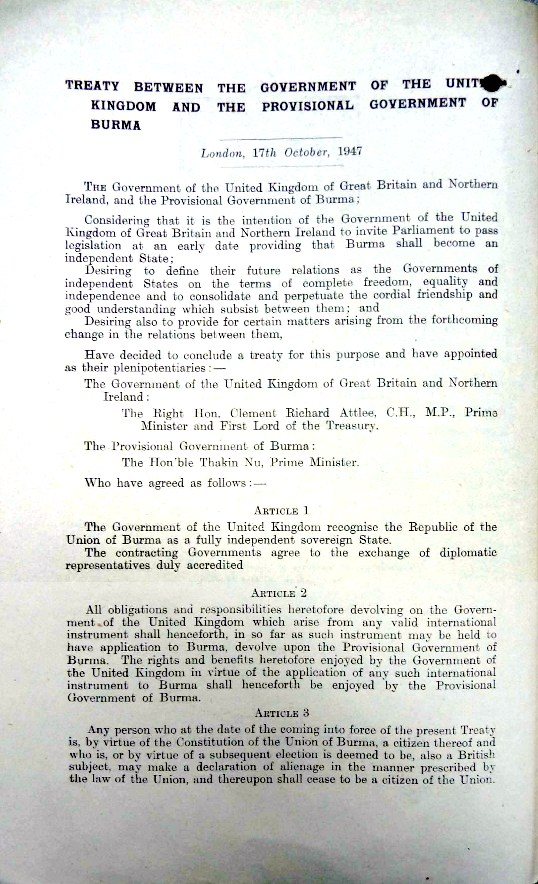
Nu-Atlee Treaty (1947)
Pre-1962 Pathways to Citizenship
While ethnicity and residency were central to the 1948 Citizenship Act, the act included pathways to citizenship for people unable to document their pre-1823 residency, for non- taingyintha (non- indigenous) peoples who had immigrated to Burma after 1823, and for those born in the country after 1948. Non-citizens could apply for naturalization after five years of permanent residence, three years of service in the armed forces, or a year of permanent residence for a woman married to a citizen.4 Children born in the Union were automatically granted citizenship if one of their parents was a citizen. Nick Cheesman, a legal scholar, argues that in practice, ‘whether a person was taingyintha or not was incidental to one’s citizenship . . . . Like its counterparts in other newly independent Asian countries, the state in Burma granted citizenship rights to pretty much anyone residing in its territory and opting for them.’5 Significantly, National Registration Cards (NRCs), or ‘green cards’, which were issued for the first time in 1952, had no entry for taingyintha , and no government agency had the authority to issue an official document classifying a person as belonging to a national race.6
Citizenship and the evolution of ‘national races’ under Ne Win 1962-1988
The concept of national races took on new political significance under the military regime of Ne Win. On March 2, 1962, the socialist general overthrew the civilian government in a coup d’état and established military rule under the Revolutionary Council Government. In 1964, he gave a carefully prepared speech heralding taingyintha unity as the key to a prosperous and stable Burma. ‘ Kachin, Karenni, Karen, Chin, Burman, Shan and other taingyintha . . . need to be resolved to stick together for life, through weal and woe ,’ Ne Win stated. ‘ Only then will taingyintha be able to join hands with each other and work trustingly for the good of the Union and the good of all its inhabitant races. ’7
Ne Win ’s speech identified taingyintha as a central framework for the socialist state-building project. He vowed to work ‘systematically’ for the economic and social equality of the national races and the elevation of their languages, cultures, and literatures.8 Within the year, the government established the Academy for the Development of National Race s. Ne Win’s Burma Socialist Programme Party published books that ‘ anchored aspirations for the new socialist economy in a narrative of solidarity that once had existed but had been lost during the colonial period. ’9 Taingyintha became tied to the idea of ‘national races’, replete with connotations of ethnic and political superiority.
The privileging of an exclusive national community whose unity was rooted in a mythical past of shared suffering and resistance to colonial rule created out groups – both foreign powers and internal enemies – whose identities or perceived interests aligned them with colonial domination.10 This aligned with the xenophobic character of Ne Win’s socialist project , which vowed to eliminate foreign influence on Burma and to nationalize businesses operated by people of Chinese and Indian descent.11 Ne Win used the concept of taingyintha to prevent Chinese and South Asians from benefiting from the socialist economy.
Ne Win’s ‘Burmanisation’ Campaign
Asserting the dominance of taingyintha required the physical and cultural suppression groups considered non-indigenous. To expand military control in border states, quell ethnic unrest, and consolidate power for taingyintha , Ne Win targeted ethnic and religious minorities through a campaign of ‘Burmanisation’. In minority regions, the government removed local authorities and replaced them with Burman officials. It mandated the teaching of the Burmese language in schools, forced conversions to Buddhism, and built pagodas in Muslim and Christian areas. Women from ethnic minority communities were forced to marry Burman soldiers, while the army waged military campaigns against ethnic minority rebel groups.
Ne Win’s Burmanisation campaign meshed with a larger program for control and exclusion through the deportation of alleged aliens.12 In an effort to nationalize assets and purge the country of foreign influence, Ne Win expelled hundreds of thousands of Chinese and Indian immigrants. Thousands more – residents of Chinese and Indian descent - were arrested and imprisoned on allegations of economic crimes.13 Taingyintha went ‘ from being a term of limited political salience to the paradigm for military-dominated statehood. ’14
A ‘target of choice’
The 1970s were a time of economic crisis in Burma, brought about by the failure of the Burmese Road to Socialism. As the country’s financial condition worsened, General Ne Win looked for populations to blame. The regime selected Muslims, and in particular an ethnic group called the Rohingya, as a convenient ‘target of choice.’ As Azeem Ibrahim notes, ‘They were unarmed, ethnically easily identifiable, spoke a non-Burmese language and were Muslims in a country where 90 per cent of the population was Buddhist .’15 By 1978, the government had classified the Rohingya living in Burma’s northern Rakhine state as foreigners, stripped them of their rights, and subjected them to waves of violence at the hands of the military and local Buddhist populations.
Registration and expulsion of Muslims in Rakhine State, 1968-1978
Prior to a 1978 census, Tatmadaw military and immigration officials carried out a three-month campaign known as Operation Nagamin to register citizens in Rakhine State. The work was done under the auspices of the Department of National Registration, which the government established in 1968 to investigate citizenship records and petitions. Through Operation Nagamin the government expelled anyone deemed an illegal migrant or non-citizen. The expulsions especially targeted the Rohingya, who were intimidated, rounded up in mass, raped, and killed. More than 200,000 fled to Bangladesh.16 The government used the mass flight to support its claim that Rohingya were illegal immigrants.
The registration and expulsion campaigns implemented by Ne Win instituted a strategy of restricting minorities’ access to citizenship, classifying them as foreigners, and using their imposed statelessness to expel them. It was a strategy that governments would employ again, and which would eventually expand to encompass Muslims and religious minorities throughout Myanmar.
The 1982 Citizenship Law
Four years after Operation Nagamin, the government enacted the 1982 Citizenship Law, which institutionalized national races as the pre-eminent marker of citizenship. The law created distinct classes of citizenship, prioritizing national race as the basis for full belonging in the political community. The first class of citizenship included ‘citizens by birth’ and ‘others’. To be a citizen by birth, one had to be taingyintha , which meant to b elong to the ‘indigenous races of Burma’ . The ‘others’ category include d non- taingyintha who held a green card prior to 1982, and children born in Burma to two citizen parents. The status of those with green cards was protected by section six of the law, which guaranteed that no one who already held citizenship would lose it. This safeguard would later fall apart under targeted government campaigns to strip minorities of their cards. At the outset, however, hundreds of thousands of people classified as non- taingyintha found themselves in the position of second-class citizens, with different rules regarding the transmission of citizenship to their children and the circumstances under which their citizenship could be revoked. In addition to these categories, the law created two further classes of citizenship - Associate citizens and Naturalized citizens. These afforded certain residents – mainly those who had immigrated to Burma after 1942 – a quasi-status, with limited political rights and a path to full citizenship in the third generation.17 The law removed all pathways to citizenship for future immigrants to Burma. The 1982 Citizenship law cemented a political reality in which only those classified as belonging to the ‘indigenous races’ of Burma, or taingyintha , had access to the full rights and protections of citizenship.
Xenophobia and anticolonial narratives
In the week prior to the enactment of Burma’s 1982 Citizenship Law, Ne Win gave a speech outlining the reasoning behind the law’s passage.18 The speech was a mixture of purported humanitarianism and xenophobia. It began by highlighting the plight of people who had settled in Burma between 1824 and 1948, and who were now ‘ living in panic ’ because of their undefined status. Ne Win urged the need for magnanimity, noting that many of these families had been living in Burma for more than a century. He claimed the law solved this dilemma by creating Associate citizenship status for those who had already submitted citizenship applications, and Naturalized citizenship for those who had not.
While Ne Win couched the gesture as altruistic, he invoked anticolonial sentiments that stoked fears of foreigners and internal enemies. People who arrived between 1824 and 1948 were either British colonizers or collaborators, he claimed - ‘foreigners, or aliens [who] entered our country un- hindered under various pretexts.’19 According to Ne Win, ‘those foreigners’ had ‘become a problem’.20 Part of the problem he outlined was the political autonomy and security of the state. Ne Win portrayed Associate and Naturalized citizens as criminals and as people with divided loyalties. He accused them of smuggling goods to relatives in foreign countries, casting them as people who would work against the good of the nation if allowed full access to the political community. ‘We are aware of their penchant for making money by all means,’ he stated, ‘and knowing this, how could we trust them in our organisations that decide the destiny of our country? ’ His answer betrayed the true intentions behind the law: ‘We will therefore not give them full citizenship and full rights.’21
Ne Win’s emphasis on colonial legacies and economic deviancy touched on deeply held grievances over the political and economic control wielded by British authorities. British colonial policy excluded native Burmese from the military and favored people from the Indian sub- continent in the civil service and police. Chettiar moneylenders (who were Hindu) gained a reputation for exploiting farmers by taking their lands as payment for defunct loans during the Great Depression – including some 25 per cent of agricultural land in lower Burma.22 Immigrant populations who found political opportunity and economic success during the colonial era also played considerable roles in the administration of the state after independence.23 These grievances, and the tendency to associate the descendants of immigrant populations with neocolonialism and the continuing injustices of colonial rule, remained salient in the 1980s.
By describing Associate and Naturalized citizens as a problematic legacy of colonialism, prone to criminality and foreign loyalties, Ne Win tapped into a powerful historical consciousness that identified foreigners as a threat to Burma’s political future. To protect the nation, their legal rights would have to be curtailed. ‘Leniency on humanitarian ground,’ he argued, ‘cannot be such as to endanger ourselves. We can leniently give them the right to live in this country and to carry on a livelihood in the legitimate way. But we will have to leave them out in matters involving the affairs of the country and the destiny of the State.’ Ne Win’s words cast Associate and Naturalized citizens as potential traitors to the nation. ‘If they were to betray us, we would be in trouble,’ he warned.24
Underlining the entire schema was the reliance on race as the basis for determining which tier of citizenship a person could attain. ‘Racially, only pure - blooded nationals will be called citizens,’ Ne Win stated. This meant that race and ethnicity, even mo re than a person’s legal standing or date of arrival, symbolized whether they belonged fully to the nation or existed as a distrusted second- class citizen with limited political rights. As the meaning of taingyintha became synonymous with Burman Buddhist identity in the late 1980s, the prejudices and anticolonial rhetoric attached to Associate and Naturalized citizens was applied wholesale to Muslims and minority groups whose ethnic or religious identity excluded them from Burma’s political community.
The 1983 Census
As Jane Ferguson notes, colonial and post-colonial authorities in Burma/Myanmar have long used census enumeration to organize and construct ideas about ethnicity, citizenship, and belonging.25 The 1983 census identified eight national races (Burman, Kachin, Kayah, Karen, Chin, Mon, Rakhine, and Shan), which included 135 sub-groups. The census registered Rohingya as Bangladeshi, classifying them as illegal immigrants. This list of 135 ‘ races ’ excluded other groups as well . Those left out included ‘Panthay Chinese Muslims, Overseas Chinese (speakers of Hokkien and Cantonese), Anglo-Burmese (Eurasians of mixed Burmese and European background), Burmese Indians, Gurka, [and] Pakistanis.’26
Muslims excluded from the public sector
Throughout Burma, Ne Win gradually excluded Muslims from military, government, and civil service. Muslims in pre- and post-independence Burma held prominent roles as cabinet ministers, politicians, and high-ranking military officers. Ne Win banned Muslims from top administrative and military posts.27 Those already in civil or military service were no longer promoted. The Tatmadaw became blatantly anti-Muslim in its admission system, reducing the number of Muslim recruits. Because most senior government positions went to active or retired officers, this meant that Muslims were essentially barred from high-ranking government positions. The measures further institutionalized the socio-political marginalization of Muslims and emphasized their classification as people excluded from the national races of Burma.
Conclusion
Muslims in Burma were in a precarious position in the 1980s. General Ne Win’s xenophobic and nationalist policies classified them as second-class citizens and made them vulnerable to discriminatory policies. Mandatory registration campaigns in Rakhine state identified Muslims as foreigners, while violent expulsions targeting Rohingya Muslims left hundreds of thousands stateless and destitute in refugee and internal displacement camps. Throughout the country, restrictions prevented Muslims from participating in public service, rising in military rank, and attaining high-level positions in government. When the Tatmadaw established a new military junta in 1988, they found in the Muslim population a convenient and already isolated scapegoat for their political and economic problems.
5Section II: Propaganda and the creation of an existential threat under the SLORC, 1988–1989
"A race does not face extinction by being swallowed into the earth, but from being swallowed up by another race." – The Fear of Extinction of the Race
The removal of Ne Win
Despite efforts to shift attention from the economy to internal threats, Ne Win’s military dictatorship continued to face public discontent and calls for democratic governance. In 1988, nation-wide pro-democracy demonstrations broke out, with wide support among Burmese monks and students. The military regime forcibly repressed the uprising, but made several concessions, including the removal of General Ne Win from power and the promise of democratic elections. Ne Win resigned as chairman of the Burma Socialist Programme Party (BSPP) on July 27.
The 1988 uprising
Ne Win was replaced by U Sein Lwin, a colonel in the military with close ties to the General. Protests continued and the military responded by shooting protestors, most famously during demonstrations on August 8, 1988, giving the event its moniker: the 8888 uprising. Lwin was dubbed the “Butcher of Yangon” for his brutal suppression of student demonstrations in the capital.28 He served as president of Burma for 17 days before resigning and leaving the country with a civilian-led interim government.
The 1988 coup and the State Law and Order Restoration Council (SLORC)
On September 18, 1988, the Tatmadaw took power in a coup, killing thousands of civilian protesters.29 They established the State Law and Order Restoration Council (SLORC),30 a military junta led by General Saw Maung. The SLORC imposed martial law and disbanded the constitution, promising multi-party elections (these would take place in 1990). In 1989, the SLORC changed the name of the country from the Union of Burma to the Union of Myanmar, a name they claimed was more inclusive of the country’s diversity.
Instability
While the military held onto power, its position was far from secure. Ideological splits within the Tatmadaw and disagreements among its elites over how to maintain control of the country’s resources undermined the stability of the SLORC. When the National League for Democracy (NLD) emerged as a new political movement in 1988, it did so with the support of at least some high- ranking military officers, as evidenced by its decision to appoint a Brigadier General and a former general as its chairman and vice-chairman.31 The NLD’s emphasis on mass resistance, its frequent organizing of anti-military street protests, and its widespread popularity among the Burman ethnic majority foreshadowed a dire electoral outcome for the military and its newly created political front – the National Unity Party (NUP). Amidst this background of crisis and transition, the Tatmadaw sought to unite Buddhists around a common enemy, reasserting the political salience of ‘national races’ and reviving an institutional strategy that used propaganda to mobilize fears of religious extinction and colonial domination.
Stimulating the ‘religious nerves’: an institutional strategy
The military employed a fierce propaganda campaign against Muslims, using a strategy it developed three decades earlier against communist foes. In 1959, under a caretaker government ruled by Ne Win, the Tatmadaw published a pamphlet titled “ Dhammantaraya (Danger to the Dhamma). The pamphlet stoked fears of religious extinction and identified communists as a danger to the Buddhist faith. Writing about the success of the Dhammantaraya campaign, Colonel Dhammika U Ba Than - Director of the Department of Psychological Warfare and Policy and military assistant to Ne Win – said: ‘This served as a punch at their [communists’] ideological solar-plexus, and they are yet to recover from that terrible blow. The Defense Services just stimulated the “religious nerves” and all it cost them was a few thousand kyats.’32 While Ne Win ’s focus was on communists and removing people with foreign ties from the socialist economy, his successors emphasized religious identity. In the wake of the 1988 uprising, it was not communists but Muslims who the military portrayed as disloyal and dangerous.
The Fear of Extinction of the Race (1989)
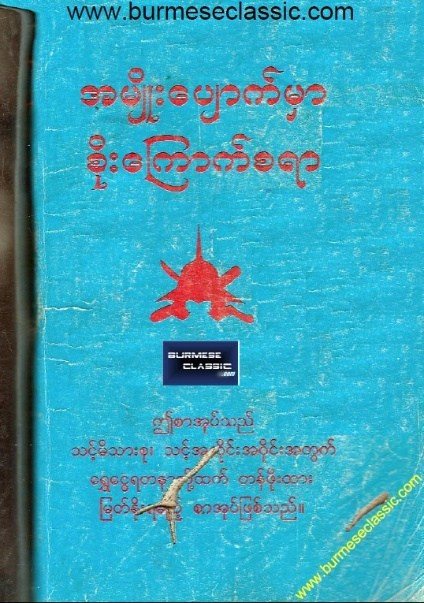
In 1989, the Tatmadaw published a booklet whose Burmese title translates to ‘ The Fear of Extinction of the Race ’ or ‘ Worrying about the Vanishing of the Race ’ . Its cover bears the traditional Tatmadaw logo – a helmet overlaying a sword and spear - used to inspire nationalism and a belief in military supremacy. Beneath the logo, an admonishment printed in red reads : “This is a book that your family and community must treasure more than jewelry, such as gold and silver.” It is unclear who authored the material; it bears only the pseudonym Amanda Nu in its final pages. The 32- page booklet presents an apocalyptic message and a call to action against Muslims.
‘Myanmar will disappear from the world map’
The Fear of Extinction of the Race accuses Muslim populations of planning the intentional destruction of Buddhism and taingyintha peoples through intermarriage, economic domination, and religious subversion. In sections titled ‘ Do no water the poisoned tree ’ and ‘ A hidden weapon to kill us ’ , taingyintha are told to be ‘ vigilant ’ in protecting themselves from the threat of being ‘ swallowed ’ by another race. ‘ Human beings will only survive if they preserve and protect themselves, ’ the book warns. ‘ Let me conclude that that if we are poor in organizing . . . then in the following (100) or (200) years, Myanmar will disappear from the world map. ’33 The booklet calls for commitments to religious and racial purity, organized discrimination against Muslims, and the teaching of an ultra-nationalist, exclusive variant of Theravada Buddhism to Myanmar’s youth.
‘If you are careless, you will be victims’
The Fear of Extinction of the Race identifies the presence of Islam and any of its followers as an existential threat to the country’s religious identity. Eighteen of the book’s 32 pages trace the historical expansion of Islam in Asia and the Middle East and the resulting decline of previously dominant religions. ‘ The Muslim armies that gradually colonized empires religiously devoured small countries such as Iran and Iraq ’ , it reads. A section on Pakistan claims ‘The Buddhists have now been completely eradicated by the Muslims.’34 The argument is that the expansion of Islam can take place only at the expense of other religions.
As the narrative turns to the danger of rising Muslim demographics in Myanmar, the intended historical lesson is clear. The book discusses the growth of Islamic influences in Rakhine state, with section titles such as ‘Monk! Be careful’ and ‘Afghanistan and Pakistan were swallowed by Muslims’. The failure of 15 -century rulers to retain their religious and cultural purity led to the destruction of the Rakhine people, the author argues : ‘Even though the Rakhine people fiercely defended themselves to prevent the extinction of their race, the Rakhine rulers could not escape the shadow of the Muslims.’35
The author uses Rakhine as a case study for what might happen throughout Myanmar if Islam is allowed to spread. Tables calculate the number of mosques and Islamic schools in states and townships across the country.36 ‘ Therefore, let me remind you Buddhist Golden Myanmar that “ it has come close to home. If you are careless, you will be victims. ”’37 T aingyintha are urged to ‘organize and educate each other so that . . . our race and religion do not disappear. If they don’t,’ the book warns, ‘ they will be swallowed up by the python-like Muslims, like India and Indonesia, once Buddhist countries. ’38
The racialization of Islamic Identity
The conflation of religion, national identity, and race leaves no space for the Muslim ‘ other ’ to co-exist within, yet alone belong to, the Myanmar polity. By identifying Muslims as a distinct race of peoples, the author entrenches the classification of Burmese Muslims as settlers within Myanmar, much as Mahmood Mamdani argues occurred with the racialization of the Tutsi identity in Rwanda.39 Muslims are depicted as foreign colonizers who can only subsume and never assimilate into the taingyintha population.
The racialization of Islamic identity is especially apparent in the booklet’s focus on intermarriage. The text warns taingyintha that Muslims are ‘ sneaking in en masse ’ to carry out the Islamic ‘ missionary work of human breeding. ’40 Preventing Buddhist women from marrying Muslims is described as a crucial action in a wider war for Myanmar’s survival. ‘ It would be sad if 500 Myanmar Buddhist sons were killed on the battlefield, but 500 Myanmar mothers can still give birth to 500 more sons. But if (500) Myanmar women get married wrongly, the country will feel like it will be infected with a disease in the future. . . ’41 The author attributes the saying to the renowned Burmese monk, Sayadaw U Narada, casting it as a religious duty as well as a national imperative.
Parents and monks are instructed to ‘ educate our adolescent children that they should only marry people of the same race and religion . . . or they will lose themselves, their children, their grandchildren, their generations, and even the country. ’42 Instead of abandoning daughters who have married Muslim men, parents are told ‘ it would be better to kill her because it would eliminate the enemies. ’43 The instruction places religious and ‘ racial ’ purity above familial bonds and emphasizes the classification of Muslims as possessing an ascribed identity that is biologically passed down to children. Viewed through this lens, marriages between Muslims and non- Muslims threaten the very existence of the taingyintha construct, which fuses religious, racial, and national identity. ‘ If we remain careless in today ’s time, ’ the text warns, ‘ the taingyintha born in this nation will have a low profile in their own country, will never be able to recover, and will be swallowed up by the snakes. ’44
Economic discrimination against Muslims
The Fear of Extinction of the Race also calls for economic discrimination against Muslims. The reason is not economic jealousy, the author claims, but because ‘ money is used to attract taingyintha women to eliminate our race and religion. ’45 Readers are instructed to boycott Muslim-owned shops, establish large numbers of ‘ Myanmar-owned stores, ’46 and eat food cooked only by taingyintha cooks. Even if an item is more expensive, ‘ You should only shop at Myanmar taingyintha shops. Buying it from the bad Kalars’ store is like watering the poison tree. . . . 1 Kyat of the Kalar’s profit is the destruction of our religion . . .’47 Kalar is used as an anti- Muslim slur in Myanmar and a derogatory term for people of Indian or South Asian descent.
Readers are told to look for specific numbers and signs that identify Muslim shops and restaurants, including crescent moons, the number 786, or men with beards. The latter, the author claims, are ‘ proof that they are a zealous believer in their religion. ’48 References to physical signs and attributes by which Muslims can be identified are indicative of symbolization – the visual manifestation of classification that marks a stage of escalation in the genocidal process (discussed in more detail below).
Fears surrounding Muslims’ economic success in Myanmar, Buddhism’s privileged status as a national religion, and the racial purity of Burmese identity are impossible to disentangle. The booklet accuses Muslims of controlling the country through relationships with the daughters of high-ranking Buddhist figures ‘ such as state leaders, village presidents, and trustees of a pagoda. ’ Noting the presence of Muslim- owned shops around a seminary in Myanmar’s capital city , Maha Yangon, the author questions whether ‘ it is because the relevant trustees are short-sighted or because they have Kalar’s blood.’49 The success of Muslim business owners is portrayed not merely as a threat to the economic welfare of the majority population, but more critically as an indicator of religious and political subversion.
Religious education
A third emphasis of the booklet is a call for religious education. Like its treatments of intermarriage and economic discrimination, the text weaves together religion, race, and national identity, instructing parents, monks, and religious organizations to instill in youth an exclusive, ethno-nationalist form of Theravada Buddhism. The booklet calls for the implementation of mandatory religious instruction, ‘ teaching taingyintha groups about the religion from childhood . . . instructing them not to have close relationships with non-Buddhists and not to marry them, and telling stories that will inspire patriotism. ’50
The blurring of religious and political identities is significant not least because of the long history of co- dependency between Theravada Buddhism and Myanmar’s political and military rulers , in which Buddhist elites provide authorities with the legitimacy to rule and the authorities provide the power needed to enforce and protect Buddhism.51 In the 1989 booklet, the Tatmadaw draws on this co-dependency to legitimize and disseminate its anti-Islamic agenda. The result for Myanmar, as we will see later, is that Buddhism and identity-based discrimination become mutually reinforcing and institutionalized in law, in military training, in schools, and through extremist Buddhist groups – laying the necessary ideological and organizational groundwork for genocide. While this process escalated amidst political crisis in the 2000s, Myanmar’s 1982 citizenship law and the publication of The Fear of Extinction of the Race show that it was underway by the late 1980s.
A propaganda campaign
In addition to the Tatmadaw’s pamphlet, the SLORC waged a propaganda campaign in the press. Between 20 February and 28 June 1989, they published a series of 14 articles in the state newspaper L ô k-tha Pyi-thu Ne-sin (Working People’s Daily) , titled Amyo-pyauk-hma So-kyauk Hla- pa-thi (We Fear Deracination!). The articles claimed Buddhism was under threat by Islam, reviving colonial-era myths of ‘ a Burman Buddhist siege mentality that saw itself on the verge of extinction from the world, first by the Indian race and then the Muslim world. ’52 They also traced the history of the country’s citizenship legislation, defending the 1982 Citizenship Act as a bulwark against illegal immigration.53 In 1992, an article titled Dhammantaraya Rohingya appeared in a monthly magazine known to have ties to military intelligence - Myet-kin-thit (Greener Pastures). The military had used the word Dhammantaraya (Buddhism in danger) in a 1959 publication identifying communists as a threat to Buddhism. The 1992 article employed the same narrative but against a different target – the Rohingya. The similarities between the narratives in The Fear of Extinction of the Race and the articles published in L ô k-tha Pyi-thu Ne- sin and Myet-kin-thit show the collaboration between the armed forces and the military regime in their shared strategy to unite the country against a Muslim enemy.
Conclusion
Facing an uncertain political future at the hands of a population demanding an end to military rule, the Tatmadaw revived an institutional strategy it had developed against communist enemies in the 1950s. It moved to unite Buddhists around a shared existential threat, drawing on anti-Islamic prejudices and fears that were already salient in much of the country. Constructing an internal enemy gave the regime a scapegoat on which to blame the country’s struggles and a pretense for continued unrest, which they used to justify strong military control of the state. By creating a crisis that required a strong government capable of protecting the Buddhist faith, the Tatmadaw sought to solve its most urgent political problem: remaining in power.
The 1990 election was disastrous for the military regime. The NLD won over 80% of the seats, the military backed NUP just over two percent.54 The Tatmadaw annulled the results and continued to rule through the SLORC junta. That same year, it increased deployments in northern Rakhine and escalated its targeting of Muslim populations through discriminatory citizenship policies and registration campaigns. The SLORC, which changed its name to the State Peace and Development Council (SPDC) in 1997, also put in place institutional and decentralized infrastructures capable of mobilizing anti-Muslim actions across the country.
6Section III: Building the infrastructure for persecution, 1990–2006
Weaponizing the taingyintha construct
While Myanmar emerged in 1989 as an entity that supposedly encompassed all taingyintha , the SLORC used the construct to cement the preeminent position of the Burman population and justify attacks (cultural, legal, and military) against ethnic and religious minorities, including some whose groups were considered national races.
The SLORC conflated ‘Myanmar’ with taingyintha and taingyintha with Burmese language and culture. Curricula used to teach children about the new ‘Myanmar’ privileged the Burmese language. As Cheesman summarizes, ‘ While school children across the country now sang of Myanmar to signify taingyintha ,’ the books from which they learned (called Myanmar readers) ‘did not include the language and alphabets of all taingyintha , or even the biggest linguistic groups; merely those of the dominant group. ’55 ‘ To speak and read the language of the Burman, to be civilized and cultured like a Burman was nothing other than to belong to Myanmar, which is to say, to be taingyintha . ’56
In a 1989 press conference, SLORC chairman General Saw Maung referenced a taxonomy of 135 groups that made up Myanmar’s national races. The taxonomy seemed to originate from the 1983 census conducted by Ne Win. The taxonomy was problematic. The data and methodology were never formally announced or explained, and the resulting list contained inconsistencies and contradictions. There also appeared to be no consistent basis for how groups were classified or excluded.57 By 1990, the junta was referencing the taxonomy regularly.
Although the taxonomy failed to meet objective criteria, it worked as a tool to further instrumentalize the classification and exclusion of populations in Myanmar. The schema excluded roughly 10% of the country’s population, including Tamils, Gurkhas, Chinese, Bengalis, Punjabis, Rohingyas, Telugus, Anglo-Burmese, and Bayingy (Portuguese-Bamar Roman Catholics), among others. Unable to be citizens by birth, these groups became what some scholars have referred to as Myanmar’s ‘unofficial minorities.’58 Like the 1983 census, the taxonomy excluded groups of Islamic faith. Only Kaman Muslims were included in the list; all others (Rohingya, Pathi, Panthy Pashu and Myaydu) were left out of the taxonomy altogether, placing them outside the bounds of taingyintha . Any benefit of being included for the Kaman would be short lived. Like the Rohingya, Kaman Muslims would become victims of discriminatory registration campaigns, persecution, and detention as the government sought to cement Myanmar’s Buddhist identity and establish military control in the border regions.59
Registration campaigns and identity cards
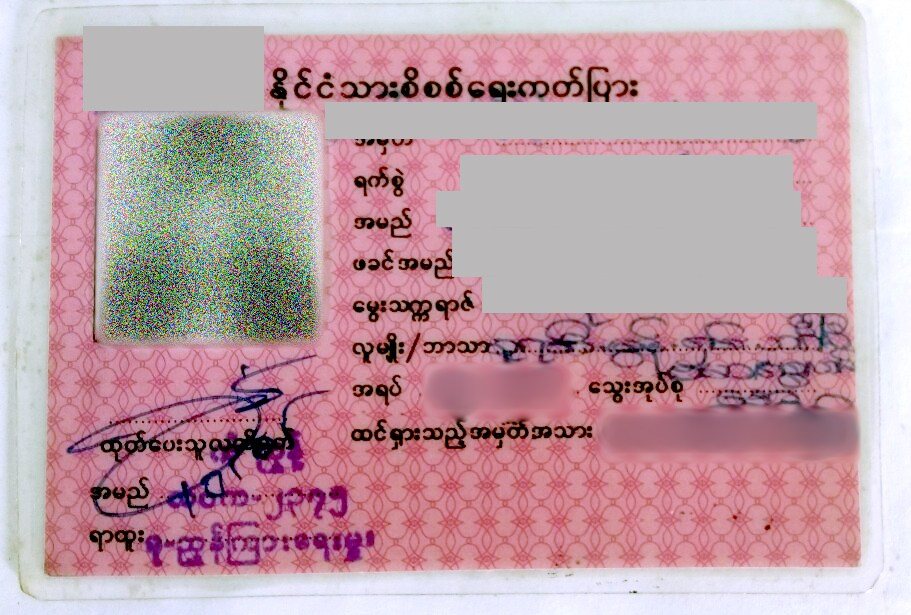
The SLORC embraced the 1982 citizenship law with renewed vigor and began a process of re- registration to enforce citizenship categories. All citizens had to exchange their green cards for a pink Citizenship Scrutiny Card. Unlike its predecessor, the pink card listed a person’s ethnicity, religion, and lineage, identifying whether they could claim membership in a ‘national race’.
The re- registration process should not have posed a unique difficulty to Burma’s Muslim population. Many, and especially those living near Bangladesh, were relatively well documented because of previous disputes over residency.60 In theory, all citizens should have received a pink card merely by submitting their application with their green card attached. However, registration officers in Rakhine State refused to issue Rohingya with pink cards. People who gave over their green cards with their applications lost them. Instead, they were issued Temporary Registration Cards or ‘white cards’.61 The white cards removed them from Myanmar’s new system of citizenship and designated them as ‘Bengali’. Using this practice, the junta rendered some 700,000 people stateless.62 In practice, re-registration became a means of realizing a political community based on a narrowing conception of taingyintha , one that equated taingyintha with Burman identity and excluded some groups entirely. While the SLORC targeted Muslims in Rakhine State systematically, the strategy would later expand to encompass Muslims and religious minorities throughout the country.
Violence against Muslims in Rakhine State
In 1991 and 1992, brutal attacks that included rapes and torture forced roughly 250,000 Rohingya to seek survival in Bangladesh while hundreds of thousands more became internally displaced. Those who remained lost their land to the construction of new villages for non-Rohingyas – which they were often forced to build themselves as slave labor.63 Under the government’s ‘birth - spacing program,’ Rohingya women were given mandatory birth control injections and restrictions were put in place on marriages and the number of children families could have.64 These crimes violate Article II(d) of the UN Genocide Convention (discussed below) and constitute genocide when committed with the intent to destroy a group in whole or in part. In the early 1990s, they represented an escalation in the genocidal process against a population who the government had chosen as a scapegoat and a distraction for its political problems.
The Department for the Promotion and Propagation of the Sasana (DPPS)
Amidst the escalating violence, the regime developed infrastructure to support the dissemination of anti-Muslims propaganda. In 1991, the junta created within the Ministry of Religion the Department for the Promotion and Propagation of the Sasana (DPPS). To lead it, they selected a former monk and SLORC official named Kyaw Lwin.65 The department’s official role was to promote Buddhism in Myanmar (Sasana means ‘religion’ in Pali, the liturgical language of Theravada Buddhism but in Myanmar refers to Buddhism generally). It continued editorial work that had begun under the Ministry of Religion in the 1980s and published books and translations on the teachings of Buddha and Buddhist life, none of which propagated the radical ideology of the Tatmadaw’s booklet . Unofficially, the DPPS operated as a state-run body through which the Tatmadaw supported extremist Buddhist nationalist movements.
The rise of the 969 Buddhist nationalist movement


969 Logo and movement (Photo : Irrawaddy)
The 969 movement emerged in the late 1990s as a Buddhist nationalist group committed to creating a religiously pure state. The movement did not appear on the radar of international observers until 2012, when its incitements were condemned for contributing to violence against Muslims in Rakhine State, but its beginning dates to a book written by Kyaw Lwin in 1997 when he was director-general of DPPS.66 The book featured the 969 symbol on its cover and encouraged Buddhists to display it on their homes, businesses, and belongings.67 The symbol represented the ‘three jewels’ of Buddhism – 9 for the nine attributes of the Buddha, 6 for the six attributes of his teachings, and 9 for the nine attributes of the Buddhist Sangha. The number was intended to be a counter-symbol and the cosmological opposite of 786 – the numerical representation of an Islamic prayer – ‘In the Name of Allah, the Most Compassionate and Merciful ’ – which many Muslims used to adorn their homes and shops. Proponents of the 969 movement claimed the 786 symbol was evidence of a Muslim plot to conquer Myanmar in the 21 century, based on the premise that 7 plus 8 plus 6 equals 21.
The 969 movement spread the ideology found in The Fear of Extinction of the Race , convincing Buddhist audiences that the country was under siege by Islam within and outside of Myanmar.68 Monks associated with the movement preached about the need to save Buddhism from Muslim invaders and protect Buddhist women from forced conversion. They emphasized the economic threat posed by Muslims and the need to destroy the economic foundations of Muslim families.
The monks associated with 969 organized the mass actions called for in the 1989 booklet. They led boycotts against Muslim-owned businesses, targeting confessional Muslims regardless of their ethnicity.69 They became active in leading educational initiatives in impoverished communities. This included the operation of Buddhist Sunday schools across Myanmar, which became platforms for anti-Islamic propaganda. When their rhetoric inspired violence against Muslims, monks used ethical gymnastics to abdicate moral responsibility. They claimed that if their intent was to safeguard and promote the faith, they were not accountable for any violence their speech might incite.70
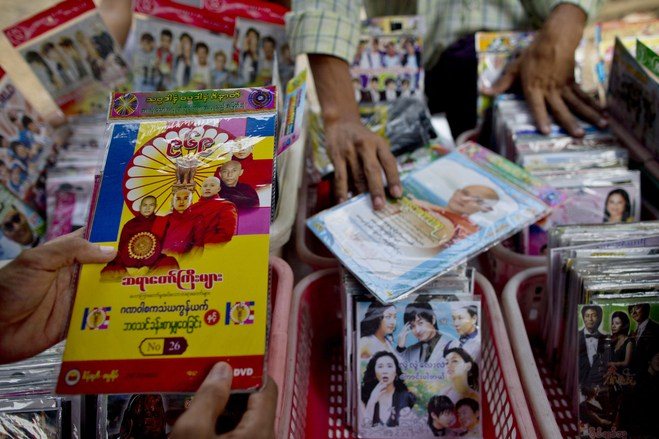
The deep reverence shown to monks in Myanmar made 969 an effective means of influencing the Buddhist public. Their speeches were sold as videos on the streets and were commonly heard in tea shops and homes. The boycotts they led were widely participated in by Buddhists across the country. Nyi Nyi Kyaw argues that understanding 969 ’s impact on the Buddhist population is impossible without appreciating the role of Buddhist monks in Myanmar. He quotes cultural anthropologist Melford Spiro, who states: ‘there i s probably no other clergy in the world which receives as much honour and respect as offered to the Buddhist monks of Burma.’71 As guardians of Buddhism and as representatives of the Sangha – one of Buddhism’s Three Gems – monks possess a power within Myanmar society that puts them on par with political elites.72 Their influence in Buddhist affairs, in particular, cannot be overstated.
Conclusion
By 1989, the targeting of Muslim minorities was central to Tatmadaw strategies for maintaining power. The Fear of Extinction of the Race created a justification for military rule in a time of political crisis by constructing an internal enemy and creating a logic for their annihilation by identifying them as an existential threat. The narratives were powerful in part because they tapped into deeply held anti-colonial sentiments, reviving apocalyptic warnings that monks had directed at Indian Muslims and Indian Hindus during British rule.73 The introduction of pink cards and simultaneous registration campaigns stripped Muslim citizens of their ID cards, leaving them without civil protections. Meanwhile, the 969 Buddhist nationalist movement, operating with unofficial government support, mobilized public appetite for attacks against the Rohingya and justified discrimination against Muslims based on self-preservation. The strategy, which the government used to maintain the need for a strong military regime, combined the creation of a national crisis with the construction of an isolated and vulnerable scapegoat. It was a strategy the military would deploy again in 2008, when it faced another political catastrophe.
7Section IV: Crisis and escalation, 2007–2008
The Saffron Revolution: 2007
In August 2007 the military junta – now officially the State Peace and Development Council (SPDC) – sent a new wave of civil unrest crashing through the country when it raised gas and oil prices amidst already grinding economic conditions.74 By September, monks and students were demonstrating widely against the regime in what became known as the Saffron revolution after the color of the monk’s robes .75 Although the regime was initially tolerant towards the monks, it turned to violence when protests merged with demands for democracy and open political support for the opposition NLD party. The military brutally repressed the demonstrations, conducted nighttime raids of monasteries, and arrested thousands (often in their homes in the middle of the night).76 Unlike previous episodes of state oppression, cell phone cameras captured the violence and local stations aired it on satellite televisions in urban homes – a consequence of globalization that impaired the Tatmadaw’s ability to downplay the abuses and control the narrative. The Tatmadaw had long based its moral right to rule on the blessing of the Buddhist religious establishment and its portrayal of the military as the only entity able to protect the Buddhist faith. Scenes of soldiers closing monasteries and beating robed monks in the streets badly damaged the Tatmadaw’s legitimacy and strengthened the alliance between monks and the NLD.
Cyclone Nargis, 2008
The regime’s popularity was already in tatters when Cyclone Nargis hit in May 2008. Roughly 50% of Myanmar’s population was living at or below the poverty line. Malnourishment and disease were endemic, and nearly half of all primary students left school.77 Nargis devastated the Irrawaddy Delta. Crops were destroyed, fisheries and livestock washed away. Approximately 65% of Myanmar’s rice paddies, critical for feeding the country, were lost to salt damage and flooding. Ninety-five percent of buildings were lost to storm surge, leaving over a million people homeless.78 Estimates of the death toll reached into the hundreds of thousands. The SPDC handled the disaster poorly. Paranoid and concerned for its political survival, the regime resisted international aid. A week passed before the government allowed basic humanitarian assistance into the country, three weeks before it fully opened its borders to foreign aid workers.
The 2008 Constitutional Referendum
Once again, the military found itself scrambling to secure control over the political process and its access to Myanmar’s economic resources. Civic outrage at the government’s inept economic management and its responses to the Saffron Revolution and Cyclone Nargis forced the junta to hold a long-promised constitutional referendum. The 2008 constitution created a nominal civilian government. It secured a significant amount of power for the military but offered limited democratic reforms and an alternative to outright military rule, with elections planned for 2010.
Significantly, the preamble to the constitution invoked the tainyingtha construct seven times in two pages, addressing the polity not as citizens of Myanmar but as national races. The word ‘citizen’ did not appear once.79 To be taingyintha, which meant most of all to be Burman Buddhist, was to be a citizen. To be anything else was to occupy a politically marginalized and vulnerable out-group.
As it had in 1989, the Tatmadaw responded to political crisis by escalating its persecution of minorities and returning to its strategy of inciting hatred toward internal enemies. In 2008 it published a second booklet, this time with a substantially more developed, 17-step plan to remove Muslims from Myanmar.
Methods to Protect Against Extinction of the Race

The Tatmadaw’s 2008 booklet - titled Methods to Protect Against Extinction of the Race – is a 57-page manifesto filled with genocidal propaganda and instructions for organizing the Buddhist population against Myanmar’s Muslim minorities. Like the first booklet, not much is known about its initial publication and distribution. It was published under the pseudonym Min Ye Nanda Kyaw Khaung and, until recently, was available on the now defunct website, www.burmeseclassic.com. Several hundred paper copies were believed to have been printed for distribution in Myanmar, though the exact number and the number of subsequent printings is unknown. The booklet begins with a preface and a short summary of the existential threat that Muslims pose to the taingyintha ‘ race ’ , religion, and nation. The remaining 53 pages present 17 methods80 for preserving the racial and religious purity of the Myanmar polity.
‘A race - consuming colonialism’
Though the preface and opening section – titled ‘ Worrying about the Vanishing of the Race ’ – claim only four pages of the manifesto, they establish a context of crisis in which the remaining text must be read. In the preface, the author calls upon Golden Myanmar to fulfill its racial, religious, and political duty to defend the nation against the threat of Muslim incursion, clarifying that ‘ the use of Myanmar, Golden Myanmar, and Myanmar race refers to all Buddhist Myanmar indigenous ethnicity groups. ’81 Readers are told that Muslims have been consuming Myanmar ‘ one by one ’ through ‘ a race-consuming colonialism ’ that will subtly bring taingyintha to the brink of extinction. By marrying Buddhist girls, raising their children in the Islamic faith, and rapidly increasing their population, Muslims will destroy Myanmar ‘ without firing a single gunshot ,’82 The author points to growing Muslim populations in Rakhine, Mon State, and Myanmar’s cities as well as to the emergence of Muslim villages to underscore the urgency of the message. If taingyintha fail to ‘ implement the necessary strategies to protect against the loss of their race, ’ the author warns, ‘ My prediction is that [the] Buddhism we worship, the Myanmar race, and the Myanmar nation will disappear, and this country will definitely become an Islamic Muslim Kalar country within the next 150 to 200 years . . .”83
A 17-step plan for a racially and religiously pure Myanmar
The apocalyptic tone of the booklet’s opening pages set s the stage for the strategies that follow and provides the lens through which their intent should be understood. The 17 methods can be grouped into three categories: 1) anti-Muslim propaganda that aims to polarize Buddhists and Muslims; 2) instructions for discriminating against Muslims in economic, social, and legal spheres; and 3) strategies for organizing Buddhist society around the removal of Muslims from Myanmar. Together they present a call to action against Muslims in the name of self-preservation and sacred duty. Lest readers forget what is at stake, the author closes the preface with an ominous warning: ‘ A race consumed by the earth will not perish, but a race consumed by another race will perish . . . We, Golden Myanmar, must protect against that danger. ’84
Polarizing Propaganda
Eight of the 17methods85 convey polarizing propaganda about the danger posed by Muslims, taingyintha ’s patriotic duty to ‘ save the nation from extinction ’ , and the actions Buddhist families must take to ensure Myanmar’s survival.86 Some methods – such as one and three – equate anti- Muslim sentiment with patriotism and call for ‘ patriotic distributors ’ to distribute the manifesto throughout the country.87 Others draw on entrenched historical narratives to alienate Muslims from society and justify actions taken against them in the name of self-defense.
‘Like worms destroying the roots of the Myanmar race’
Method six – ‘ To convince them that they should never be broad-minded to Muslims ’ – draws on the colonial past and the portrayal of Muslims as dangerous foreign enemies. The author claims Muslims are a more serious and permanent threat than that posed by British colonizers. Whereas the British destroyed ‘ the great tree called Myanmar nation, ’ they ‘ could not destroy the roots of the Myanmar race. ’ ‘ Muslims, ’ the author writes, ‘ are like worms destroying the roots of the Myanmar race in the underground . . . . ’88 ‘ If the roots of the Myanmar race are destroyed because they do not protect themselves from being eaten by these insects, the great tree called Myanmar nation will automatically collapse. This time, the fall . . . will never be revived and is an eternal collapse and death. ’89
‘We must do whatever is necessary’
The creation of an existential threat and the dehumanization of Muslims provides a preemptive justification for the discriminatory instructions that follow. The protection of a religiously pure nation is ‘the most crucial historical duty that all Myanmar’s indigenous ethnic groups must carry out. ’ ‘ We must do whatever is necessary ,’ the author argues, ‘ for the Myanmar race and nation to survive as long as the world exists. Everything that should be done must be done. Any rules that should be followed must be followed. ’90
The rules that follow intersect with the most intimate functions of family life: the birth and raising of children. Method 12 implores Buddhist women to avoid contraceptives. Pointing to increases in Myanmar’s Muslim population, the author calls on Buddhist women to fulfill their religious and patriotic duty to bear large families. ‘ If the mothers of this race fulfil their motherly duties and give birth to as many new generations of authentic Myanmar as possible to ensure the preservation of the Myanmar people, the Myanmar race will not disappear. ’91 Women who plan their family size around economic concerns are accused of ‘ helping the Muslims succeed in their plan to destroy the race. ’92
Method 15 provides rules for men in areas such as economic spending and entertainment, urging them to ‘ outperform non-Buddhists in all sectors ’ to avoid ‘ being swallowed up. ’93 Here and in other sections addressed to men and boys, the emphasis is on preventing marriages between Muslim men and Buddhist women by rivaling the wealth and comfort that economically successful Muslims purportedly use to lure women away from the Buddhist faith.
The ‘three key systems’ : indoctrinating young people in homes, schools, and monasteries
Methods four, five, and 16 – which the booklet identifies as ‘ three key systems ’ for preventing the disappearance of Myanmar – focus on indoctrinating young people with anti-Islamic propaganda in homes, schools, and monasteries. The messaging conflates religion and propaganda, weaving polarizing rhetoric about racial and political purity into tenants of the Buddhist faith. To nurture children ‘ to be firm and devout believers in Buddhism ’ is not only to teach them to love the three treasures and respect the Five Infinite Venerables, but to instill them with ‘ a strong desire to protect [against] the danger of . . . the race-consuming colonialism of the Muslims . . . to compete with the Muslims in all aspects such as business, education and religion . . . . ’94
The booklet encourages monks teach these principles by opening monastery schools and incorporating ‘ cultural classes ’ into school curricula. Thousands of such monastery schools now operate in Myanmar. Methods five and 16 outline mandatory worship programs for youth and young couples, complete with ideas for preaching about the protection of Buddhism and the taingyintha race, mantras for recitation, and targeted messaging for young boys and girls. Boys ‘ must strive to be better than Muslims in all aspects, such as economy, education, religion, and marriage, ’95 while girls must know that marriage to a Muslim ‘ is the extermination of the new generation of Buddhists born from that girl. ’96 Readers are told to organize the youth and to ‘ make the young people understand and accept the methods described in this book to protect the race against extinction. ’97 The methods aim to produce a generation steeped in anti-Muslim thought and equipped to enforce a monolithic society. ‘ Realize these children will become anyone, from police officers, military soldiers, teachers, and professors to country leaders, ’ the author writes.
Economic Discrimination
While anti- Islamic ideology colors the entirety of the Tatmadaw’s 2008 booklet, three methods incite specific acts of discrimination against Muslims in economic, social, and legal spheres. Returning to the claim that Muslims use financial incentives to lure Buddhist women into sexual relationships, method two focuses on preventing Muslims from achieving economic security. Muslims who find economic success are said to be embezzling from Myanmar as part of an intentional five-step plan to ‘ successfully occupy ’ the country.98 Muslims, the author warns, ‘ 1) Will take the land. 2) Will take the money. 3) Will take the girl. 4) Will take Golden Myanmar. 5) Will take the power of the nation. ’99
As in other sections of the booklet, constructions of Muslims as internal enemies are linked directly to fears about intermarriage and rising birth rates among Muslim families. According to the author, failure to prevent the ‘ economic attack ’ being waged by Muslim men will decrease the taingyintha population, allowing Muslims to claim sovereignty over Myanmar ‘ either automatically or through elections . . . or by attacking and seizing it by force. ’100
Buddhists are called on to boycott Muslim businesses, establish competing Buddhist businesses in all sectors of the economy, hire only Buddhist employees, and prevent Buddhist young people from working for Muslim business owners. Buddhist organizations and monks are encouraged to provide capital investments to start new businesses under Buddhist ownership. ‘ The priority must be to prevent the economic opportunities from all over Myanmar from reaching their mouths, ’ the booklet states.101
Method two provides insights into the political concerns and strategies of the Tatmadaw following the Saffron Revolution and cyclone Nargis. The comparatively long, seven-page treatment given to the country’s economic struggles address es the fiercest critique of the military regime. Pitting Muslims against non-Muslims economically, accusing Muslims of embezzling from the country, and casting Buddhists as ‘ economic slaves to non-Buddhists ’102 provides a scapegoat for the SPDC’s economic failures and the impoverishment experienced under military rule. References to elections demonstrate the Tatmadaw’s awareness of its increasingly fragile grip on power. The booklet was published in the context of political concessions. By placing anti-Islamic propaganda in the context of upcoming elections, the manifesto provides a reason for continued military control and instills fears about the potential dangers of democracy. ‘If the nation’s power falls into [Muslim] hands, ’ the author claims, ‘ they will rule Myanmar by Islamic Sharia law. . . . imprisoning and killing those not following Islam, declaring Jihad and killing all non-Muslims across the country . . . ’103 The message: a change in power risks spiritual and physical destruction.
To make three cuts
While method two focuses on economic discrimination, method seven – ‘ To make three cuts ’ – demands the complete isolation of Muslim communities. Buddhists are to ‘ cut off all economic, social, and marital ties with Muslims ’ in the name of self-protection. Mundane interactions such as purchasing goods from Muslim businesses are again cast as betrayals in an ongoing race war in which Muslims use their earnings to secure marriages to Buddhist women and convert them to Islam. ‘ The fact that the Muslims marry the Taingyintha women means that all the new generations of Myanmar Buddhists who will be born from these women are slaughtered by the Muslims with their innate blade. ’104 ‘ Therefore, ’ the author argues, ‘ shopping in Muslims stores is like giving a knife to a thief and saying, “ Kill our race. Consume our race. Consume our Buddhism. Take over our country through race-consuming colonialism. ”’105
Reminiscent of the attempt by the Khmer Rouge in Cambodia to place loyalty to the party and its ideology above familial ties, readers are told to police those around them, identifying those who are disloyal and correcting their behavior. If a woman is ‘ stubborn ’ and marries a Muslim ‘ despite being disciplined, control them by any means possible, ’ the author instructs. Those who do not follow the three-cut rule should be considered traitors – ‘ encouraging and helping the Muslims to run their race-consuming colonial machine. ’106 Internalizing these principles would upend nearly every facet of daily life - from the casual act of grocery shopping to intentional practices such as childrearing. ‘ Organize every Buddhist close to you to follow the three-cut rule. . . . Teach them to follow from childhood. Organize with patience. Tell them carefully so that they understand and accept. ’107 The message does not advocate for a single act of discrimination, but rather a radical alteration of private and public life, built around the principle of ostracizing Muslims from the daily rhythms of society.
The third discriminatory strategy - presented in method 10 - advocates for punitive legislation targeting Buddhist women who marry non- taingyintha spouses. The method argues for the adoption of the ‘ Race Protection Law, ’ which would criminalize inter-faith marriages and sentence convicted women to ten years in prison. Because women are considered ‘ biologically responsible for the birth and growth of the new Myanmar generation, ’ they are seen simultaneously as targets for Muslim men and as potential collaborators. ‘ Myanmar girls born to Buddhist parents married to a person of a different race or religion must be regarded as perpetrators of a colossal crime that could lead to the extinction of the whole Myanmar nation, ’ the author writes.108 The booklet includes a draft of the law and a pre-written petition for readers to send to their heads of state and to Buddhist leaders. The section provides detailed instructions: where to find the full names and positions of political leaders, the mailing address for the State Sangha Maha Nayaka Committee in Yangon, even instructions for how petitioners should write their return address. The Race Protection Law is one of several strategies in the booklet that provide a roadmap for entrenching polarization through institutions such as law, education, the monkhood, and the military. Like many of the actions found in Methods to Protect Against Extinction , it would later become a reality.109
Organization
The methods discussed above inculcate an exclusionary ideology into the religious, economic, customary, and legal spaces of daily life. Methods eight, nine, and 17 address the organization of central groups and institutions in Myanmar around a shared commitment to defend the nation against internal enemies.
Uniting monks, students, and the military
Method eight urges monks, students, soldiers, and police to unify around their common duty to defend Myanmar against the danger of Muslims. These ‘ essential and organized institutions, ’ the author argues, ‘ must be mobilized to be aware of the danger of the race-consuming colonists ’ if they hope to prevent Myanmar from being ‘ slowly swallowed . . . like a bug biting the root. ’110
The attempt to unite these institutions around a shared enemy is a clear effort by the Tatmadaw to respond to the Saffron revolution, which just one year before saw monks and students joining together to protest military rule. By creating an existential threat and casting its defeat as a religious, racial, and national duty that supersedes all others, the manifesto asserts the need for a strong military while rationalizing the need to quell civic action; to work against one institution (the military) is to work against the survival of them all. The severity of the threat is heightened by identifying the danger as one of permanent annihilation. The author uses a poem from the Shwe Dagar Mhuu magazine to underscore the message. A portion of the poem, titled ‘I want the fences to be safe and secure’, reads:
‘ Guard and guard The fence of the village More adequately. . . .
With all the villagers, I want to secure the fences. Be responsible not to fail. Always serve and Guard with diligence The entrance of the village. . . .
Be strict about Our village land, our benefit, Our people, our strength, and Our religion.
The saying goes, “ Even if the land collapses, the land will not be lost. If a person is swallowed, the person disappears.”’111
The appropriation of Buddhist teachings
In support of method eight, method nine argues that harmony between Buddhists is not only essential to the fight against Muslims but also constitutes a religious obligation. The conflation of race, nationalism, and religion – which permeates the 1989 and 2008 booklets – allows the Tatmadaw to harness the persuasive power of each in support of a single cause. Buddhism, with its deeply respected place in Myanmar society, is crucial to this goal. Successfully co-opting Buddhism would enable the military to do three things: legitimate their ideology by claiming approval from the Sangha; use the deep reverence people hold for monks and Buddhism to support the internalization of their message; and mobilize society around the need to obey religious directives and safeguard the Buddhist faith.
Methods to Protect Against Extinction of the Race appropriates Buddhism by integrating anti- Muslim ideology into otherwise benign religious teachings. In method nine, a list of 18 instructions for promoting harmony among Buddhists, which includes cultivating empathy, complimenting others, and avoiding arguing, must be done ‘ to protect against the Muslim threat. ’112 The instructions are followed in whiplash fashion by a poem from the 19 century poet, Achote Tan Saya Pe:
The Myanmar people have lost their throne because they broke the rules. We rely on new scaffolding, but they are dirty races. We lost both our parents and possessed nothing like a stray dog. The Myanmar people want to boast to each other. Evil people like robbers, who are Kalars, are ready to fuck our mothers, so hide in the ground now. The stupid young men and women did not bark like dogs at her stepfather. Changed our history, so historians surrender and run like a dog. Every time I think about it, my bones hurt. I wish to curse my own race.113
The poem by Achote Tan Saya Pe, who was known for his anti-colonial writings, provides a warning from the past and supports the Tatmadaw’s labeling of Muslims as colonial invaders. The seamless transition between the 18 instructions for harmony and the vitriolic rhetoric in the poem exemplifies an attempt to normalize anti-Islamic ideology within Buddhist thought and teaching.
To form a Sangha Committee for the comprehensive development of Buddhists
The final method relating to organization – and the last method presented in the manifesto – is method 17: ‘ To form a Sangha Committee for the comprehensive development of Buddhists. ’ The task of this organization is to ‘ implement all the methods shown before ’ throughout the country, with particular devotion to the ‘ three key strategies (4, 5, 16). ’114
The establishment of such a committee is both a practical means of carrying out the manifesto’s objectives and a symbolic repudiation of the official Sangha Council. The author claims it was the ‘ weaknesses of the Buddhist world in Myanmar ’ that allowed the dangers posed by non-Buddhist groups to penetrate the country. The survival of the faith and nation, they argue, now depend on a new guard of monks ‘ who are in direct contact and guidance to the Buddhist public ’ and who will ‘ vigorously organize ’ to increase their numbers and ‘ to promote the good deed which is to implement these projects throughout the whole country. ’115
The order to form a new Buddhist Sangha is the most direct indication of the Tatmadaw’s intention of implementing their ideology systematically. The creation of such an organization would establish a Buddhist entity separate from the state apparatus and committed to the removal of Muslims from Myanmar. ‘ The practical success or failure of tasks necessary to prevent the disappearance of race, language, and religion and to develop all Buddhists are in the hands of over 300,000 monks in Myanmar, ’ the author states.116 The vision is one of apolitical monks dedicated to the protection of Buddhism. ‘ It must be mandatory to include the rule that every member must be completely free from political activities, and the membership will be permanently terminated if it is found that it is not clear, ’ the booklet reads. The author continues: ‘ as long as the Buddhist Myanmar government is ruling in Myanmar, there will be no politics against the government at all. ’117
While the edict that monks remain apolitical is certainly a reference to the protests of the Saffron Revolution, it also harkens to long-held feelings that monks should remain separate from politics, and the traditional belief of a symbiotic relationship between the Sangha and the rulers of Myanmar in which the moral legitimacy of the government stems from its support from the Sangha; a legitimacy that the Tatmadaw lost and here seeks to reclaim.
Perhaps most striking is the clear break between the existing Sangha and the new. The author warns existing Sangha organizations to participate only if they ‘ successfully implement all these methods nationally. ’ The warning is followed by a poem (attributed to a monk of the Mahagandharama Monastery) that concludes the section. The poem’s title – ‘ If the old one is broke, fix the new one ’ – serves both to condemn the existing Sangha and proclaim the Tatmadaw’s intent ion to establish its replacement. If successfully established, the new Sangha organization would be a powerful tool of indoctrination and mobilization toward the military’s aim of an ethnically and religiously pure state.
Putting the methods into practice
In its conclusion, Methods to Protect Against Extinction of the Race demands that every facet of life in Myanmar be urgently redirected and reshaped to engage in the existential fight against non-Buddhists. Monks ‘ still learning the Pariyatti literature ’ are told to waste no time in completing their studies and implementing the operations laid out in the pages above. Every sermon, every festival, must be utilized to spread the ideology within. Myanmar’s citizens must ‘ make special efforts to organize ’ against their Muslim neighbors. ‘ Every moment should be used valuably for the goals of one’s life and for the success of the projects to protect against the loss of race, language, and religion, ’ the author urges.118
The urgency of the manifesto’s message is heightened by the purported cost of failure in the pre- emptive war of the Tatmadaw’s making. ‘ It is a fact, ’ the author warns, ‘ that the Myanmar race, Buddhism, and the Myanmar nation will become in a situation where they are only in Southwest Asia’s ancient history books.’119 The author concludes with the following words, written in bold: ‘Putting all these methods into practice is now more important than ever in every second.’120
Conclusion
Like the 1989 publication of The Fear of Extinction of the Race , the 2008 booklet marked a time of crisis for the Tatmadaw and the military regime. After its violent reaction to public protests during the Saffron Revolution and its lacking response to Cyclone Nargis, the SPDC faced critique at home and abroad. The participation of Buddhist monks in demonstrations against the government signaled the Sangha’s disapproval, stripping the regime of its moral legitimacy to rule. As the junta imagined its downfall in the promised elections, it conjured threats of erasure and extinction in hopes of redirecting the anger and frustration of an impoverished nation toward an internal enemy. A denounced regime desperate for a reason to prolong its rule found its solution by falling back on what it knew best: control through military power. The solution lacked only a problem, one that the Tatmadaw created by wedding anti-Islamic ideology to narratives of colonialism and war. For Myanmar’s Muslims, the future depended on whether the methods disseminated by the military would become realities.
8Section V: The genocidal process in Myanmar
Genocide occurs when a government or non-state entity intentionally seeks the destruction of a national, ethnical, racial, or religious group, in whole or in part, through any of the crimes identified by Article II of the United Nations Genocide Convention:121
a) Killing members of the group; b) Causing serious bodily or mental harm to members of the group; c) Deliberately inflicting on the group conditions of life calculated to bring about its physical destruction in whole or in part; d) imposing measures intended to prevent births within the group; e) Forcibly transferring children of the group to another group.
Article III states that any of the following acts are punishable under the convention:
a) Genocide; b) Conspiracy to commit genocide; c) Direct and public incitement to commit genocide; d) Attempt to commit genocide; e) Complicity in genocide.
The commission of the crimes in Article II, however, often signals the height of a genocide rather than its beginnings. Before a genocidal entity can destroy a target group, it must exert control over the group, either in its entirety or over the part of the group it seeks to destroy. It must identify and define a target group, isolate the group from the rest of society, create a logic for why the group is appropriate for extermination, and make logistical preparations for the group’s destruction. Therefore, while cases of genocide are each unique in their historical specificity, they often exhibit common patterns of escalation that point to the existence of a genocidal process.122
Gregory Stanton provides a helpful schema for understanding the process of genocide. The schema includes ten non-linear but interconnected phases that highlight methods by which genocidal entities pursue the destruction of target groups. The ten phases (discussed in detail below) are: classification, symbolization, discrimination, dehumanization, organization, polarization, preparation, persecution, extermination, and denial. Rather than a teleological explanation for how genocide happens, which would risk oversimplification, the phases aid analysis by providing indicators or warning signs that can be used to identify situations at risk of becoming genocide even when the contexts are fluid or the actions have not yet escalated to physical annihilation.
The booklets published by the Tatmadaw reflect a genocidal process that was evolving in the consciousness of Myanmar’s military elite. By the time the Tatmadaw published The Fear of Extinction of the Race in 1989, Ne Win’s government and the succeeding military junta (the SLORC) had classified Muslims as foreigners and denied their rights to full citizenship. The military led violent persecutions of Rohingya in Rakhine State and made hundreds of thousands of Muslims, first in Rakhine and then throughout the country, stateless through discriminatory registration campaigns. The Fear of Extinction of the Race justified discrimination against Muslims by casting them as an existential threat to the majority Burman Buddhist population. Measured against Stanton’s schema, the booklet evidences five key indices: classification, symbolization, discrimination, dehumanization, and polarization.
Published nearly twenty years later in 2008, Methods to Protect Against Extinction of the Race presents a substantially more developed logic for the annihilation of Myanmar’s Muslim population. It casts Muslims as an identity group with ascribed and biologically reproducible traits and explains their destruction as a necessary act in a war for the survival of Buddhism and the Burman identity of the Myanmar polity. The booklet dehumanizes Muslims – likening them to insects eating the root of a tree, to decay eroding the foundations of a pot, and to snakes ready to swallow the taingyintha race whole – as part of a wider argument that sees their extermination as not only acceptable, but necessary for the survival of the Burman Buddhist community. The seventeen methods propose an organized and systematic attack on the foundations of Muslim life.
Since 2008, Muslims in Myanmar have experienced systematic discrimination, dehumanization, and organized persecution. Rohingya in Rakhine State have suffered crimes against humanity, genocide, and enslavement. Buddhist nationalist groups such as the 969 movement and The Association for the Protection of Race and Religion (MaBaTha) have implemented many of the methods outlined in Methods to Protect Against Extinction of the Race and enjoy significant grassroots support among the Burman Buddhist majority. Muslims throughout the country are caught in an ongoing genocidal process that threatens their survival.
Evidence from across Myanmar shows that the government and military have committed genocide against the Rohingya and are committing eight of the ten actions that lead to and include the intentional commission of genocide against Myanmar’s Muslim population more broadly. The actions outlined below have been carried out with the intention of destroying the collective existence of Muslims in Myanmar for purposes of regime survival. Some actions fall within Article II and Article III of the UN Genocide Convention and constitute genocide according to international law. All of them contribute to a genocidal process that has isolated Muslims from society socially and politically and enabled the state to exert extreme levels of coercive control over them, leaving them vulnerable to recurring episodes of persecution and, in some cases, extermination. Many of the actions have been discussed in detail above. Thus, the aim here is not to provide an exhaustive analysis of each, but rather to identify pieces that make up a larger whole so that the nature and trajectory of the crime being committed can be seen.
Classification and Symbolization
In its simplest iteration, classification is the act of organizing things (or people) into groups or categories. Classification is ubiquitous in human societies – for example, classifying one’s nationality as Cambodian or Laotian – and is not inherently genocidal. In genocide, however, the act of separating people into groups becomes a central part of the genocidal process and the basis for subsequent acts of escalation. Genocidal entities use classification to identity and define their target groups, and to isolate and disenfranchise them based on their collective identity. This essential step makes possible ensuing actions such as symbolization, discrimination, and persecution.
Symbolization, another common human phenomenon, is the attaching of names or physical symbols to classified things or people. A nation’s flag symbolizes its country and mascots symbolize sports teams. In cases of identity-based violence, perpetrators use names, symbols, and physical attributes either adopted by the victims themselves or forced upon them to operationalize their classification, making it easier to isolate and control them.
Muslims classified as citizens by law, not by birth
The 1982 Citizenship Law restricted full citizenship (citizenship by birth) to 135 legally recognized national ethnic groups or ‘indigenous races’ of Burma. Decisions about wh ether ethnic groups were national or not rested with the state, and the state could revoke the citizenship ‘of any person except a citizen by birth.’123 The law stripped Muslims and other excluded minority groups of automatic citizenship. Those who already held citizenship found themselves in the perilous position of having to prove their nationality (and their rights to the full protections and opportunities afforded to nationals) by producing a National Registration Card (NRC) or ‘green c ard’.
Muslims classified as foreigners
Myanmar has classified Muslims and targeted minority groups as foreigners through discriminatory practices that alter or deny their National Registration Cards. Systematic campaigns to strip Muslims of their NRCs began in 1978 with operation Nagamin in Rakhine State, though the bureaucratic infrastructure for such actions was put in place as early as 1968 with the establishment of the Department of National Registration. Operation Nagamin, which resulted in the mass flight of over 200,000 Rohingya Muslims, introduced a strategy in which mandatory registration campaigns denied or revoked Muslims’ citizenship status, leaving them stateless and without access to civil rights in Myanmar. This in turn makes them vulnerable to various types of coercive control, including discrimination, enslavement, violent expulsion, and – as was seen in the case of Rohingya Muslims in 2016 – extermination. It is a pattern that Muslims and other minorities across Myanmar (even some listed in the taxonomy of national races such as the Kachin, Shan, and Karen) have experienced repeatedly.
Evidences from GAD
For Muslims, no matter what the category of citizenship they hold, they are categorized as foreigners by the local General Administration Department(GAD). There are 325 Townships in Burma. Following the 2014 national census, every township in Burma has reported and published its population on GAD’s website. The Muslim population in most of the townships has been listed as foreigners.
Muslim citizens listed as foreigners of Myanmar by the General Administration Department (GAD)
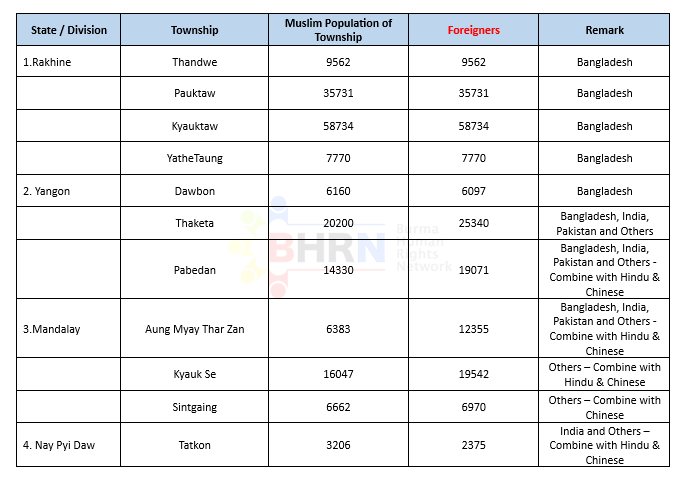

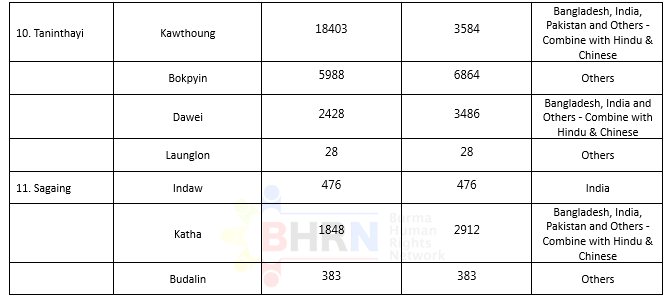
Identification Cards as tools of symbolization
Government policies and unwritten immigration practices have worked in tandem to strip Muslims of their citizenship and to symbolize, or operationalize, their status as foreigners through identification cards. State law in Myanmar requires citizens to renew their government ID cards (or NRCs) at ages 10, 18, and 35. Registration officials have denied the applications or altered the information of Muslim citizens who comply with state orders to exchange their green NRCs for the pink Citizenship Scrutiny Cards that list a person’s ethnicity and religion. Those who have received new documentation have received pink cards that identify them as naturalized citizens of ‘mixed blood’ and foreign origin. Thus, a person who self -identifies as a Bamar Muslim receives a card labeling them as Bengali, Indian, or Pakistani. This bars them from full citizenship rights and makes it difficult for them to obtain citizenship for their children.
Millions of people have lost their green cards (and thus their citizenship) permanently and instead of receiving pink cards, have been issued Temporary Registration Cards or ‘white cards’ which designate them as foreigners. This leaves them stateless and without civil rights and is itself a violation of international law. In 2015, the government abolished white cards altogether and moved to an electronic system, which it continues to use today. People with white cards were required to hand them in to the government, receiving only a paper receipt in return. The new electronic system automatically removes identities such as Burmese Muslim and Kachin and leaves ‘Indian’ in their place.
Myanmar authorities have also used identification cards as a means of preventing the return of Rohingya refugees. In 2017, after its devastating military campaigns in Rakhine State caused around 700,000 Rohingya to flee to Bangladesh, the government instituted the National Verification Cards (NVCs) process. The process served as a barrier to repatriation for Rohingya refugees seeking to return home and a means of cementing the erasure of Rohingya identity within Myanmar. As in previous censuses and registration campaigns, people who go through the NVC process are unable to self-identify as Rohingya. Instead, NVCs use foreign identifiers such as Bengali or religious labels (Muslim/Islam).124 Authorities told refugees that without an NVC, they would be barred from medical services, business, education, freedom to move freely, and from owning property.
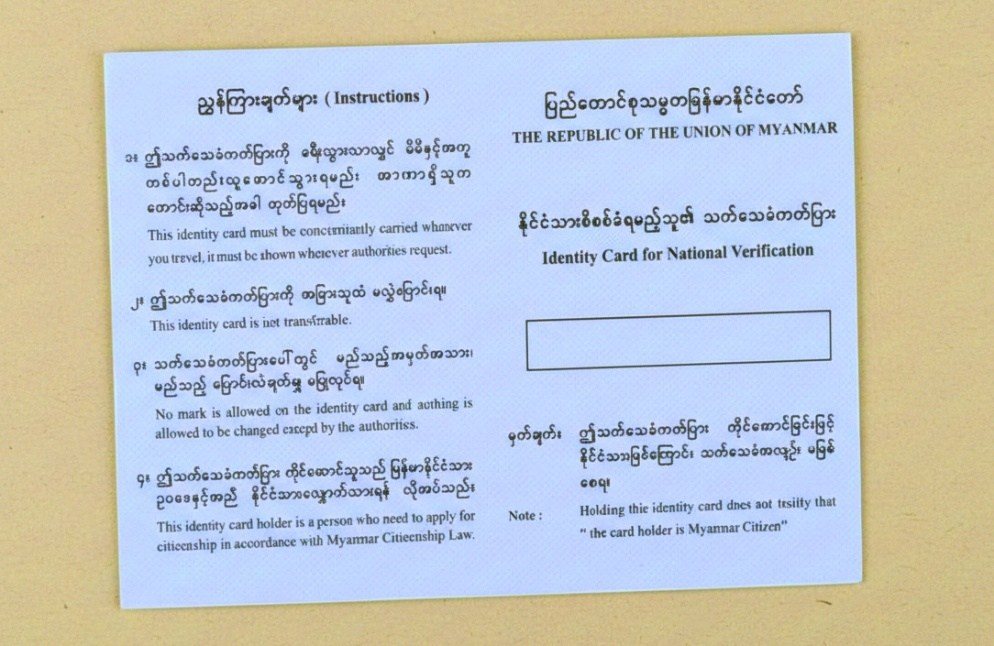
Analyzing this system in 2018, a report by the International State Crime Initiative declared NVCs “a quieter tool of genocide.”125 The authors described NVCs as “a crude attempt to involve the Rohingya in their own identity- denial.” They also noted that this “vigorously pursued non -violent means of genocidal coercion” was “always reinforced by the threat of violence.”126 Although the government issued propaganda framing NVCs as a “first step” to citizenship, the NVC itself declares the holder to be a non-Myanmar citizen. The card-holder then faces the administrative hurdles of Myanmar’s citizenship laws, made insurmountable by a combination of successive pogroms and flights in which family documents have been lost or destroyed, previous registration campaigns requiring Rohingya to surrender their existing documentation, and decades of forced alteration to family lists by Myanmar authorities (including the refusal, since 1994, to register Rohingya births or issue Rohingya children with birth certificates).127
While the above practices are instruments of classification and symbolization, they are also examples of discrimination and show that processes like classification, symbolization, and discrimination are often interwoven rather than discreet stages in the genocidal process. As BHRN has noted in past reports, registration processes and document verification in Myanmar are not always discriminatory. In the 1990s, many citizens received pink cards without any trouble and for some, Myanmar’s tiered system of citizenship has functioned largely without difficulty. What has made the system devastating for minorities is the strategic selection of target groups and the methodical erasure of their identification documents and citizenship rights.
People who received temporary white cards found themselves subject to a range of discriminatory restrictions which prevented them from freely traveling (even locally between villages), marrying, or working. Those whose documents were simply not returned to them, or whose white cards were suddenly revoked in 2015, are helpless to advocate for themselves in a country that no longer recognizes their identity, their citizenship, or their civil and human rights.
Government Censuses
The government has manipulated census data to understate its non-Buddhist populations and to further institutionalize their status as non-citizens. Regardless of what category of citizenship they hold, Muslims (along with Christian, Hindu, and Kaman minorities) are classified as foreigners on government censuses and in data used by the Immigration Department and the General Administration Department. *128 The International Crisis Group (ICG) has accused Myanmar of using census enumeration to purposefully underestimate its minority populations. According to the ICG, data collected by the 1983 census showed a 10% Muslim population, but the government chose to publish a ‘more acceptable figure of 4%.’129
The 2014 census registered ethnic and religious minorities as foreigners; for instance, a township with a Taman population of 2,000 would document the presence of 2,000 foreigners.130 In Rakhine State, the 2014 census became a tool for denying both the citizenship and ethnic identity of Rohingya. The census did not include the term Rohingya as a category. Although there was an ‘other’ line where a respondent could write in their ethnicity, enumerators in some areas of Rakhine refused to recognize requests to write in ‘Rohingya’, referring to them instead as Bengali.131 Tensions became so high that enumerators in Kyauktaw Township and Tha Win Chaung (south of Maungdaw) stopped conducting the census altogether. The government responded by confirming that it would not allow Muslin minorities in Rakhine State to self-report their ethnicity. The United Nations Population Fund (UNFPA) critiqued the decision. Weeks later, Myanmar’s Immigration and Population Ministry reported that over 6,000 families from the Buthidaung, Maungtaw, and Sittwe townships had ‘accepted themselves as ‘Bengalis’ and were registered as such on the census.132
Civilian opinions at the time reflected the polarizing language of the Tatmadaw and military regimes. As a city elder from Sittwe remarked: ‘If we accept the use of “Rohingya” in the census, then Myanmar will become the destination country for all Bengalis migrating around the world who call themselves “Rohingya.” Bengalis do not want to obey the 1982 Citizenship Law and they want to exploit the census to become citizens of Myanmar.’133
When the UNFPA published provisional results of the 2014 census, observers were surprised to see that the total population was reported as 51.4 million – more than 8.5 million people fewer than the country’s estimated 60 million population.134
Central components of the genocidal process
Classification and symbolization do not inevitably lead to genocide. However, when states operationalize classification systems and symbols to isolate and disenfranchise members of society based on their collective identity, classification and symbolization become central parts of the genocidal process and the bases for subsequent acts of discrimination.
The use of symbols, labels, and or identification cards to mark a group’s place in the classification system enables a government or genocidal entities to selectively apply mechanisms of coercive control to a target group. Mechanisms of coercive control can include, among others, the removal of freedoms and protections, the application of discriminatory laws and practices, interference with a group’s ability to reproduce, confinement or deportation, and even execution. The Nazis isolated Jews from the German population by requiring them to carry identity cards that marked their Jewish heritage, invalidating passports, and forcing them to wear the yellow star of David as a physical symbol of their identity. In 1933, during the height of the man-made famine in Soviet Ukraine, Stalin issued internal passports to Ukrainian peasants, restricting their movement and resigning them to starvation. In 1994 Rwanda, people carrying ethnic identity cards that marked them as Tutsi were killed, along with those unable to produce an identity card. While the classification of an identity group can begin years or decades before genocide occurs, it marks a necessary step in the process of destroying a people.
In Myanmar, ID cards, and now the state’s electronic identification system, function as tools of coercive control – physical markers of a discriminatory classification system that allows the government to control the movements, rights, protections, and opportunities of the people who hold them. The ability to prove one’s citizenship with a passport or ID card determines a person’s ability to leave and return to their country, their ability to attend school, access state services, and receive care at a hospital. Immigration officials in Myanmar allow Muslims to leave the country to pursue migrant work opportunities in neighboring states such as Thailand and Malaysia, but those who return without an ID card risk being prosecuted under the Illegal Border Trespassing Law or chapter three, article 40 of the 1982 Citizenship Law, which can fine and jail someone for 15 years for forging citizenship documents.135 They join hundreds of thousands of Rohingya refugees who remain outside of Myanmar, unable to return, and vulnerable to a complex array of regional dynamics including economic pressures and human trafficking.
For Muslims who remain in Myanmar, their classification as foreigners and the formal symbolization of this status through the altering of ID cards and government censuses leaves them vulnerable to a wide range of discriminatory practices at state and local levels.
Discrimination
Discrimination encompasses a wide range of strategies by which genocidal entities deprive target groups of their rights and exert coercive control over them. It includes the use of law, custom, and political power. In Myanmar, the systematic denial of citizenship and ID cards for Muslims and other minority groups, while foundational to processes of classification and symbolization, is itself an example of discrimination. Other acts of discrimination are briefly discussed below.
‘Muslims excluded from military, civil service, and government
Muslims are barred from serving in the military and civil service and have largely been prevented from holding government positions.136 Under the xenophobic regime of General Ne Win, the Tatmadaw stopped admitting Muslims into the armed forces and discriminated against Muslims already in the military by denying them promotions. Discriminatory promotion practices extend to Buddhist servicemen with non-Buddhist spouses. As one interviewee told the BHRN: ‘ If the wife of an officer is a Kachin- Christian, Kayin-Christian, or Muslims, they are not granted promotion. Those who are already serving are not promoted above the rank of a Major’. In another interview, a former member of the armed forces referenced deployment strategies dating back to the 1980s in which the military would ask servicemen whether they had ‘mixed blood’, then se nd only Buddhist troops to areas with ethnic and religious minorities and encourage them to marry local Buddhist women.137
On July 4, 1995, the Township Law and Order Restoration Council issued an order instructing government departments not to appoint Muslims to civil servant positions and requiring that they share candidates ’ biodata with the Council prior to making appointments.138 The order formalized a long-standing practice of excluding Muslims from the civil service. Military and public service careers provide the most typical pathways to government positions. Exclusion from these professions has made it more difficult for Muslims to engage in political careers.

Township Law and Order Restoration Council Thandwe Township Letter Number- 026/1-1- Pa Nga Ta Thandwe- 1562 Date- 1995 4 July
To All Concerned Department Thandwe
Subject- Selection and appointment of civil servants
Reference: The letter from the Thandwe District Law and Order Restoration Council, dated 17 January 1995, letter number 08/2-44/ Khawata (Thandwe) (122)
1. Reference is made to the abovementioned latter, if your departments have a vacancy and do recruitment to fill up the positions, do not appoint Muslims. If your departments need to do recruitment of the selection of outstanding artists and sportspersons, their biodata must be shared with the District Law and Order Restoration Council, before the appointment is being made.
2. In that regard, it is advised to follow the instruction mentioned in paragraph 1 and send the biodata of to the Township Law and Order Restoration Council.
Chairman Copies to Office File Distribution
Muslims who have entered politics face discrimination from electoral bodies, which use citizenship regulations to bar Muslims from the political process. In 2015, Myanmar’s Union Election Commission (UEC), led by former army general Tin Aye, rejected hundreds of Muslim candidates from standing for elections. In August of 2015, the UEC rejected the reelection bid of parliamentarian and Muslim Rohingya candidate, Shwe Maung, because his parents were not Burmese citizens. The following week, the Commission rejected 17 of 18 Muslim candidates who had filed to run for parliamentary seats as members of the Democracy and Human Rights Party (DHRP). citing “violations based on laws and regulations” as its rationale.139 Although the candidates were reinstated on appeal following significant pressure from nine countries, by late September, the UEC had disqualified 124 potential candidates.140 Writing for the Guardian in late November, David Baulk and Matthew Smith, claimed the UEC disfranchised hundreds of thousands: “Before a single ballot was cast on 8 November, the vote was rigged against ethnic and religious minorities.”141 Even after the election, which dislodged the military backed USDP from power, the NLD chose not to appoint a single Muslim government minister.
Muslims denied the right to vote in political elections
While political hopefuls belonging to ethnic and religious minorities faced exclusion from the 2015 elections, President Thein Sein stripped Muslims of their right to vote by revoking the temporary ID cards (white cards) given to Rohingya and other Muslim minorities during citizenship registration campaigns. While white cards were highly discriminatory because they legally classified someone as a foreigner, they retained a person’s right to vote in political elections. By revoking the ID cards in early 2015, the Thein Sein government categorically denied suffrage to people holding white cards. For tens of thousands of Muslims, their ability to participate in politics vanished overnight.
‘Muslim-Free’ Villages
Since 2012, a growing number of villages across the country have declared themselves ‘Muslim - free’ areas. Local authorities have restricted Muslims from purchasing land, building Mosques and religious schools, and owning businesses. In 2017, the BHRN documented at least 21 such villages. Large signs sponsored by Patriotic Youth Organizations display three warnings: 1) ‘ Muslim are not allowed to stay overnight ’; 2) ‘ Muslim are not allowed to buy or rent properties ’; and 3) ‘ No one is allowed to marry with Muslim. ’ The village of Pha Yar Gyi Kone in Irrawaddy added a fourth: ‘Anyone [who] breaches the local rule will be labelled as a traitor and punished by the local people.’ A sign photographed in the Mandalay village of Orinn in Ngathayauk township, read: ‘ Orin village is populated with purely Buddhist people. We strictly prohibit Muslim (786) from intermingling, living in the village and trading in this village. ’ Printed underneath the proclamation, in red letters, was: ‘ Do not regret later on when your race and religion are wiped out, but be vigilant and defend it now. ’142 The expansion of ‘Muslim - Free’ villages shows that propaganda and hate speech disseminated by the Tatmadaw in booklets like The Fear of Extinction of the Race and by influential Buddhist monks in their teaching and through social media have been internalized at the local level in much of Myanmar.
Muslim Free Villages Movements
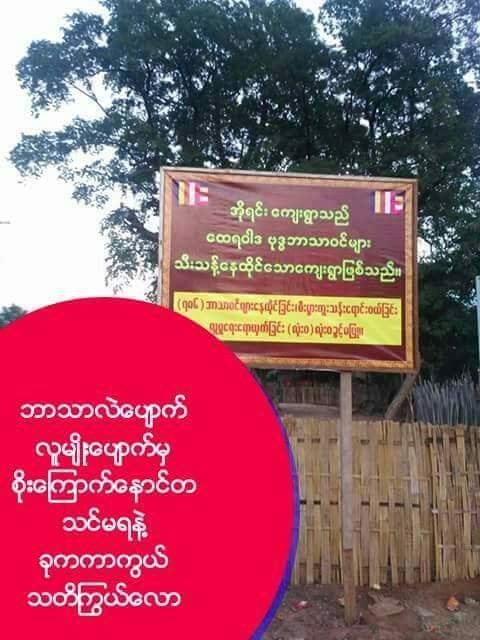
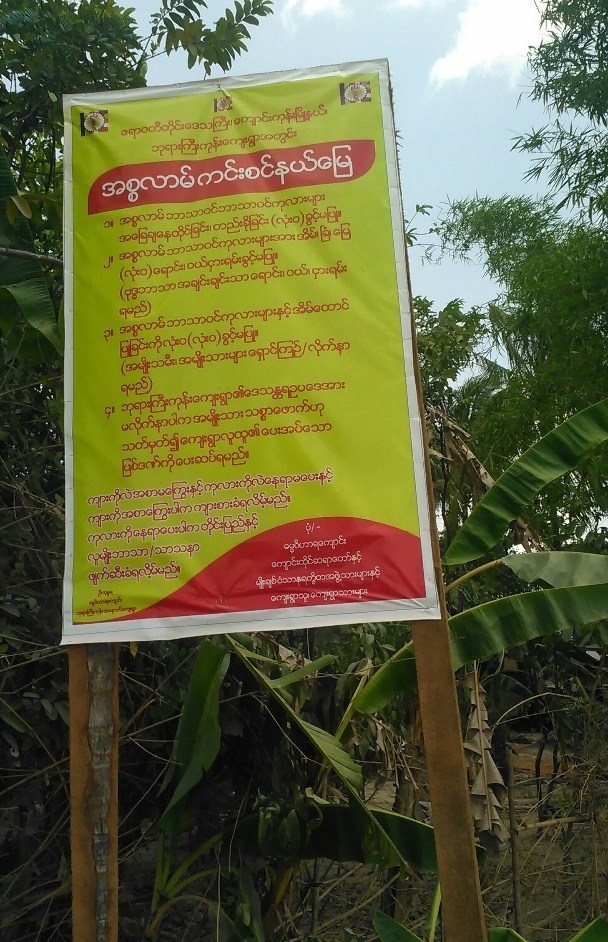


Orinn village in Ngathayauk township (left), Pha Yar Gyi Kone village Kyaungone Township.(right) Myanma Pyath village in Nyaungdone township (left), Ingyin Pin village in Shwebo Township.(right)
Economic Discrimination
Buddhist extremist organizations and their supporters have carried out the Tatmadaw booklets’ calls to destroy the economic foundations of Muslim life. They have boycotted businesses, identifying them by symbols – such as crescent moons or the number 786 - or by the appearances of their owners. Monks have participated in the intimidation, and in some cases the physical attack, of Muslim vendors operating stalls near Buddhist pagodas.143 Muslims whose citizenship has been revoked struggle to find stable, well-paying jobs. Muslim students report being denied access to government universities because of their ‘mixed blood’. Muslims who have managed entrance into university have been told they must submit their citizenship papers in order to receive their degrees. Lack of access to higher education has a direct impact on Muslims’ abilities to pursue professional careers.
Religious Discrimination
Muslims have been prohibited from observing Islamic holidays and banned from building Islamic schools and Mosques. Existing schools and places of religious worship have been destroyed. In some cases, authorities have imposed bans on worship at Islamic schools. Buddhist nationalist groups have seized sacrificial cattle from Muslims participating in the celebration of Eid and put them on trial under section five of the Emergency Commodity and Service Act.144
- The ’Race and Religion Protections Laws’
In 2015, Myanmar’s parliament passed four laws known as the ‘Race and Religion Protection Laws’ that resembled in some respects the ‘Race Protection Law’ advocated by Method 10 in Methods to Protect Against Extinction of the Race . The legislative package placed restrictions on interfaith marriages and religious conversion, banned polygamy, and put laws in place to control population growth among targeted groups. Buddhist extremist groups including 969 and later MaBaTha lobbied heavily for the laws, lending credibility to fears that the legislation supported a broader anti-Muslim agenda.
- The Religious Conversation Law
The Religious Conversion Law requires any citizen who wishes to change their religion to request formal approval from Registration Boards for Religious Conversation, established in townships. The process requires an applicant to be interviewed by the Board and engage in several months of religious study before receiving approval. While the law is not as explicit as Method 10 – which recommended that Buddhist women who marry outside the faith be prosecuted and sentenced to 10 years in prison – it includes punishment for forced conversion and for applying to convert ‘with the intention of harming a religion.’145
- Myanmar’s Buddhist Women’s Special Marriage Law
A second law regulates marriages between Buddhist women and non-Buddhist men, requiring parental consent for women under the age of 20 and allowing local registrars to publicly post marriage applications for 14 days to determine whether there are any objections to the unions. Supporters of the laws say they protect Buddhist women from being forcibly converted to Islam. Critics say the laws penalize intermarriage through a system of barriers, public intimidation, and the threat of prosecution. In a joint statement, Amnesty International and the International Commission of Jurists, decried the laws as discriminatory and warned that they violate human rights including the freedom of thought, conscience and religion, and privacy rights.146
- Population Control Law
The law on population control allows state and regional authorities to request a presidential order that limits reproductive rates by requiring women to space the birth of their children 36 months apart. Authorities can request the order if they determine that ‘population grown, accelerating birth rates, or rising infant or maternal mortality rates are negatively impacting regional development,’ or that there exists an ‘imbalance between population and resources, low socio-economic indicators and regional f ood insufficiency because of internal migration.’147 If triggered, the law designates a ‘special region’ in which the law’s provisions are carried out and a ‘delivery services body’ is formed to ‘administer health care in coordination with the Ministry of Health.’148
The Population Control Law provides the government with legislative infrastructure to reduce Muslim birth rates in a country where ethnic and religious minorities have already been targeted based on identity and region, and where Rohingya in Rakhine State have experienced involuntary birth reduction measures. Amnesty International found ‘the power given to the Ministry of Health, its related departments, and Regional and State authorities to issue notifications, orders, instructions, and procedures in implementing provisions of the law without oversight Article 19)’ to be ‘particularly alarming’.149 If carried out with the intent to destroy a group in whole or in part, the law would violate Article II d) of the Genocide Convention : ‘imposing measures intended to prevent births within the group.’
- Monogamy Law
The monogamy law makes it a criminal offence to have more than one spouse or to live with an unmarried partner. The government has denied that the law targets Muslims, though some see it as specifically directed at Muslim groups who practice polygamy.
Dehumanization
In genocide, dehumanization supports the genocidal entity’s logic of annihilation and makes killing easier by denying the humanity of the target group and justifying the group’s destruction. Target groups are often likened to diseases or animals that illicit feelings of revulsion or that pose a threat to society (the Nazis referred to Jews as rats, Hutus called Tutsi cockroaches, etc.). Genocidal entities disseminate dehumanizing language through propaganda, textbooks, radio, and social media, indoctrinating society and making incitements to violence more effective.
The dehumanization of Muslims is endemic in government/military propaganda and hate speech propagated by nationalist groups. In their propaganda booklets, the Tatmadaw likens Muslims to insects eating the roots of a tree, to decay eroding the foundations of a pot, and to snakes ready to swallow taingyintha whole. The analogies contribute to a logic of annihilation which creates an existential threat and argues that the extermination or removal of Muslims is necessary for the survival of the Burman Buddhist community. Colloquially, initiatives to strip Muslims of their citizenship and documentation have been referred to as the Flower Bed Project, with Muslims likened to the weeds that must be cleansed for the flowers [Burman Buddhists] to thrive.
Organization and Preparation
Genocide requires organization and planning. Genocidal entities mobilize resources – military, economic, bureaucratic, and civilian – to pursue the destruction of target groups. They must appropriate or develop infrastructures that disseminate propaganda and instill rationales for extermination among the population (through schools, mass media, religious institutions, nationalist groups, civil service, and military training programs, among others). They must organize segments of the state, its militaries, and/or non-state militias and actors to apply coercive control against target groups; examples include enforcing discriminatory laws, rounding people up and detaining them, working people to death through slave labor, violently expelling people, and carrying out massacres or executions. While organization can occur at local levels (in specific communities) or decentralized levels (terrorist or nationalist groups), it often operates as part of a larger genocidal process facilitated or consciously condoned by state or military powers. In Myanmar, the Tatmadaw and military-led governments have achieved much of this organization work through Buddhist nationalist groups.
The genocidal process also entails phases of targeted preparation, during which genocidal entities plan specific actions or operations that escalate coercive control over their target groups. Preparations may include plans for the ultimate form of coercive control, which is killing. Signs of preparation for genocide include the dissemination of logics of extinction that identify the target group as an existential threat and instill fear of the group in the population, the training of military units and militias, the stockpiling of weapons or tools for killing, and the creation of physical infrastructure for the detainment or murder of the target group (concentration or death camps, routes for death marches, etc.).
Genocidal entities often cloak such preparations in euphemisms that denote actions perceived as necessary for purifying the dominant society or solving its most urgent problems. Nationalist leaders in the Ottoman Empire and Nazis in Germany spoke of implementing ‘Final Solutions’ to their respective Armenian and Jewish ‘ problems ’ . Hutus in Rwanda were told to go to work – a euphemism for the brutal job of hunting down and hacking Tutsi to death with machetes and clubs. In 2017, the Tatmadaw carried out what it called ‘clearance operations’ against Rohingya and ethnic minorities in western Myanmar.
Sudden increases in the above actions, rhetoric, and propaganda can signal moments of escalation in the genocidal process and can be triggered by events that threaten the security or dominance of the ruling group (elections, peace processes, attempted coups, judicial indictments, international sanctions, or regional shifts in power).
The General Administration Department & the training of civil servants
One of the farthest-reaching bureaucratic bodies in Myanmar is the General Administration Department, which falls under the military-controlled Home Affairs Ministry. With over 36,000 staff, the department operates in every township in the country and is responsible for a wide range of functions that include ensuring law and order, maintaining ‘community peace and tranquility,’ overseeing regional development and land administration, and collecting taxes. The department also oversees the training of civil servants.
Working through the General Administration Department, the military uses civil service training programs to indoctrinate government employees with anti-Islamic propaganda. The largest training program in Myanmar is run through the Central Civil Servant Training University, which has campuses in
Phaunggyi
and
Zeebingyi
. Together these campuses train 10,000 civil servants each year. In some cases, the training is mandatory while in others the incentive is a greater likelihood of promotion. Trainings last two months and include lectures by current and former members of the armed forces.
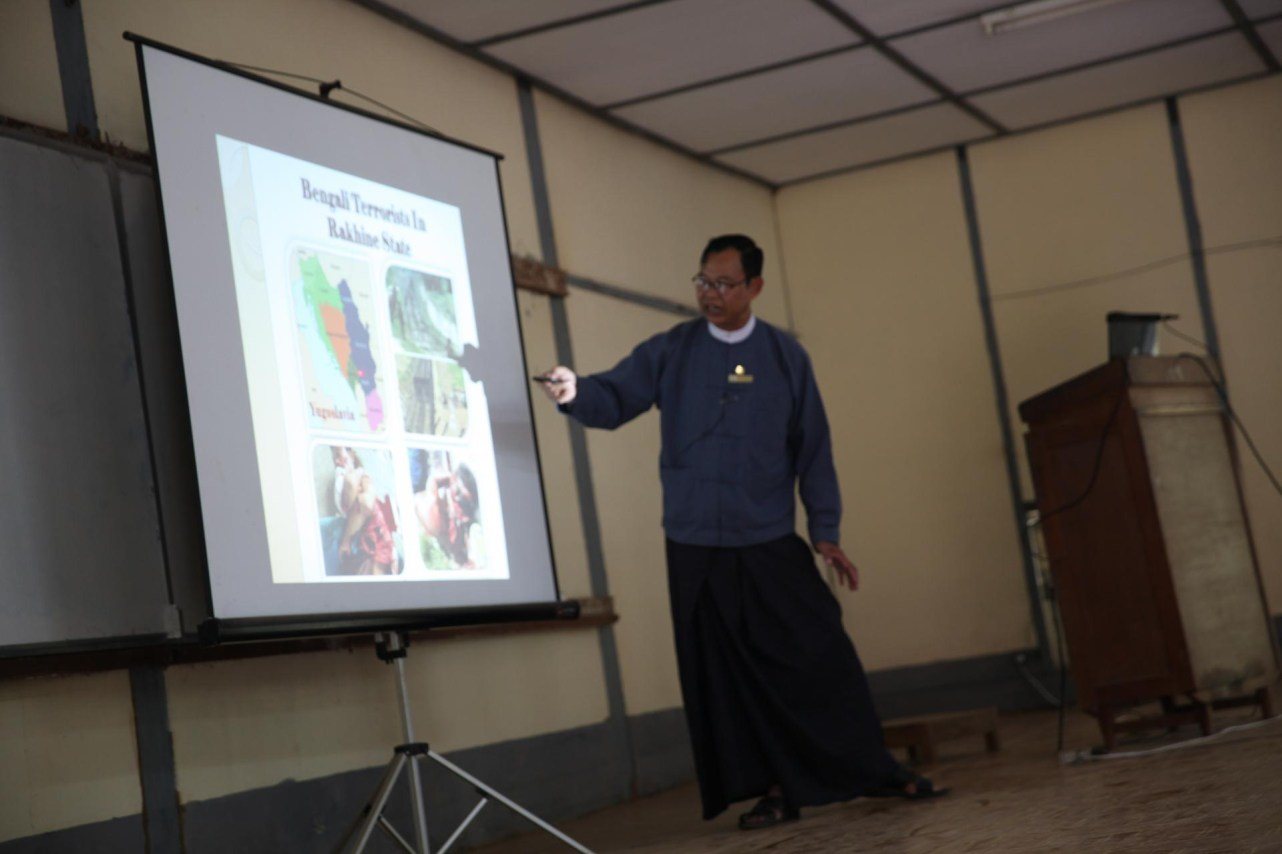
Presentation slides obtained by the BHRN show content remarkably like the propaganda in the 1989 and 2008 booklets produced by the Tatmadaw. In a 2012 presentation delivered by Lieutenant Toe Naing and titled ‘We fear the diminishing of our race’ , students were warned of immigrants from ‘China, Hindu India, and Muslim Bangladesh’ penetrating the country in large numbers and giving birth ‘to mix - blooded offspring’ to expand their religions. The lecture reproduced the narrative found in We fear the Extinction of the Race , tracing the history of Islam’s spread through Asia, emphasizing polygamy as a tactic of population growth and the execution of conquered peoples who refuse to convert to Islam. Multiple slides bore variations of the saying printed in Methods to Protect Against the Extinction of the Race : A race does not vanish by being swallowed into the earth by a landslide, but from being swallowed up by another race.150 In another training, U Ohn Hla, former chair of the National Human Rights Commission, argued that Myanmar must place national interest above international human rights resolutions : ‘Should we take back the Muslims in the camps in Bangladesh, who are wearing beards . . . do we have to accept them as our citizens? They do not even know our history. We do not need to recognize them. Our country should not grant human rights to Muslims. They should be excluded from [the] human rights we are talking about.’151
The military’s blatant indoctrination of civil servants has not gone without criticism. In 2018, Dr. Soe Thura Zaw, a dentist who underwent an 8-week course designed for people entering senior government jobs, sparked a formal investigation into the Civil Servant Training program when he accused the program of brainwashing students with ‘Ma Ba Tha Dhamma talk’ (referring to an extremist Buddhist nationalist group discussed below) and making political statements against the ruling NLD party, which won the 2015 election. When the Ministry of Health put Zaw on trial in Mandalay for violating regulations for government staff, hundreds of former trainees wrote on social media to corroborate his account.152 The episode led the NLD government to transfer the General Administration Department to the Ministry of the Office of the Union Government in December 2018. The transfer appears to have been reversed by the military junta that took power in 2021. The government website of the General Administration Department lists its structure as residing once again under the Ministry of Home Affairs.153 While events surrounding Dr. Zaw’s testimony show that not all civil servants are internalizing the military’s propaganda, the Tatmadaw remains in control of a powerful bureaucratic system designed to embed its anti- Muslim messaging in the minds of people charged with implementing state policy.
The PowerPoint presentations used in training conducted by the military in 2012 include anti-Muslim hate messages


The role of Buddhist nationalist movements
Outside formal bureaucratic structures, Buddhist nationalist movements such as the 969 movement and The Association for the Protection of Race and Religion (MaBaTha) have advanced the dehumanizing rhetoric and anti-Islamic propaganda found in The Fear of Extinction of the Race (1989), implemented the methods outlined in Methods to Protect Against Extinction of the Race (2008), and incited and participated in violence against Muslims. While the movements have had different structures and various levels of centralization over time, they have ties to the Tatmadaw military and have provided platforms for organized action in line with the strategies promoted by the Tatmadaw’s publications.
The 969 movement
The 969 movement (discussed above) offered an economic rationale for discrimination and violence against Muslims. Its symbolic logo, representing the attributes and teaching of Buddha and the monkhood, was used to identify Buddhists and polarize them from people of other faiths. The movement’s stickers, which became visible on Buddhist shops, vehicles, homes, and belongings, represented what one scholar describes as ‘not just an exclusivist wave seeking to engulf the entire country, but symbols of identification, distinguishing between supporters and the enemies – the Muslims.’154
Connections between the Tatmadaw and 969
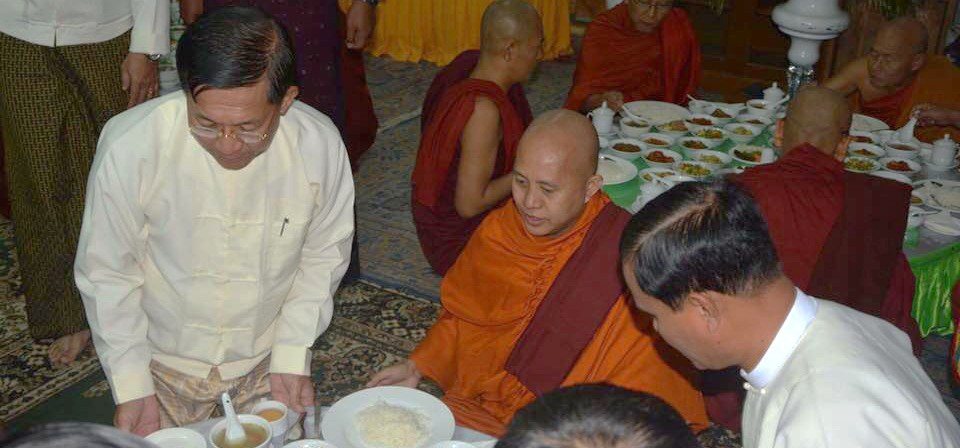

CoC of the Myanmar Military, Senior General Min Aung Hlaing donate to Wirathu on 30 Nov, 2016 CoC of the Myanmar Military, Senior General Min Aung Hlaing confer Religious Honorary Titles to U Wirathu on January 2, 2023.
While 969 operated as a decentralized movement and relied on the economic support of individual monks and their respective monasteries, it had close connections to the military junta, first through director-general of the DDPS, Kyaw Lwin, whose writing provided ideological inspiration for the movement, and then through government support for its leaders and its message after Lwin’s death.
When Kyaw Lwin died in 2001, his mantle was taken up by a radical monk named Wiseitta Biwuntha (commonly known as Wirathu). Wirathu had met Lwin in 1992 and the two remained in touch.155 After Kyaw Lwin’s death, Wirathu became one of the movement’s most well -known and incendiary advocates for violence against Muslims.
In 2010, former General U Thein Sein – who had served as prime minister for the military junta since 2007 – retired from the Tatmadaw along with 22 military officers to lead the newly created Union Solidarity and Development Party (USDP) in the 2010 elections. The creation of the USDP gave t he military an insurance policy amidst the country’s transition to democracy. The referendum reserved 25 per cent of seats in the new parliament for the USDP, and these were allocated to serving officers.156 When the NLD (whose leader, Aung San Suu Ky was banned from standing) boycotted the elections, the USDP won a resounding but controversial victory. Thein Sein became president in March 2011, giving the country a nominally civilian government with significant amounts of military control over its political and economic resources.
In October 2011, Thein Sein issued an amnesty package freeing a number of political prisoners. Among them was Wirathu, who had been arrested in 2003 for inciting communal riots that killed 10 Muslims in his hometown of Kyaukse.157 After his release, Wirathu campaigned fiercely for the 969 movement. Once again, the extremist discourse spread by the movement mirrored the rhetoric of the Tatmadaw’s booklets, including warnings about a Muslim plot to take over the country and schemes to pay Muslim men to marry and convert Buddhist women.158 The movement’s actions also aligned with specific strategies outlined in Methods to Protect Against Extinction of the Race , including continued boycotts of Muslim businesses (called for in Method Seven: To make three cuts) and support for legislation that resembled the ‘race protection law’ in Method 10.
Meanwhile, President Thein Sein described 969 as ‘a symbol of peace’ and referred to Wirathu as ‘a son of Lord Buddha.’159 Myanmar’s minister o f religious affairs – a former lieutenant general in the army named Sann Sint – insisted that 969’s proclamations were messages of peace. Scholar Bibhu Prasad Routray, in his 2013 profile of 969 for the Institute of Peace and Conflict Studies, identified th e Tatmadaw as the driving force behind the movement, noting: ‘The real power behind the 969 movement, however, is the military rulers who have implanted a sense of hatred for Muslims in the mind of the general populace, and have enacted ad hoc and de facto discriminatory restrictions.’160
The Tatmadaw likely saw in 969 the new organization outlined in Method 17: ‘To form a Sangha Committee for the comprehensive development of Buddhists.’161 As noted above, the Buddhist Sangha wields tremendous influence. In Kyaw ’s analysis, it possesses ‘ the ultimate moral authority and organizational efficiency ’ in Myanmar society.162 Method 17 was a radical repudiation of the Sangh, tantamount to calling for its replacement ( likely in response to monks’ participation in anti-military protests). An organization in lockstep with the military’s ideology and with the ability to draw on the moral authority held by the monkhood offered the Tatmadaw an unparalleled opportunity to restore its standing with the Buddhist public and to advance its agenda of maintaining power through the targeting and persecution of the country’s non - Buddhist population.
The relationship between the Sangha Council and the 969 movement was indeed strained. In 2013, 969’s lobbying for the Protection of Race and Religion laws earned the ire of the Council, not because the Sangha opposed the laws themselves, but because it saw them as falling exclusively under the purview of the Council and the Ministry of Religious Affairs. The Sangha banned 969, citing its unauthorized use of Buddhist symbolism. Members of 969 rejected the ban, criticizing the Sangha for placing political interests above those of the Buddhist faith and challenging its religious legitimacy.163 The sentiments were forceful iterations of the critiques in Methods to Protect Against Extinction of the Race . In its rhetoric, its actions, and its growing status across the country, the 969 movement was precisely the type of organization the Tatmadaw had hoped to inspire.
The Association for the Protection of Race and Religion (MaBaTha)
The Sangha’s ban of the 969 movement led to the emergence of a more organized nationalist group, The Association for the Protection of Race and Religion (known by its Burmese language acronym, MaBaTha). Founded in June 2013, MaBaTha developed a more formal (but still decentralized) structure than the 969 movement. It included roles not only for monks, but for laymen and women, which created ambiguity about whether it fell under the Sangha Council’s jurisdiction.164 By 2014, MaBaTha had an upper branch in Mandalay and was taking its anti- Muslim nationalist message deep into the rural areas of the country; by 2017 it would have eight regional branches. As with the 969 movement, the similarities between MaBaTha’s strategies and the methods outlined in Methods to Protect Against Extinction are striking.
MaBaTha has significant grassroots support in Myanmar, not least because of the way it blends its anti-Muslim message with the promotion of Buddhism and social work. The need to respond to Buddhists’ economic and social grievances is a central theme in Methods to Protect Against Extinction of the Race . While many of the methods advocated for active discrimination against Muslims, others focus on the importance of education initiatives, supporting Buddhists in the economic sector, and promoting Buddhist values. Indeed, the methods identified as the ‘three key systems’ (methods four, five, and 16) focus on integrating anti-Muslim ideology into monasteries, schools, and homes through the opening monastic and religious schools, the introduction of ‘cultural classes’ in secular curricula, and programming for youth and families. Others, such as Method 11: ‘ to establish poor relief fund organizations ’ , address the importance of assisting Buddhists economically. These are not seen as separate from the anti-Muslim ideology the booklet espouses but as critical means of disseminating the message, supporting a resurgence of Buddhism among young people, and enabling Buddhist men to be economically competitive with Muslims so they can attract Buddhist wives.
In interviews conducted with MaBaTha supporters in 2017, the International Crisis Group found that ‘ [f]or many – male and female – MaBaTha provides not only a powerful, well-funded channel for participation in community-support activities, but also a sense of belonging and direction in a context of rapid societal change and few jobs or other opportunities for youth. ’165 The movement invests heavily in Buddhist Sunday schools (along with some secular education initiatives), women’s organi zations, and social services such as legal aid and disaster relief. It also has support from Buddhist women who feel that MaBaTha’s commitment to the Protection of Race and Religion laws responds to their concerns about polygamy and forced conversion, which many see as the by-product of Muslim-Buddhist marriages.166 This shows the difficulty in separating issues such as women’s rights and religious freedom from commonly held fears about Islam. As the International Crisis Group notes, MaBaTha ‘ sees itself – and is viewed by many of its supporters – as a broad-based social and religious movement dedicated above all else to the protection and promotion of Buddhism at a time of unparalleled change and uncertainty in a country and society where historically Buddhism and the state have been inseparable. ’167
There is no doubt that MaBaTha’s commitment to the protection and promotion of Buddhism also includes active promotion of the discriminatory methods found in the 2008 booklet and discussed above . Its leaders are vocal about the need to ‘make three cuts’ (method seven) - isolating Muslims economically, socially, and through the banning of interfaith marriages. The movement has produced and disseminated virulent anti-Islamic sermons and publications, advocated for legislation that restricts the freedoms of religious minorities, developed religious education curricula that includes anti-Muslim ideology, led boycotts of Muslim businesses, encouraged the establishment of ‘Muslim - free’ villages, and incited violence through social media. In Rakhine state, MaBaTha has petitioned local authorities to prevent Muslims displaced by violence from returning to their homes.
While the Sangha declared MaBaTha illegal in May 2017, its nationalist members have carried on their agenda through re-named organizations like the Dhamma Parahita Foundation and the Rightful Patriots Association. Since the military’s 2021 coup, they have also served as recruitment pools for proxy militia groups (discussed below).
Extreme Buddhist nationalist groups are powerful vehicles for disseminating the anti-Islamic ideology propagated by the Tatmadaw and organizing actions against Muslims. While the Tatmadaw booklets avoid outright calls for physical violence (this would be seen as violating Buddhist values), they dehumanize Muslims, identify Muslims as an existential threat to Buddhism and to the nation’s Buddhist identity, and include incendiary commands like Method 14 – ‘ To be on standby to prevent the threat of violence by race-consuming colonists .’ Nationalist groups have used this exterminatory logic to incite and justify violence against Muslims. At times, nationalist groups have participated alongside state military forces in the persecution of Muslims. Their ties to the military, their decentralized structures, and their levels of broad-based support make them key but fluid actors in the genocidal process, capable of escalating and carrying out actions against Muslims or – if their leaders so choose – of de-escalating such attacks.
Proxy militia groups
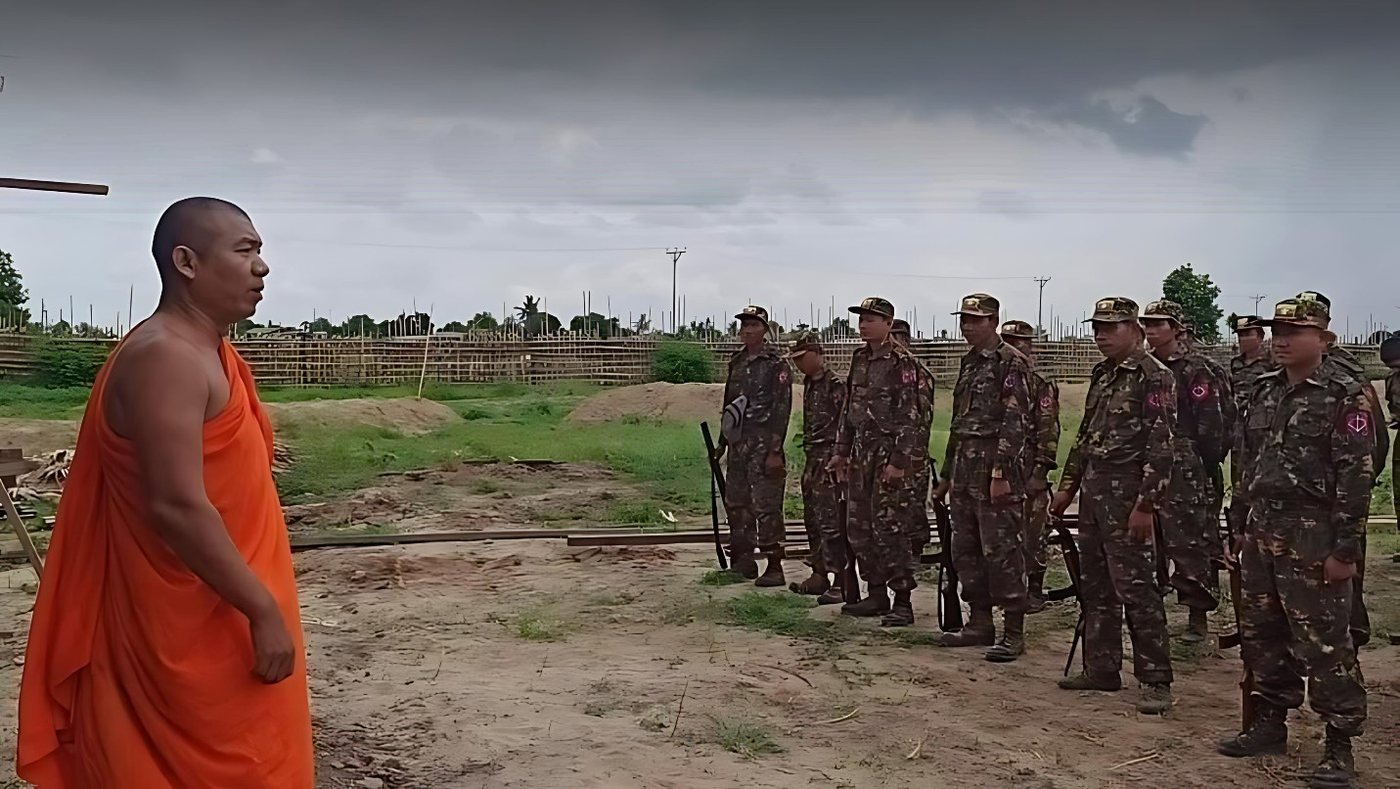
Since the defeat of the military backed USDP party in Myanmar’s 2020 elections, the Tatmadaw has created networks of proxy militia groups across the country. The largest such group is Pyu Saw Htee , named after a king from the Bagan era (9th-13th centuries). A previous iteration of the group existed from 1955-1958 and operated largely against political opponents of the ruling party, using intimidation and violence against opposition candidates and in some cases murdering political rivals. Following the milit ary’s political defeat in 2020, the head of the Tatmadaw, General Min Aung Hlaing, revived the group, turning it into a weapon against pro- democracy activists and internal enemies. In February 2021 Hlaing took power in a coup d’état and appointed himself Prime Minister and Chairman of a new military junta, the State Administration Council (SAC).
Pyu Saw Htee grew substantially after the coup. Many of its members appeared to be former members of MaBaTha and the Dhamma Parahita Foundation (which the Sangha banned in 2019). Observers in Myanmar noted that shortly after the 2020 election, members of extremist Buddhist nationalist groups changed their social media profiles to Pyu Saw Htee . In March 2021, Hlaing established a headquarters for Pyu Saw Htee in Mandalay. The Mandalay branch and a branch in Yangon oversee smaller branches throughout the country. The Tatmadaw directly oversees the group, providing training, financial and military support, and directives. The group collects information on enemies of the Tatmadaw, assists the military in communications and military affairs, and fights against armed and unarmed groups who oppose the SAC. In February 2022, an independent local media source, Myanmar Now , published a report claiming the military had established 77 militia groups and provided them with over 2000 weapons.168 The military periodically changes the names of its proxy groups (from Pyu Saw Htee to Thway Thauk Apwe , for example) to avoid scrutiny.
As the military and SAC junta have faced more formidable opposition from armed opposition groups across Myanmar, the use of proxy militia groups has become a central part of their strategy to retain power. A leaked order by Min Aung Hlaing from August 2022 detailed plants to mobilize members of Myanmar’s Fire Brigade and Red Cross against anti -regime activists as well as plans to establish a Public Security Force that includes police, military veterans, militia groups, fire brigade and Red Cross personnel, and members of social organizations like the Young Men Buddhist Association (YMBA).169 A 2024 report by the BHRN lists locations of five pro-military proxy groups, including Pyu Saw Htee , Nagarapala , Patriotic Alliance, Sun Ye , and Thway Thauk . The report details attacks, political assassinations, and public intimidation tactics carried out by such groups over the past four years.170 While the proxy groups’ immediate focus is on defeating the armed opposition in what has become a civil war, they represent organizations the Tatmadaw could use to continue its strategy of creating instability and targeting Muslims and other constructed enemies if it succeeds in maintaining power.
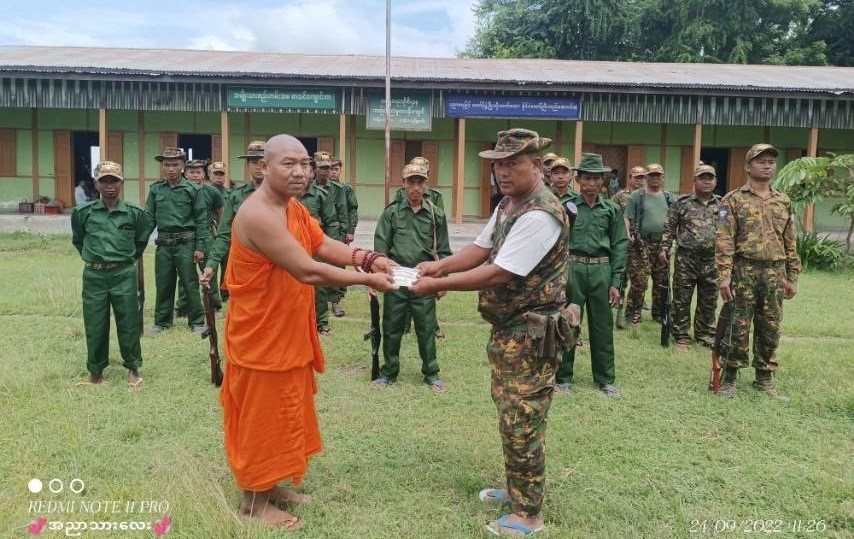
Polarization
Polarization encompasses propaganda, hate speech, and legislation that isolates the target group from the dominant society and increases their vulnerability to coercive control. Examples include the broadcasting of polarizing propaganda, actions taken by extremists to drive the groups apart, and laws that forbid intermarriage or social interaction.171 Polarization can also include intimidation and attacks on moderate members of the dominant group, who are viewed as potential resistors to escalations of the genocidal process.
The booklets published by the Tatmadaw in 1989 and 2008 are prima facia examples of polarizing propaganda. Other examples of polarization in Myanmar include the race and religion laws, the dissemination of anti-Islamic propaganda by nationalist groups, and hate speech promulgated by extremist monks like Wirathu.
Wirathu and other extremists have used social media as a vehicle for inciting discrimination and violence toward Muslims. Much of this reads as though copied from the Tatmadaw booklets. For example, a 2018 independent international fact-finding mission by the Human Rights Council cited a Facebook post that read: ‘ every citizen has the duty to safeguard race, religion, cultural identities and national interest. ’172 Myanmar authorities have condoned these narratives and used rhetoric that mirrors their polarizing message, especially when it comes to Rohingya Muslims. Examples include the insistence that Rohingya do not exist or belong in Myanmar; the association of Rohingya identity with terrorism; and the repeated allusions to illegal immigration and uncontrollable birth rates.173 State-level rhetoric reinforces the false and incendiary information shared on social media platforms. In the words of the investigation ’s report: ‘The Myanmar authorities, including the Government and the Tatmadaw, have fostered a climate in which hate speech thrives, human rights violations are legitimized, and incitement to discrimination and violence facilitated.’174
Polarizing propaganda in Myanmar has also included language that accuses Buddhists who do not support discrimination against Muslims, or women who marry non-Buddhist spouses, as traitors to their nation and religion. The same can be said of the sign constructed by the Muslim- free village of Pha Yar Gyi Kone, which warned that anyone caught breaking the local rules would be labeled a traitor and punished.
Persecution
Muslims across Myanmar face sporadic and systematic persecution. Some episodes, such as the violence in Western Myanmar in 2012, have received international coverage and have been condemned by human rights bodies. Other, smaller-scale episodes of violence, which have taken place with regularity throughout the country, have received attention primarily through the work of local and regional organizations.


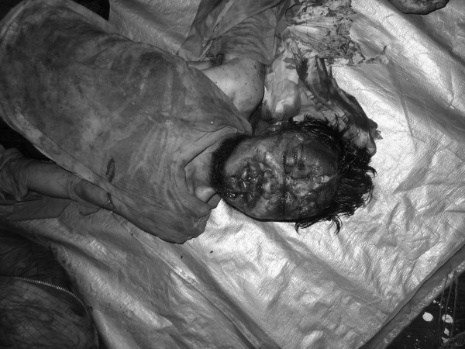
Taungup massacre on 3 rd Jun, 2012 In Rakhine State, persecution has been systematic and state-led. It has included killing, physical and sexual violence, forced expulsion, the burning of villages, forced labor, local restrictions on the number of children Muslims are allowed to have, the confinement of internally displaced persons (IDPs) in government-controlled camps and shelters.
In 2012, police, military, and Buddhist citizens killed, raped, and beat Muslim civilians. Roughly 130,000 Rohingya and Kaman were forced into IDP camps, where they have remained for over a decade. A UN officer working in Rakhine State at the time noted the significance of the escalation. While Muslims in Rakhine had faced oppression for decades, the coordinated attacks of 2012 signaled a coordinated, longer-term approach – ‘Corner them, fence them, confine the “enemy.”’175 The coercive control achieved over the Rohingya and Kaman in 2012 provided the preparatory groundwork for exterminatory campaigns in 2016 and 2017.
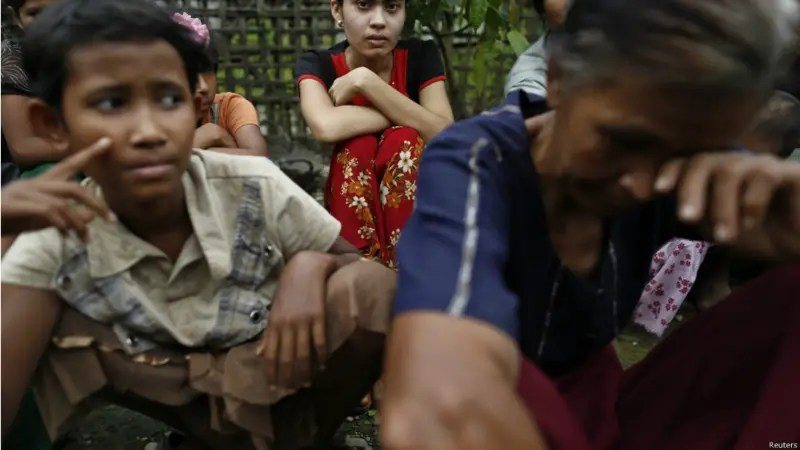
Today, Muslims in Rakhine State survive in squalid IDP camps, which Human Rights Watch in 2020 called ‘open - air detention facilities, where they [Muslims] are held arbitrarily and indefinitely.’176 People in the camps suffer from lack of medical care, lack of access to education, malnutrition, disease, and high maternal and infant mortality rates.177 The camps are, as former United Nations Assistant Secretary- General Ursula Mueller said in 2018, ‘beyond the dignity of any people.’178 Since the outbreak of civil war in 2021, Muslim IDPs have been victims of forced conscription – used as slaves by the Tatmadaw to fight for the same regime that is persecuting them. The detention of people in such conditions constitutes a crime of genocide under Article II(c): ‘ Deliberately inflicting on the group conditions of life calculated to bring about its physical destruction in whole or in part.’179
In other parts of the country, Muslims experience sporadic episodes of communal violence that are more difficult to predict. In some cases, waves of persecution seem to spread through the country, as they did between 2012 and 2014 when violent riots directed primarily at Muslims occurred in Meiktila (March 2013), Okkan (April 2013), Lashio (May 2013), Kanbalu (August 2013), and Mandalay (July 2014).180


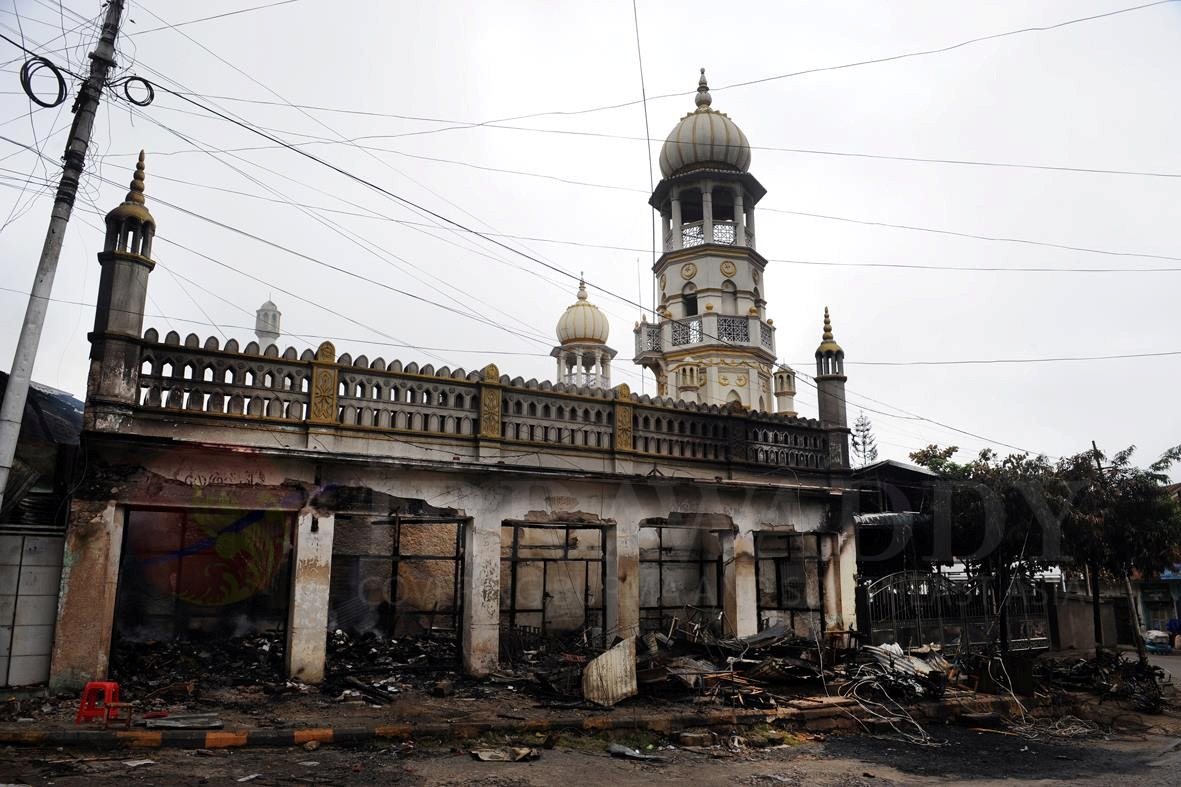


Meiktila riot in March 22, 2013. (Photo : Soe Than Win) Muslims people remove debris from a damaged mosque following fresh anti-Muslim violence broke out in Okkan, 64 kilometers (40 miles) north of Yangon, May 1, 2013. (Photo:AP) In 29 May 2013 – A Grand Mosque in Lashio attacked and set on fire by 969 extremist groups (Photo - Steve Tickner /Irrawaddy) A Muslim woman and children clear debris of a burnt-down building in Htan Gone village of Kantbalu township, Sagaing Division, Burma, Aug. 26, 2013.(Photo:AP) The mob that took part in the Mandalay riots in July 2014. (Photo: Steve Tickner/ Irrawaddy)
Some of these episodes have been covered by international news platforms. On March 20, 2013, a mob of Buddhist civilians attacked Muslims in the central Myanmar town of Meiktila. Video footage taken by local police and aired by the BBC shows looting of Muslim businesses, the burning of Muslim homes, and the killing of Muslim civilians. A man in the crowd yells: ‘Muslims are not Burmese.’ Monks are captured in the film angrily inciting the mob, while riot police look on, either unable or unwilling to intervene. In one portion of the footage, a Muslim man being burned alive lies on the ground. ‘ Pour water on him ’ , a voice can be heard saying. It is quickly followed by another: ‘ Let him die. No water for him. ’ In reprisal, Muslims in Meiktila killed a monk. The following day, video of the pogrom captured the brutal beating to death of a young Muslim man. A monk in an orange robe can be seen in the group of five men wielding sticks and a sword against the huddled figure on the ground.181 The BBC estimated that the mobs killed at least 43 Muslims. The victims included 12 Muslim children, dragged from a local orphanage, beaten, and burned alive as a mob chanted “We are Bama.”
Extermination
By 2017, Rohingya living in Rakhine state faced extreme levels of coercive control. Authorities restricted their freedom of movement, requiring them to receive official authorization to move between (and even within) townships or risk arrest and prosecution. Curfews granted authorities discretion ary power to limit peoples’ right to assemble in groups and to move freely after dusk. Security forces were heavily present in villages. Many Rohingya continued to struggle with the physical and mental consequences of violence perpetrated by the military and organized militias in 2012.182
In 2017, the Tatmadaw carried out what it called ‘ clearance operations ’ in Rakhine State, orchestrating the killing, mass rape, sexual enslavement, mutilation, and torture of Rohingya and of ethnic groups from the Kachin and Shan States, and carrying out the scorched earth destruction of villages. In 2018, the ‘ Report of the independent international fact-finding mission on Myanmar ,’ by the Human Rights Council determined that security forces acting together with segments of the civilian population committed four of the five criminal acts prohibited by the Genocide Convention: a) killing; b) causing serious bodily or mental harm; c) inflicting conditions of life calculated to bring about the physical destruction of the group in whole or in part; and d) imposing measures intended to prevent births.183 They also identified multiple factors indicating intent, including: ‘ the broader oppressive context and hate rhetoric; specific utterances of commanders and direct perpetrators; exclusionary policies; including to alter the demographic composition of Rakhine State; the level of organization indicating a plan for destruction; and the extreme scale and brutality of the violence committed. ’184
The investigation rejected the Tatmadaw’s claims that the violence was a necessary response to security threats posed by ethnic armed groups including the Arakan Rohingya Salvation army (ARSA) and the ethnic Rakhine Arakan Army. Drawing on a statement made by the Tatmadaw Commander-in- Chief, the investigation concluded that ‘The “clearance operations” were not a response to a concrete threat from ARSA, but to the “unfinished job” of solving the “long - standing” Bengali problem.”’185 During a 2018 visit to Bangladesh where roughly 700,000 Rohingya had fled, United Nations Special Adviser on the Prevention of Genocide, Adama Dieng, said ‘ Rohingya Muslims have been killed, tortured, raped, burnt alive and humiliated, solely because of who they are. All the information I have received indicates that the intent of the perpetrators was to cleanse norther Rakhine state of their existence, possibly even to destroy the Rohingya as such, which, if proven, would constitute the crime of genocide. ’186 Other human rights observers have reached similar conclusions , finding that the government’s actions are ‘unlawfully discriminatory, indefinite, and do not reflect specific security threats as international law requires.’187
In 2019, The International Court of Justice determined that it had jurisdiction under the Genocide Convention to adjudicate a case brought against Myanmar by the Gambia.188 That case is ongoing at the time of writing.
Denial
A final but significant component of the genocidal process is denial. Genocidal entities can engage in denial during and long after genocide through a multitude of actions. In some cases, genocidal entities refuse to recognize that crimes have been committed. Perpetrators cloak their actions in euphemisms; concentration camps are called education centers, forced detainment is referred to as part of a government’s social and development plans, and expulsions are couched as demographic control. Deaths that cannot be hidden are explained as accidents or as consequences of counter-insurgency operations and other security imperatives. Genocidal entities often hide or destroy evidence of crimes – exhuming bodies from mass graves and scattering or burning them to impede forensic testing, denying entry to investigatory teams, and blocking access to sites of killing. State archives are culled or closed to scholars and the public. Denial is critical not only because it makes it difficult to adjudicate crimes of genocide and hold perpetrators accountable, but because it signifies continuing structures within a state and society that put target groups at further risk. As Stanton notes, denial ‘is among the surest indicators of further genocidal massacres.’189
In his 2018 statement, UN Secretary General Adama Dieng wrote : ‘I am perplexed by the denial of the widespread commission of serious crimes that has characterized the response of the Myanmar authorities.’190 He noted that most Rohingya living in refugee camps in Bangladesh wished to return home ‘in safety, dignity and with access to the basic rights that are fundamental to us all.’191 He also recognized that authorities in Myanmar had shown no genuine efforts to allow such a return and that in fact the number of Rohingya fleeing across the border was increasing. ‘ T he solution to this problem lies first and foremost with the Myanmar authorities,’ he stated. Dieng called on Myanmar to create ‘the conditions for the Rohingya population to return home in safety and be entitled to the same rights as any other citizen of Myanmar .’192 He called on the international community to embrace its responsibility to protect an at-risk population from further atrocity crimes. Dieng concluded his report: ‘Under present conditions, returning to Myanmar will put the Rohingya population at risk of further crimes. However, accepting the current status quo would be a victory for those who planned the attacks. We must not accept either of these scenarios. ’193
The continuation of camps for Rohingya and Kaman Muslims in Rakhine State and the government’s refusal to recognize or reverse its actions is itself a sign of the ongoing genocidal process in Myanmar. At the core of genocide is the desire to remove a target group from the dominant society. While it is easy to mistake the beginning and end of a genocide by mapping them onto the start and stop of overt killing, understanding genocide as a process of coercive control in which perpetrators use a variety of methods to achieve group destruction changes the way we view the phases and boundaries of the crime. Genocidal entities use detention, enslavement, starvation, and conscription as slower means of pursuing annihilation. Using such methods as strategic tools of group destruction can serve to obfuscate genocidal intent, delay or avoid international intervention, reduce the human and economic resources needed to destroy a target group, allow genocidal entities and societies to benefit from the labor or sexual exploitation of victims as they are destroyed, and continue genocide by other means when overt killing becomes politically, economically, or logistically inconvenient.
For Muslims in Myanmar, the genocidal process is proceeding with little hope of reprieve. The Rohingya and Kaman living in refugee camps and in IDP camps are removed from Myanmar society. Prohibited from working outside the camps, they are shut out of the economy and excluded from contributing to trades. T hey are not teaching in Myanmar’s classrooms or adding to conversations as pupils. They are not participating in politics or contributing to the Arts. They are removed from the cultural fabric that makes up society. As the genocidal process has continued against Muslims in other parts of the country, they too have seen their space and rights within society shrink. Many fear that the extermination and expulsion of Muslims in Rakhine State is a test project for how the Tatmadaw might deal with all of Myanmar’s Muslim peoples. Meanwhile, authorities deny the plight of Muslims and any responsibility for it by refusing to recognize them as citizens. Muslims exist in a state of vulnerability, scapegoats for a military regime that sees their destruction as an acceptable price to pay for maintaining power and victims of a society in which voices of extremism and intolerance are drowning out calls for moderation.
9Conclusion
In November 2020 , the NLD won a majority of seats in Myanmar’s election. The Tatmadaw and its aligned USDP party refused to recognize the results. On 1 February 2021, before the new parliament could be sworn in, the Tatmadaw overthrew the government and restored their rule through a military junta. Invoking the ‘ state of emergency ’ clause in article 417 of the 2008 constitution, they shut down the national communications system, placed government officials and parliamentarians under house arrest, and detained political activists. The military transferred power to Commander-in-Chief Min Aung Hlaing and announced the creation of the ‘ State Administrative Council ’ (SAC). In September, the junta dropped all charges against Ashin Wirathu, who had been arrested for sedition in 2019 and was awaiting trial.
Millions of people in Myanmar united in resistance to military rule. Within days, people of different ethnicities, ages, and socio-economic statuses formed the Civil Disobedience Movement (CDM) to organize protests. Members of the elected NLD-led government formed the National United Government (NUG).194 The junta unleashed violent campaigns targeting civilians seen as sympathetic to the protests and NUG. Abuses have been carried out by military and police and by local junta-aligned security forces and supporters.195 In July, 2021, the UN High Commission for Human Rights estimated that 200,000 people had fled their homes.196
The regime ’ s repression of anti-coup protests sparked a wave of armed insurgencies. For the past four years, Myanmar has been locked in civil war. Rohingya have been forcibly conscripted to fight for the military regime. And the junta has again placed regime survival above humanitarian response to natural disaster – bombing resistance-held areas even amidst an ASEAN-brokered ceasefire and rescue efforts in the wake of the catastrophic earthquake that struck Myanmar on March 28, 2025. For the country’s Muslim population, the stakes of the civil war could not be higher.
Muslims in Myanmar are experiencing systematic discrimination, dehumanization, and organized persecution. Rohingya and Kaman Muslims in Rakhine State have suffered crimes against humanity, genocide, enslavement, and most recently, forced conscription in the civil war. Muslims throughout the country are caught in an ongoing genocidal process that threatens their survival. Muslims have been classified as non-citizens, identified as foreigners on identity cards and censuses, discriminated against, dehumanized, and subjected to episodes of persecution and extermination. The actions outlined above have been carried out with the intention of destroying the collective existence of Muslims in Myanmar in whole or in part. Many of these actions fall within Article II the UN Genocide Convention and constitute genocide according to international law. All the actions contribute to a genocidal process that has enabled the state to exert extreme levels of coercive control over them and isolated Muslims from society socially, politically and, in the case of Muslims confined to camps or denied re-entry to the country, physically.
The genocidal process in Myanmar has been orchestrated by the Tatmadaw military, various military governments, and by Buddhist nationalist groups such as the 969 movement and The Association for the Protection of Race and Religion (MaBaTha). The process itself can be traced, from its beginnings during the dictatorship of General Ne Win, through periods of escalation in times of crisis, and continuing today through the work of Buddhist nationalist groups and the military’s persistent strategy of scapegoating the Muslim population. No government in Myanmar, even the democratically elected NLD, has taken action to protect Muslims and restore their rights as full citizens.
The two booklets examined in this report – The Fear of Extinction of the Race and Methods to Protect Against Extinction of the Race – are significant because they suggest that the targeting of Muslims in Myanmar is part of a conscious strategy by the Tatmadaw to maintain control of the country. While there is much we still do not know about the books – including how many have been distributed and how directly influential they have been on members of movements such as 969 and MaBaTha – similarities between the content of the publications and the rhetoric and actions of leading nationalist figures indicate significant connections between the Tatmadaw and Buddhist nationalist groups. The military has also been directly supportive of key figures in these movements – including Kyaw Lwin, who was hand selected to promote Buddhism in 1988, and Ashin Wirathu, who it twice freed from prison. Buddhist nationalist movements in Myanmar have not emerged from a vacuum, nor have they developed organically in response to national and regional pressures, though these pressures are real and have bolstered the movements’ salience. Rather, they should be seen as the outputs of a genocidal narrative that has developed over several decades. While the narrative appeals to people across Myanmar for a variety of reasons, including the country’s colonial past, social divisions, economic grievances, and religious identity, it developed as part of the military’s strategy to maintai n power.
This raises grave concerns for the future pending the outcome of Myanmar’s civil war. If the military succeeds in holding onto power, its grasp will be tenuous. If it follows old patterns, attacks on Muslims (the Tatmadaw’s chosen scapegoat) could escalate as part of the military’s attempt to unite the majority Buddhist population around fears about religious identity. If such escalations emerged, they would do so amidst a context of Buddhist extremism that has gained widespread support in Myanmar with both monks and laypeople and amidst the militarization of civilians involved in proxy militias. While not all supporters of nationalist groups are enthusiastic about their extremist rhetoric and actions, their support for the social programs that these groups provide and their belief in the importance of protecting the country’s Buddhist identity may be enough to convince many to accept or even participate in violence against Muslims.
The saying – ‘a race does not face extinction by being swallowed into the earth, but from being swallowed up by another race’ – is the motto of the Myanmar’s immigration department. Muslims in Myanmar also have a saying – ‘ You will have to draw pictures to describe us. ’
10Appendix: attacks on mosques and Muslim homes since the coup
Photographs of attacks by the Myanmar military on Muslim villages, mosques and religious schools, 2022–2025, with the captions from the report. Tap a page to see it full size.
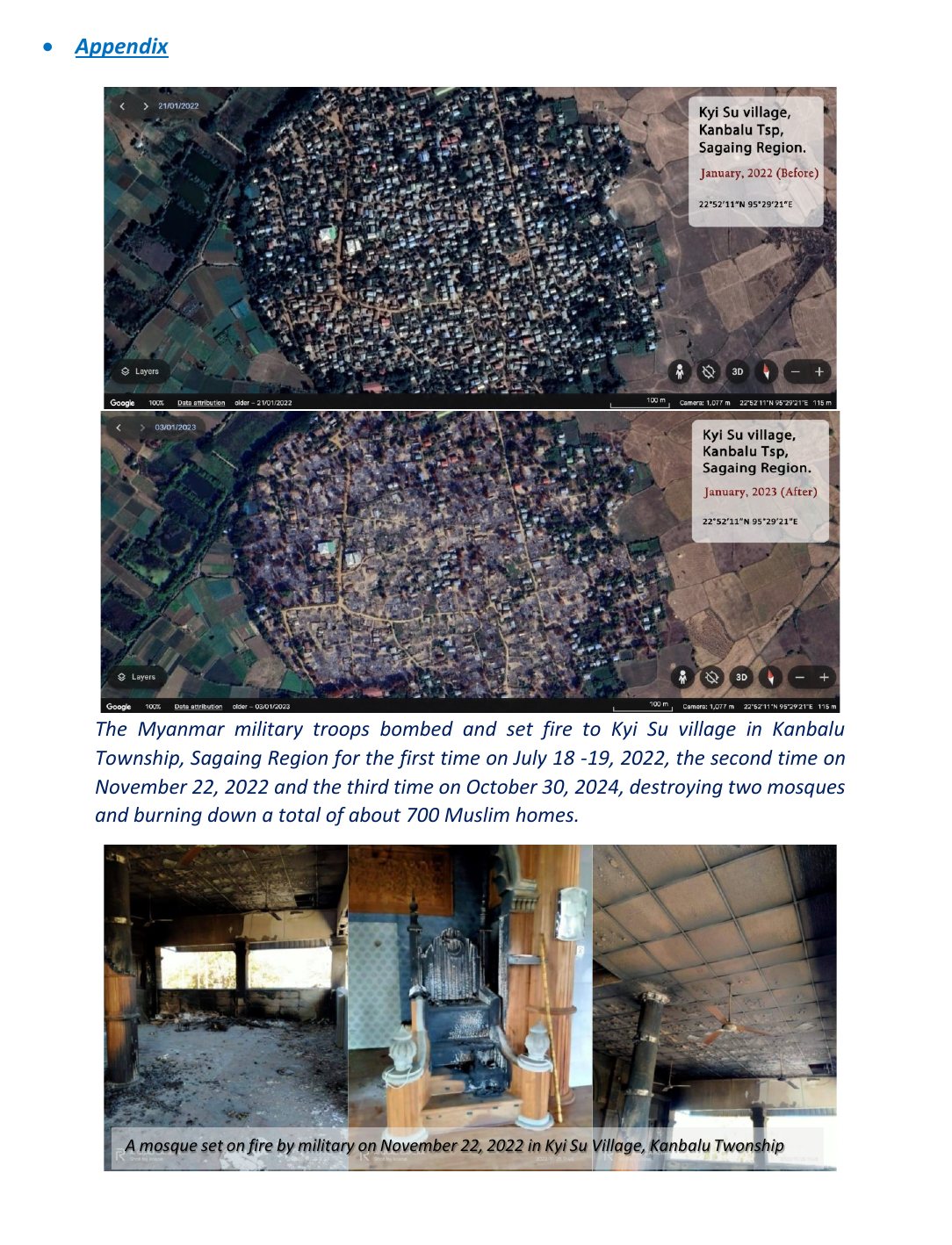


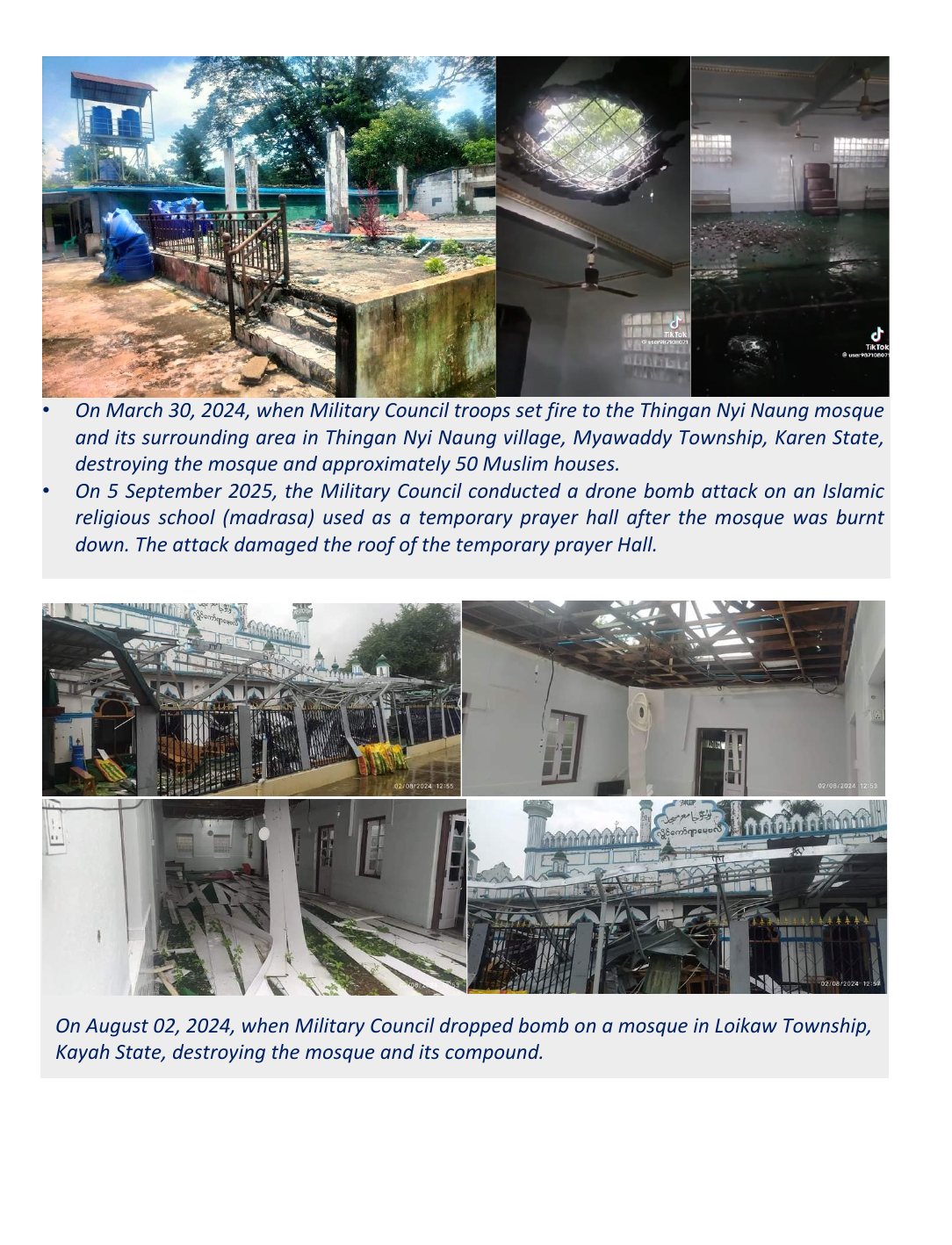
Footnotes
- U.S. Department of State, “2022 Report on International Religious Freedom: Burma”: https://www.state.gov/reports/2022-report-on-international-religious-freedom/burma/ . ↩
- International Crisis Group, “Myanmar Conflict Alert: A Risky Census” (12 February 2014): https://www.crisisgroup.org/asia/south-east-asia/myanmar/myanmar-conflict-alert-risky-census . ↩
- Myanmar, The Union Citizenship Act, Act No. LXVI of 1948, Articles 7, 13, and 11 (‘1948 Union Citizenship Act’) (https://www.legal-tools.org/doc/f63770/ ↩
- Myanmar, The Union Citizenship Act, Act No. LXVI of 1948, Article 3(1), (‘1948 Union Citizenship Act’) (https://www.legal-tools.org/doc/f63770/ ↩
- Nick Cheesman, “How in Myanmar ‘National Races’ Came to Surpass Citizenship and Exclude Rohingya,” Journal of Contemporary Asia (2017), 471. ↩
- Ibid. ↩
- Ne Win (1965), 308, quoted in Cheesman, “How in Myanmar ‘National Races’ Came to Surpass Citizenship and Exclude Rohingya,” 465. ↩
- Ne Win (1965), 316, quoted in Cheesman, 466. ↩
- Cheesman, “How in Myanmar ‘National Races’ Came to Surpass Citizenship and Exclude Rohingya,” 466. ↩
- Much of this work was done through the Academy for the Development of National Races, which sponsored state- directed research on ‘national races’ culture’. See Chessman (2017), 466. ↩
- Indians at the time controlled 60% of Burma’s trade and commerce. See Jane M. Ferguson, “Who’s Counting?: Ethnicity, Belonging, and the National Census in Burma/Myanmar.” Bijdragen Tot de Taal-, Land- En Volkenkunde 171, no. 1 (2015): 10. https://doi.org/10.1163/22134379-17101022 . ↩
- Chessman, “How in Myanmar ‘National Races’ Came to Surpass Citizenship and Exclude Rohingya,” 465. ↩
- Nick Cheesman, Opposing the Rule of Law: How Myanmar’s Courts Make Law and Order (Cambridge: Cambridge University Press, 2015), 110-111. ↩
- Chessman, “How in Myanmar ‘National Races’ Came to Surpass Citizenship and Exclude Rohingya,” 465. ↩
- Azeem Ibrahim, The Rohingyas: Inside Myanmar’s Genocide ( London: Hurst & Company, 2016), 53. ↩
- Although the government officially estimated that 150,000 people had fled to Bangladesh, it reluctantly allowed more than 180,000 refugees to return after reaching an agreement with Bangladesh. ↩
- For an overview of the 1982 Citizenship Law, see Peggy Brett and Kyaw Yin Hl aing, “Myanmar’s 1982 Citizenship Law in Context” TOAEP policy Brief Series No. 122 (2020). ↩
- “Speech by General Ne Win at the Meeting held in the Central Meeting Hall, President House, Ahlone Road, 8 October 1982”, The Working People’s Daily , 9 October 1982. Available at: https://www.burmalibrary.org/docs6/Ne_Win%27s_speech_Oct-1982-Citizenship_Law.pdf ↩
- Ibid. ↩
- Ibid. ↩
- Ibid. ↩
- International Crisis Group, Buddhism and State Power in Myanmar (5 September, 2017), 7. ↩
- For a description of the role played by Muslim minorities in the years after independence, see: Md. Mahbubul Haque, “Political Transition in Burma/Myanmar: Status of Rohingya Muslim Miniority”, South Asian Journal of Policy and Governance , 2017, vol. 41, no. 2. ↩
- “Speech by General Ne Win at the Meeting held in the Central Meeting Hall, President House, Ahlone Road, 8 October 1982.” ↩
- Ferguson, “Who’s Counting?: Ethnicity, Belonging, and the National Census in Burma/Myanmar,” 3. ↩
- Ferguson, “Who’s Counting?: Ethnicity, Belonging, and the National Census in Burma/Myanmar,” 16. ↩
- BHRN, Persecution of Muslims in Burma (2017), 15. ↩
- Wei Yan Aung, “The Day the Butcher of Yangon Began His 17 - Day Presidency,” The Irrawaddy (July 27, 2019). https://www.irrawaddy.com/specials/on-this-day/day-u-sein-lwin-began-17-day-presidency.html . Accessed July 13, 2024. ↩
- Human Rights Watch, “Burma: Justice for 1988 Massacres: On 25 {{th}} Anniversary of Crackdown, Accountability, Rule of Law Remain Elusive” (August 6, 2013). https://www.hrw.org/news/2013/08/06/burma-justice-1988-massacres . Accessed July 13, 2024. ↩
- The SLORC changed its name to the State Peace and Development Council (SPDC) in 1997. ↩
- The NLD appointed Brigadier General Aung Gyi as its chairman and former General Thura Tin Oo as its vice- chairman. Aung Gyi held the position for only two months before leaving to start his own political party. He was replaced by Aung San Suu Kyi. See Ibrahim, 40. ↩
- Ni Ni Kyaw, “ Islamophobia in Buddhist Myanmar: The 969 Movement and Anti- Muslim Violence,” in Melissa Crouch, ed. Islam and the State in Myanmar: Muslim-Buddhist Relations and the Politics of Belonging (Oxford: Oxford University Press, 2016): 193. ↩
- Fear of Extinction of the Race (1989), 24. ↩
- Ibid., 15. ↩
- Ibid., 15. ↩
- Ibid., 28-29. ↩
- Ibid., 19. ↩
- Ibid., 2. ↩
- Mahmood Mamdani, When Victims Become Killers . ↩
- Fear of Extinction of the Race (1989), 16. ↩
- Ibid., 24., 20. ↩
- Ibid., 24. ↩
- Ibid., 26. ↩
- Ibid., 2. ↩
- Ibid., 21. ↩
- Ibid., 2. ↩
- Ibid., 1-2. ↩
- Ibid., 23. ↩
- Fear of Extinction of the Race (1989), 27. ↩
- Fear of Extinction of the Race (1989), 1. ↩
- Ibrahim, The Rohingyas: Inside Myanmar’s Genocide , 64. ↩
- Nyi Nyi Kyaw, “Islamophobia in Buddhist Myanmar: The 969 Movement and Anti - Muslim Violence”, in Melissa Crouch, ed., Islam and the State in Myanmar: Muslim-Buddhist Relations and the Politics of Belonging (New Delhi: Oxford, 2016): 194. ↩
- Ibid., 194-195. ↩
- Ibrahim, 41. ↩
- Cheesman, “How in Myanmar ‘National Races’ Came to Surpass Citizenship and Exclude Rohingya,” 468. ↩
- Ibid., 468. ↩
- See Cheesman, “How in Myanmar ‘National Races’ Came to Surpass Citizenship and Exclude Rohingya,” 468 -470. ↩
- Aung Ko Ko, Elizabeth L. Rhoads, Nan Tinilarwin, Win Bo Aung & Yoon Thiri Khaing (2024) Beyond Federalism? Inclusion, Citizenship, and Minorities Without Territory in Myanmar’s Spring Revolution, Journal of Contemporary Asia, 54:5, 938: https://doi.org/10.1080/00472336.2024.2367497 . ↩
- Raisha Waller, “Incompatible Identities: Ethnicity, Belonging, and Excusion in Making Myanmar’s Democracy,” Modern Southeast Asia (Dec. 28, 2020): seasia.yale.edu/incompatible-identities-ethnicity-belonging-and-exclusion- making-myanmars-democracy#_ftnref14. ↩
- Cheesman, “How in Myanmar ‘National Races’ Came to Surpass Citizenship and Exclude Rohingya,” 472. ↩
- Ibid., 472; ICHR, Crimes against Humanity in Western Burma: The Situation of the Rohingyas (Galway: Irish Centre for Human Rights, 2010), 97. ↩
- UNHRC, “Draft Report of the Working Group on the Universal Periodic Review: Myanmar” (New York: United Nations General Assembly, 2011), 12, referenced in Cheesman, 473. ↩
- Ibrahim, The Rohingyas , 52. ↩
- Human Rights Watch, “Burma: The Rohingya Muslims: Ending a Cycle of Exodus? (Sept. 1, 1996); See Convention on the Prevention of the Crime of Genocide, Article II e). ↩
- Andrew R.C. Marshall, “Special Report: Myanmar gives official blessing to anti - Muslim monks,” Reuters (17 June 2013). ↩
- Differing accounts of the date the 969 movement was founded make it difficult to determine whether Lwin was personally involved in establishing the movement or whether his writings provided the ideological basis for a movement that began several years later. ↩
- Kyaw Zwa Moe, “A Radically Different Dhamma”, The Irrawaddy (22 June 2013); Yilmaz and N. Morieson, “Buddhism and Civilizational Populism,” 232. ↩
- Nyi Nyi Kyaw, “Islamophobia in Buddhist Myanmar: The 969 Movement and Anti - Muslim Violence”, in Melissa Crouch, ed., Islam and the State in Myanmar: Muslim-Buddhist Relations and the Politics of Belonging (New Delhi: Oxford, 2016): 185. ↩
- Yilmaz and N. Morieson, “Buddhism and Civilizational Populism,” in Religions and the Global Rise of Civilizational Populism (Springer Nature Singapore, 2023); Ibrahim, The Rohingya , 67. ↩
- Ibrahim, The Rohingyas , 68. ↩
- Ky aw, “Islamophobia in Buddhist Myanmar”, 186. ↩
- Ibid., 187. ↩
- Kyaw, “Islamophobia in Buddhist Myanmar” 190 -193. ↩
- In a 2008 article published in the Georgetown Journal of International Affairs, David Steinbergy noted that approximately half of Myanmar’s population was living at or below the poverty line, malnourishment and disease were rampant, and drop-out rates for primary school near 50%. See David Steinbergy, “Globalization, Dissent, and Orthodoxy: Burma/Myanmar and the Saffron Revolution,” Georgetown Journal of International Affairs 9:2 (2008), 53. ↩
- The revolution was named for the color of Buddhist monks’ robes, which were traditionally saffron before being changed to orange. ↩
- David Steinbergy, “Globalization, Dissent, and Orthodoxy: Burma/Myanmar and the Saffron Revolution,” Georgetown Journal of International Affairs 9:2 (2008): 54 (page numbers for bibliography: 51-58.) ↩
- Ibid., 53. ↩
- Seekins, D.M. 2008. ‘The Social, Political and Humanitarian Impact of Burma’s Cyclone Nargis’. Asia-Pacific Jounral . (fix citation style) ↩
- Chessman, “How in Myanmar ‘National Races’ Came to Surpass Citizenship and Exclude Rohingya,” 478. ↩
- 1) To publish and distribute literature warning about the protection against losing the race; 2) To establish shops and businesses owned by Buddhists in parallel with Muslims; 3) To make the spirit of patriotism alive and enthusiastic; 4) To correct children; 5) To educate the youths about Buddhism, to practice the system of Buddhist young boys and girls worshiping together every Sunday; 6) To convince them that they should never be broad- minded to Muslims; 7) To make three cuts (economic support, marital ties, and all social contact); 8) To unite monks, warriors, and students; 9) To build unity, mutual respect, and love; 10) To try to promulgate the law of race protection; 11) To establish poor relief fund organizations; 12) To abstain Buddhist mothers-to-be from taking birth control pills; 13) To avoid politics and violence; 14) To be on standby to prevent the threat of violence by race- consuming colonists; 15) To avoid alcohol, gambling, and having sexual intercourse with prostitutes, and reduce entertainment; 16) To practice the system of married Buddhist couples worshipping together every Sabbath day; and 17) To form a Sangha committee for the comprehensive development of Buddhists. ↩
- Methods to Protect Against Extinction , 1. ↩
- Ibid., 2. ↩
- Ibid., 4. Emphasis in the original. ↩
- Ibid., 1. Emphasis in the original. ↩
- Methods one, three, four, five, six, twelve, fifteen, and sixteen. ↩
- Ibid., 13. ↩
- Ibid., 5. ↩
- Ibid., 22. ↩
- Ibid., 22. ↩
- Ibid., 22. ↩
- Ibid., 35. ↩
- Ibid., 34. ↩
- Ibid., 40. ↩
- Ibid., 15. ↩
- Ibid., 21. ↩
- Ibid., 20. ↩
- Ibid., 21. ↩
- Ibid., 6-7. ↩
- Ibid., 6. ↩
- Ibid., 7. ↩
- Ibid., 7 ↩
- Ibid., 11. ↩
- Ibid., 7. ↩
- Ibid., 24. ↩
- Ibid., 24. ↩
- Ibid., 25. ↩
- Ibid., 25. ↩
- Ibid., 28. ↩
- Related legislation passed by Myanmar’s parliament in 2015 is discussed in Section five of the report. ↩
- Ibid., 26. ↩
- Ibid., 27. The poem is cited as Thura Zaw, “I want the fences to be safe and secure,” Shwe Dagar Mhuu Magazine (Feb. 2000). ↩
- Ibid., 28. ↩
- Ibid., 28-29. ↩
- Ibid., 49. ↩
- Ibid., 49. ↩
- Ibid., 49. ↩
- Ibid., 50. ↩
- Ibid., 52. ↩
- Ibid., 51. ↩
- Ibid., 55. Emphasis in the original. ↩
- Formally, the United Nations Convention on the Prevention and Punishment of the Crime of Genocide: chrome- extension://efaidnbmnnnibpcajpcglclefindmkaj/https://www.un.org/en/genocideprevention/documents/atrocity-crimes/Doc.1_Convention%20on%20the%20Prevention%20and%20Punishment%20of%20the%20Crime%20of%20 Genocide.pdf. ↩
- See among others: Benjamin Valentino: Final Solutions , Gregory Stanton, The Ten Stages (website), Karl A. Schleunes, The Twisted Road to Auschwitz: Nazi Policy Toward German Jews, 1933-1939 (Champaign, IL: University of Illinois Press, 1990). ↩
- 1982 Burma Citizenship Law: https://www.refworld.org/legal/legislation/natlegbod/1982/en/49622#:~:text=29.,cease%20to%20be%20associat e%20citizens. ↩
- Richard Potter and Kya Win, “National Verification Cards – A Barrier to Rohingya Repatriation,” BHRN (July 2019): https://www.bhrn.org.uk/en/report/1090-national-verification-cards-a-barrier-torohingya-repatriation-full-report.html . ↩
- Penny Green, Thomas MacManus, and Alicia de la Cour Venning, “Genocide Achieved, Genocide Continues: Myanmar’s Annihilation of the Rohingya” International State Crime Initiative (2018): file:///Users/ashleygreene/Downloads/Green%20Genocide%20Achieved,%20Genocide%20Continues_%20Myanm ar%E2%80%99s%20Annihilation%20of%20the%20Rohingya%202018%20Published.pdf . ↩
- Ibid., 41. ↩
- The Arakan Project, “Issues to be Raised Concerning the Situation of Stateless Rohingya Women in Myanmar (Burma)” (Oct. 2008) , 3. ↩
- A locally distributed booklet prepared on local population data by the Immigration Department categorises Muslims as foreigners. People whose citizenship ID cards identify them as Bengali, Indian, or Pakistani are included under the list of foreigners in Chapter 4. Similar census data can be found on the General Administration website. ↩
- International Crisis Group, “Myanmar Conflict Alert: A Risky Census” (12 February 2014): https://www.crisisgroup.org/asia/south-east-asia/myanmar/myanmar-conflict-alert-risky-census . ↩
- Census are documented by the General Administration Offices and kept on township websites. ↩
- ‘Burmese census enumerators violate commitment with UNFPA in western Burma”, Burma Times, 30 March, 2014, quoted in Ferguson, “Who’s Counting?: Ethnicity, Belonging, and the National Census in Burma/Myanmar.” , 21. ↩
- New Light of Myanmar, 25 April 2014, quoted in Ferguson, “Who’s Counting?: Ethnicity, Belonging, and the National Census in Burma/Myanmar.” , 22. ↩
- “ Quoted in Ferguson, “Who’s Counting?: Ethnicity, Belonging, and the National Census in Burma/Myanmar”, 21. ↩
- UNFPA, “Myanmar Releases Population Count From Census” (30 August, 2014): https://myanmar.unfpa.org/en/news/unfpa-press-release-myanmar-releases-population-count-census . ↩
- 1982 Burma Citizenship Law: https://www.refworld.org/legal/legislation/natlegbod/1982/en/49622#:~:text=29.,cease%20to%20be%20associat e%20citizens. ↩
- An exception to this has taken place in the last year of the civil war, during which Rohingya IDPs in Rakhine State have been forcefully conscripted by the Tatmadaw to fight. ↩
- Interviews conducted on 25 April 2018; Mandalay City. Transcript held by BHRN.. ↩
- Township Law and Order Restoration Council, Thandwe Township, Letter Number 026/1-1-Pa Hga Ta Thandwe – 1562 (4 July, 1995); held by BHRN. ↩
- Eleven of the rejected candidates were from Rakhine state; six were from Yangon. “Myanmar Election Body Rejects Muslim Parliamentary Candidates,” Radio Free Asia (Sept. 1, 2015). https://www.rfa.org/english/news/myanmar/election-body-rejects-muslim-parliamentary-candidates-09012015161036.html . ↩
- Michael F. Martin, “Burma’s 2015 Parliamentary Elections: Issues for Congress,” Congressional Research Service (March 28, 2016), 7 ; “Under Pressure on All Sides, UEC Reinstates 11 Muslim Candidates,” Myanmar Times (September 25, 2015). ↩
- David Baulk and Matthew Smith, Ethnic minorities in Myanmar denied vote as Aung San Suu Kyi claims power,” the Guardian (Nov. 26, 1015). ↩
- BHRN, Persecution of Muslims in Burma (2017). ↩
- BHRN, Persecution of Muslims in Burma (2017). ↩
- BHRN, Persecution of Muslims in Burma (2017). ↩
- Library of Congress, “Burma: Four ‘Race and Religion Protection Laws’ Adopted” (Sept. 14, 2015): https://www.loc.gov/item/global-legal-monitor/2015-09-14/burma-four-race-and-religion-protection-laws-adopted/ . ↩
- Amnesty International, “Myanmar: Parliament must reject discriminatory ‘race and religion’ laws,” (March 3, 2015): https://www.amnesty.org/en/documents/asa16/1107/2015/en/ . ↩
- Quoted in Library of Congress, “Burma: Four ‘Race and Religion Protection Laws’ Adopted”. ↩
- Ibid. ↩
- Amnesty International, “Myanmar: Parliament must reject discriminatory ‘race and religion’ laws.” ↩
- Slides on file with BHRN. ↩
- March 12, 2012 training documented by BHRN research team. ↩
- Swe Win, “’The Tatmadaw is the mother and the father!’ – inside the militarized schools training Myanmar’s civil servants” (30 January 2019): https://myanmar-now.org/en/news/the-tatmadaw-is-the-mother-and-the-fatherinside-the-militarised-schools-training-myanmars-civil-servants/ . ↩
- https://www.moha.gov.mm/eng/index.php/2024-04-24-03-57-12/2024-04-24-04-44-19 . ↩
- Bibhu Prasad Routray, “Myanmar: Profiling the 969 Movement”, Institute of Peace and Conflict Studies (10 July, 2013). ↩
- Marshall, “Special Report: Myanmar gives official blessing to anti - Muslim monks” (17 June 2013). ↩
- Ibrahim, The Rohingyas: Inside Myanmar’s Genocide , 12. ↩
- In the early 2000s, Wirathu was critical of the military junta. ↩
- International Crisis Group, Buddhism and State Power in Myanmar (5 September, 2017), 12. ↩
- Routray, “Myanmar: Profiling the 969 Movement”. ↩
- Routray, “Myanmar: Profiling the 969 Movement”. ↩
- Methods to Protect Against Extinction , 49. ↩
- Kyaw, “Islamophobia in Buddhist Myanmar”, 189. ↩
- Ibid. ↩
- International Crisis Group, Buddhism and State Power in Myanmar (5 September, 2017), 13. ↩
- Ibid., 3 ↩
- Ibid., 14. ↩
- International Crisis Group, Buddhism and State Power in Myanmar (5 September, 2017), 3. ↩
- BHRN, “Pyu Saw Htee and Pro - Junta Thugs” (2024): https://bhrn.org.uk/en/report/1271 -pyu-saw-htee-and-pro- junta-thugs.html. ↩
- Ibid. ↩
- Ibid. ↩
- The Ten Stages of Genocide: https://www.genocidewatch.com/tenstages . ↩
- Human Rights Council, “Report of the independent international fact - finding mission on Myanmar” (2018), Paragraph 73. ↩
- Ibid., Paragraph 73. ↩
- Ibid., Paragraph 73. ↩
- Human Rights Watch, “An Open Prison without End” (Oct. 8, 2020): https://www.hrw.org/report/2020/10/08/open-prison-without-end/myanmars-mass-detention-rohingya-rakhine-state . ↩
- Human Rights Watch, “An Open Prison without End” (Oct. 8, 2020): https://www.hrw.org/report/2020/10/08/open-prison-without-end/myanmars-mass-detention-rohingya-rakhine-state . ↩
- In its 2020 report on the camps, Human Rights Watch reported that fewer than 7% of live births took place in healthcare facilities. See Human Rights Watch, “An Open Prison without End” and BHNR, Persecution of Muslims in Burma (2017); World Food Program Security Assessment in the Norther Part of Rakhine State, July 2017: http://reliefweb.int/sites/reliefweb.int/files/resources/WFP-0000019264.pdf ;. ↩
- Human Rights Watch, “An Open Prison without End” (Oct. 8, 2020): https://www.hrw.org/report/2020/10/08/open-prison-without-end/myanmars-mass-detention-rohingya-rakhine-state . ↩
- United Nations Convention on the Prevention and Punishment of the Crime of Genocide: chrome- extension://efaidnbmnnnibpcajpcglclefindmkaj/https://www.un.org/en/genocideprevention/documents/atrocity-crimes/Doc.1_Convention%20on%20the%20Prevention%20and%20Punishment%20of%20the%20Crime%20of%20 Genocide.pdf. ↩
- Nyi Nyi Kyaw, “Islamophobia in Buddhist Myanmar: The 969 Movement and Anti - Muslim Violence.” ↩
- BBC: Burma riots Video shows police failing to stop attack: https://www.youtube.com/watch?v=THNy1z6bbnM . ↩
- UNHR Office of the High Commissioner, “Report of OHCHR mission to Bangladesh: Interviews with Rohingyas feeling from Myanmar since 9 October 2016” (February 2017) : chrome- extension://efaidnbmnnnibpcajpcglclefindmkaj/https://www.ohchr.org/sites/default/files/Documents/Countries/MM/FlashReport3Feb2017.pdf ↩
- Human Rights Council, “Report of the independent international fact - finding mission on Myanmar” (12 September 2018), 16. ↩
- Ibid., paragraph 85. ↩
- Ibid., paragraph 86. ↩
- United Nations Secretary- General, “Note to Correspondents: Statement by Adama Dieng, United Nations Special Adviser on the Prevention of Genocide, on his visit to Bangladesh to assess the situation of Rohingya refugees from Myanmar” (12 March 2018): https://www.un.org/sg/en/content/sg/note-correspondents/2018-03-12/note-correspondents-statement-adama-dieng-united-nations-special-adviser-the-prevention-of-genocide-his-visit-bangladesh-assess-the-situation-of-rohingya . ↩
- Human Rights Watch, “An Open Prison without End” (Oct. 8, 2020): https://www.hrw.org/report/2020/10/08/open-prison-without-end/myanmars-mass-detention-rohingya-rakhine-state . ↩
- American Society of Internationa Law, The Gambia v. Myanmar: An Analysis of the ICJ’s Decision on Jurisdiction under the Genocide Convention”, 26:9, 21 September, 2022. ↩
- Genocidewatch.com/tenstages. ↩
- United Nations Secretary- General, “Note to Correspondents: Statement by Adama Dieng, United Nations Special Adviser on the Prevention of Genocide, on his visit to Bangladesh to assess the situation of Rohingya refugees from Myanmar” (12 March 2018): https://www.un.org/sg/en/content/sg/note-correspondents/2018-03-12/note-correspondents-statement-adama-dieng-united-nations-special-adviser-the-prevention-of-genocide-his-visit-bangladesh-assess-the-situation-of-rohingya . ↩
- Ibid. ↩
- Ibid. ↩
- Ibid. ↩
- The NUG has promised equal citizenship, legal reform, and an end to discrimination against ethnic and religious minorities. In 2023, they appointed Rohingya activist Aung Kyaw Moe as deputy minister of human rights. Critical observers point to the tendency of past governments, including the NLD, to use democratizing rhetoric and the appointment of token minorities as a way to garner international support and forestall interventions. If the NUG succeeds in gaining real power in Myanmar, it will be actionable reform rather than rhetoric that reveals whether their stated commitment to human rights is genuine. See Iqthyer Uddin Md Zahed, “Responsibility to Protect? The International Community’s Failure to Protect the Rohingya,” Asian Affairs , Vol. LII, no. IV (2021): 934-957. ↩
- BHRN, “Before Our Very Eyes”, 29 July, 2021. ↩
- UN News, “Myanmar: From political crisis , to ‘multi - dimensional human rights catastrophe’ – Bachelet”, 6 July 2021, available at: https://news.un.org/en/story/2021/07/1095392 A mosque set on fire by military on November 22, 2022 in Kyi Su Village, Kanbalu Twonship ↩
About BHRN
BHRN was founded in 2012 and registered in the UK in 2015. We employ nearly 30 ground researchers across Burma and in the refugee areas of Thailand and Bangladesh. Any information we receive is carefully checked for credibility by experienced senior research officers in the organization. BHRN publishes press releases and research reports after investigations are concluded on concerning issues. BHRN is one of the leading organizations from Burma conducting evidence-based international advocacy for human rights, including statelessness, minority rights, and freedom of religion and belief.
Freedom and Human Rights for All from Birth Kyaw Win Founder & Executive Director of BHRN.
Freedom and Human Rights for All from Birth
www.bhrn.org.uk · facebook.com/bhrnuk · @bhrnuk